457 posters, 2 videos, 2 audios, 8 topics, 45 sessions, 401 authors, 265 institutions
ePostersLive by SciGen Technologies S.A. All rights reserved.
49th Annual Regional Anesthesiology and Acute Pain Medicine Meeting
March 21-23, 2024 | The Hilton Bayfront San Diego | San Diego, California

5127
A CASE OF UTILIZING DIAGNOSTIC REGIONAL PERIPHERAL NERVE BLOCKS REFRACTORY TO TREAT NEUROPATHIC PAIN FOLLOWING DREZ LESIONING.
Poster Presenter
Authors
Affiliations
Part of Topic
Medically Challenging Cases
Introduction: Chronic pain is a challenging disease to treat as pain is not only categorized in one group, but includes nociceptive, neuropathic, and neurogenic pain. There are not only oral medications, but extensive surgical and procedural techniques that can provide effective and safe relief for patients.
Dorsal Root Entry Zone (DREZ) Lesioning, usually utilized for avulsion injuries of multiple nerves, is discussed when patients continue to experience extensive neuropathic pain refractory to conventional medical therapies (1). The procedure consists of a therapeutic lesion to the specific nerve roots to inhibit the propagation of pathological pain signals within the dorsal horn (2). The dorsal root is the destination of peripheral pain signals; secondary neuron cell bodies are located there for the nerves that ascend via their respective tracts to have pain modulation and perception within the brain.
Out of the patients who receive the DREZ Procedure, regardless of the level of effectiveness, many would have the procedure again if given the option (3,4,6). This can be related to not only the effectiveness of the procedure, but also the positive risk-benefit ratio of the procedure (4,5). However, the ability to effectively target and perform therapeutic lesions certain nerves, it must first be deduced from which nerves the pain is originating. The ability to target specific nerves with high fidelity by placing localized anesthetic elicits imperative information to providers to aid patients in treating their pain.
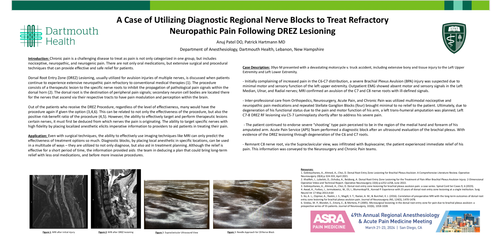
Case Description: 39yo M presented with a devastating motorcycle v. truck accident, including extensive bony and tissue injury to the Left Upper Extremity and Left Lower Extremity.
- Initially complaining of increased pain in the C6-C7 distribution, a severe Brachial Plexus Avulsion (BPA) injury was suspected due to minimal motor and sensory function of the left upper extremity. Outpatient EMG showed absent motor and sensory signals in the Left Median, Ulnar, and Radial nerves; MRI confirmed an avulsion of the C7 and C8 nerve roots with ill-defined signals.
- Inter-professional care from Orthopedics, Neurosurgery, Acute Pain, and Chronic Pain was utilized multimodal nociceptive and neuropathic pain medications and repeated Stellate Ganglion Blocks (four) brought minimal to no relief to the patient. Ultimately, due to degeneration of his functional status due to the pain and motor function of his arm, a left trans-humeral amputation was planned; Left C7-8 DREZ RF lesioning via C5-7 Laminoplasty shortly after to address his severe pain.
- The patient continued to endorse severe “shooting’ type pain perceived to be in the region of the medial hand and forearm of his amputated arm. Acute Pain Service (APS) Team performed a diagnostic block after an ultrasound evaluation of the brachial plexus. With evidence of the DREZ lesioning through degeneration of the C6 and C7 roots.
- Remnant C8 nerve root, via the Supraclavicular view, was infiltrated with Bupivacaine; the patient experienced immediate relief of his pain. This information was conveyed to the Neurosurgery and Chronic Pain teams.
Application: Even with surgical techniques, the ability to effectively use imaging techniques like MRI can only predict the effectiveness of treatment options so much. Diagnostic blocks, by placing local anesthetic in specific locations, can be used in a multitude of ways – they are utilized to not only diagnose, but also aid in treatment planning. Although the relief is effective for a short period of time, the information provided aids the team in deducing a plan that could bring long-term relief with less oral medications, and before more invasive procedures.