457 posters, 2 videos, 2 audios, 8 topics, 45 sessions, 401 authors, 265 institutions
ePostersLive by SciGen Technologies S.A. All rights reserved.
49th Annual Regional Anesthesiology and Acute Pain Medicine Meeting
March 21-23, 2024 | The Hilton Bayfront San Diego | San Diego, California

5551
REGIONAL RESET: PARAVERTEBRAL BLOCK FOR CHRONIC PAIN FOLLOWING ONCOLOGIC BREAST RECONSTRUCTION
Poster Presenter
Authors
Affiliations
Part of Topic
Medically Challenging Cases
Regional Reset: Paravertebral Block for Chronic Pain Following Oncologic Breast Reconstruction
Jessy Kurian DNP, APRN, Arun Muthukumar, M.D., Evan Wright, M.D., Keyuri Popat, M.D., Andrzej P. Kwater, M.D.
Department of Anesthesiology and Perioperative Medicine, The University of Texas MD Anderson Cancer Center, Houston, TX.
Introduction:
Advancements in surgical technique and adjuvant treatment (i.e. chemotherapy and radiation) has improved overall prognosis for breast cancer patients.
Regional anesthetic techniques have consistently shown benefits for patients undergoing chest wall surgery.4
This case report describes a patient undergoing reconstructive breast surgery with an underlying history of chronic chest wall pain stemming from prior surgical interventions. We highlight the impact of PVBs on both postop & chronic pain symptoms.
Material & Methods:
Informed consent for inclusion in this case report was obtained. As this case report is devoid of any patient identifiable information, it is exempt from IRB review requirements per the MD Anderson Cancer Center policy.
Case Report:
39-year-old woman with a history of invasive ductal carcinoma s/p neoadjuvant chemotherapy and bilateral mastectomy with chest wall radiation. Subsequently, the patient underwent bilateral free flap breast reconstruction, which resulted in persistent pain and tightness along the right chest wall, persisting over two years.
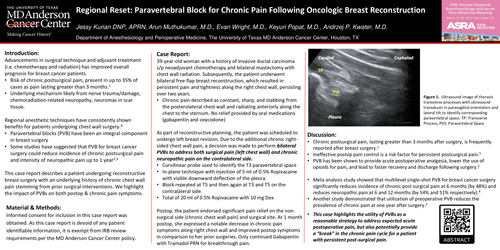
As part of reconstructive planning, the patient was scheduled to undergo left breast revision. Due to the additional chronic right-sided chest wall pain, a decision was made to perform bilateral PVBs to address both surgical pain (left chest wall) and chronic neuropathic pain on the contralateral side.
Postop, the patient endorsed significant pain relief on the non-surgical side (chronic chest wall pain) and surgical site. At 1 month postop, she expressed a notable decrease in chronic pain symptoms along right chest wall and improved postop symptoms in comparison to her prior surgeries. Only continued Gabapentin with Tramadol PRN for breakthrough pain.
Discussion: