457 posters, 2 videos, 2 audios, 8 topics, 45 sessions, 401 authors, 265 institutions
ePostersLive by SciGen Technologies S.A. All rights reserved.
49th Annual Regional Anesthesiology and Acute Pain Medicine Meeting
March 21-23, 2024 | The Hilton Bayfront San Diego | San Diego, California

5520
ULTRASOUND GUIDED RETROLAMINAR BLOCK FOR MULTIPLE RIB FRACTURES PROVIDED 36 HOURS OF PAIN RELIEF AND IMPROVED RESPIRATORY STATUS
Poster Presenter
Authors
Affiliations
Part of Topic
Medically Challenging Cases
Ultrasound Guided Retrolaminar Block for Multiple Rib Fractures Provided 36 Hours of Pain Relief and Improved Respiratory Status
Austin Snyder MD, Alisha Booms DO, Paige Georgiadis MD
University of Vermont Medical Center, Department of Anesthesiology
INTRODUCTION
Rib fractures occur in approximately 35% of blunt trauma patients and can be a major cause of morbidity and mortality, especially in older patients with a higher number of ribs fractured [1]. Regional anesthesia can be utilized to help with pain control, improve respiratory mechanics and even potentially aid in weaning from mechanical ventilation [2]. Multiple options exist to provide analgesia to the ribs and thoracic wall. We present a case of an older adult with multiple rib fractures who was not a candidate for epidural, paravertebral, or erector spinae plane (ESP) blocks, and therefore was offered the less commonly utilized ultrasound-guided retrolaminar block, from which he had significant analgesic effect.
CASE REPORT
A 75-year-old male presented after falling 20-feet while chain-sawing branches and was found to have left 9-12 posterior rib fractures, as well as T9-11 and L1-5 transverse process fractures, left superior pubic ramus fracture, and bilateral sacral ala fractures. His medical history was significant for immune thrombocytopenia (ITP), hypertension, diabetes, active marijuana use, and former tobacco use. He was started on a multimodal pain regimen with acetaminophen, methocarbamol, lidocaine patches, morphine, and PTA gabapentin. The Acute Pain Service was consulted on hospital day 2 for pain management optimization and consideration of regional or neuraxial intervention. At that time, the patient reported “100/10” pain with movement and was having side effects of sedation and pruritus with opioids.
RESULTS
DISCUSSION
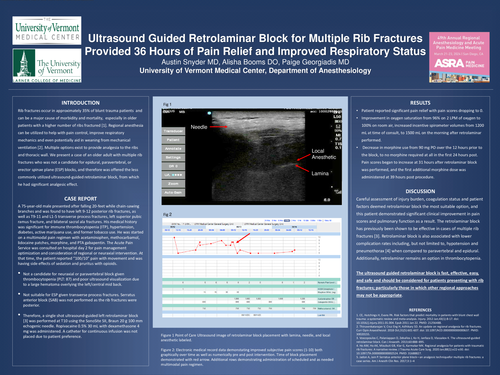
Careful assessment of injury burden, coagulation status and patient factors deemed retrolaminar block the most suitable option, and this patient demonstrated significant clinical improvement in pain scores and pulmonary function as a result. The retrolaminar block has previously been shown to be effective in cases of multiple rib fractures [3]. Retrolaminar block is also associated with lower complication rates including, but not limited to, hypotension and pneumothorax [4] when compared to paravertebral and epidural. Additionally, retrolaminar remains an option in thrombocytopenia.
The ultrasound guided retrolaminar block is fast, effective, easy, and safe and should be considered for patients presenting with rib fractures; particularly those in which other regional approaches may not be appropriate.
REFERENCES
1. CE, Hutchings H, Evans PA. Risk factors that predict mortality in patients with blunt chest wall trauma: a systematic review and meta-analysis. Injury. 2012 Jan;43(1):8-17. doi: 10.1016/j.injury.2011.01.004. Epub 2011 Jan 22. PMID: 21256488.
2. Thiruvenkatarajan V, Cruz Eng H, Adhikary SD. An update on regional analgesia for rib fractures. Curr Opin Anaesthesiol. 2018 Oct;31(5):601-607. doi: 10.1097/ACO.0000000000000637. PMID: 30020155.
3. Voscopoulos C, Palaniappan D, Zeballos J, Ko H, Janfaza D, Vlassakov K. The ultrasound-guided retrolaminar block. Can J Anaesth. 2013;60:888–895.
4. Ho AM, Ho AK, Mizubuti GB, Klar G, Karmakar MK. Regional analgesia for patients with traumatic rib fractures: A narrative review. J Trauma Acute Care Surg. 2020 Jan;88(1):e22-e30. doi: 10.1097/TA.0000000000002524. PMID: 31688827.
5. Jadon A, Jain P. Serratus anterior plane block—an analgesic techniquefor multiple rib fractures: a case series. Am J Anesth Clin Res. 2017;3:1–4