457 posters, 2 videos, 2 audios, 8 topics, 45 sessions, 401 authors, 265 institutions
ePostersLive by SciGen Technologies S.A. All rights reserved.
49th Annual Regional Anesthesiology and Acute Pain Medicine Meeting
March 21-23, 2024 | The Hilton Bayfront San Diego | San Diego, California

5634
PATIENT CONTROLLED ANALGESIA RESULTING IN DECREASED ORAL MORPHINE EQUIVALENTS IN THE SETTING OF COMPLEX REGIONAL PAIN DISORDER
Poster Presenter
Authors
Affiliations
Part of Topic
Medically Challenging Cases
Patient Controlled Analgesia Resulting in decreased oral morphine equivalents in the setting of complex regional pain disorder – A Case Study
Authors: David R. Schulze, DO, MS, David Copenhaver, MD, MHA, Scott Fishman, MD
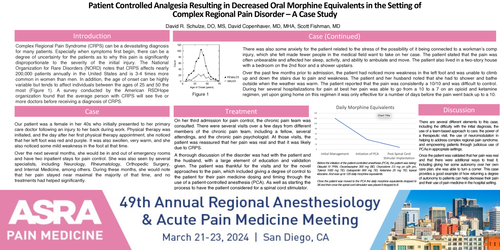
Introduction: Complex Regional Pain Syndrome (CRPS) can be a devastating diagnosis for many patients. Especially when symptoms first begin, there can be a degree of uncertainty for the patients as to why this pain is significantly disproportionate to the severity of the initial injury. The National Organization for Rare Disorders (NORD) notes that CRPS affects nearly 200,000 patients annually in the United States and is 3-4 times more common in women than men. In addition, the age of onset can be highly variable but tends to affect individuals between the ages of 25 and 50 the most (Figure 1). A survey conducted by the American RSDHope organization found that the average person with CRPS will see five or more doctors before receiving a diagnosis of CRPS.
Case: Our patient was a female in her 40s who initially presented to her primary care doctor following an injury to her back during work. Physical therapy was initiated, and the day after her first physical therapy appointment, she noticed that her left foot was red and purple. It was also swollen, very warm, and she also noticed some mild weakness in the foot at that time.
Over the next several months, she would be in and out of emergency rooms and have two inpatient stays for pain control. She was also seen by several specialists, including Neurology, Rheumatology, Orthopedic Surgery, and Internal Medicine, among others. During these months, she would note that her pain stayed near maximal the majority of that time, and no treatments had helped significantly.
There was also some anxiety for the patient related to the stress of the possibility of it being connected to a workman’s comp injury, which she felt made fewer people in the medical field want to take on her case. The patient stated that the pain was often unbearable and affected her sleep, activity, and ability to ambulate and move. The patient also lived in a two-story house with a bedroom on the 2nd floor and a shower upstairs.
Over the past few months prior to admission, the patient had noticed more weakness in the left foot and was unable to climb up and down the stairs due to pain and weakness. The patient and her husband noted that she had to shower and bathe outside when the weather was warm. The patient reported that the pain was consistently a 10/10 and was difficult to control. During her several hospitalizations for pain at best her pain was able to go from a 10 to a 7 on an opioid and ketamine regimen, yet upon going home on this regimen it was only effective for a number of days before the pain went back up to a 10.
Treatment: On her third admission for pain control, the chronic pain team was consulted. There were several visits over a few days from different members of the chronic pain team, including a fellow, several attendings, and the chronic pain psychologist. At those visits, the patient was reassured that her pain was real and that it was likely due to CRPS.
A thorough discussion of the disorder was had with the patient and the husband, with a large element of education and validation given. The patient was thankful for the visits and for the novel approaches to the pain, which included giving a degree of control to the patient for their pain medicine dosing and timing through the use of a patient-controlled anesthesia (PCA). As well as starting the process to have the patient considered for a spinal cord stimulator.
Before the initiation of the patient-controlled anesthesia (PCA), the patient was taking: Dilaudid IV PRN, Oxcarbazepine 300 mg BID, Oxycodone 2.5 mg po q3h prn, Tylenol 1000 mg TID, Gabapentin 900 mg TID, Ketamine 25 mg TID, topical lidocaine. And was up to 120 daily morphine equivalents.
Once the patient was moved to the PCA the daily morphine equivalents dropped to 38 and then once the spinal cord stimulator was placed it dropped to 8.
Discussion: There are several different elements to this case, including the difficulty with the initial diagnosis, the use of a team-based approach to care, the power of a therapeutic visit, the use of neuromodulation in helping to address complex regional pain syndrome, and empowering patients through judicious use of PCAs in appropriate settings.
Once the patient was validated that her pain was real and that there were additional ways to treat it, including giving her some autonomy over her own care plan, she was able to turn a corner. This case provides a good example of how returning a degree of autonomy to patients can help decrease their pain and their use of pain medicine in the hospital setting.