Loading...

457 posters, 2 videos, 2 audios, 8 topics, 45 sessions, 401 authors, 265 institutions

ePostersLive by SciGen Technologies S.A. All rights reserved.

49th Annual Regional Anesthesiology and Acute Pain Medicine Meeting

March 21-23, 2024 | The Hilton Bayfront San Diego | San Diego, California

49th Annual Regional Anesthesiology and Acute Pain Medicine Meeting banner

5432

A DIGITAL NUDGE INCREASES THORACIC EPIDURAL CONFIRMATION RATES AND REDUCES EPIDURAL FAILURE: A QUALITY IMPROVEMENT INITIATIVE
Poster Presenter

Andrew Wheeler

Part of Topic

Safety/QA/QI Projects

A Digital Nudge Increases Thoracic Epidural Confirmation Rates and Reduces Epidural Failure: A Quality Improvement Initiative

Andrew Wheeler MD, Richard Kim MD MSc

Department of Anesthesiology, Perioperative, and Pain Medicine

Stanford University School of Medicine, USA

Background

•Evidence supports epidural confirmation techniques, but they remain underutilized [1,2]
•Digital nudges influence clinical decision-making when thoughtfully implemented [3,4]
 
Aims
 
•Primary outcome: Can a digital nudge increase the rate of epidural confirmation?
•Secondary outcome: Can a digital nudge lead to more effective epidurals clinically?
 
Methods
 
•Opt-in documentation option implemented on October 25th, 2021 in the existing electronic medical record
•Saline column, electrical stimulation, test dose sensory level, other, none
•Confirmation technique documentation rates and catheter duration were assessed for the following periods:
•Pre-intervention period: Oct 2020 – Oct 2021
•Adaption period: Nov 2021 – May 2022
•Post-intervention period: June 2022 – July 2023
•Epidural failure: ≤48 hours duration
 
Results
 
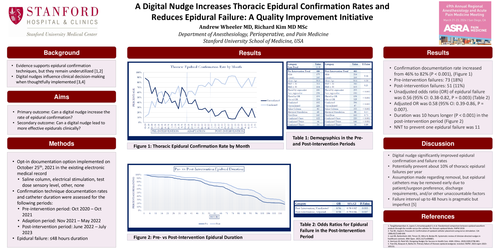
•Confirmation documentation rate increased from 46% to 82% (P < 0.001), (Figure 1)
•Pre-intervention failures: 73 (18%)
•Post-intervention failures: 51 (11%)
•Unadjusted odds ratio (OR) of epidural failure was 0.56 (95% CI: 0.38-0.82, P = 0.003) (Table 2)
•Adjusted OR was 0.58 (95% CI: 0.39-0.86, P = 0.007).
•Duration was 10 hours longer (P < 0.001) in the post-intervention period (Figure 2)
•NNT to prevent one epidural failure was 11
 
Discussion
 
•Digital nudge significantly improved epidural confirmation and failure rates
•Potentially prevent about 10% of thoracic epidural failures per year
•Assumption made regarding removal, but epidural catheters may be removed early due to patient/surgeon preference, discharge requirements, and/or other unaccountable factors
•Failure interval up to 48 hours is pragmatic but imperfect [5]
 
References

1. Tangjitbampenbun A, Layera S, Arnuntasupakul V, et al. Randomized comparison between epidural waveform analysis through the needle versus the catheter for thoracic epidural blocks. RAPM 2019.

2. Tsui BC, Gupta S, Finucane B. Confirmation of epidural catheter placement using nerve stimulation. CJA 1998;45(7):640-644.

3. Last BS, Buttenheim AM, Timon CE, Mitra N, Beidas RS. Systematic review of clinician-directed nudges in healthcare contexts. BMJ Open. 2021;11(7):e048801.

4. Harrison JD, Patel MS. Designing Nudges for Success in Health Care. AMA J Ethics. 2020;22(9):E796-801.

5. Tran DQ, Booysen K, Botha HJ. Primary failure of thoracic epidural analgesia: revisited. RAPM. 2023:rapm-2023-105151.

49th Annual Regional Anesthesiology and Acute Pain Medicine Meeting » banner
Copyright © 2015-2026, ePostersLive® SciGen is a registered trademark of SciGen Technologies S.A. Patent pending.

This website and third-party tools we use rely on cookies for the best user experience. By selecting "I agree", you agree to cookie usage as described in our Privacy Policy.