457 posters, 2 videos, 2 audios, 8 topics, 45 sessions, 401 authors, 265 institutions
ePostersLive by SciGen Technologies S.A. All rights reserved.
49th Annual Regional Anesthesiology and Acute Pain Medicine Meeting
March 21-23, 2024 | The Hilton Bayfront San Diego | San Diego, California

5534
PEC I, PECII, SAPB AS ALTERNATIVES FOR POSTOPERATIVE PAIN AFTER LUNG TRANSPLANTATION WHEN THORACIC EPIDURAL IS NOT FEASIBLE.
Poster Presenter
Authors
Affiliations
Part of Topic
Medically Challenging Cases
BACKGROUND
•Lung transplantation is a major surgery with considerable risk for post-operative complications, as well as prolonged intensive care unit (ICU) and hospital length of stay (LOS).
• Multimodal opioid sparing pain management has been preferred by ERAS protocols.
•Opioids analgesics have numerous effects detrimental to post-lung transplant recovery- sedation, respiratory depression, nausea/vomiting, and ileus.
•Thoracic epidural analgesia (TEA) has been the cornerstone of post-lung transplant analgesia due to the evidence it decreases duration of mechanical ventilations and ICU LOS.
•Ultrasound guided regional block has increased the options where there are contraindications for epidural catheter placement.
• PEC I, PEC II and Serratus anterior plane block care alternatives to minimize or eliminate the use of intravenous sedation and local anesthetic for postoperative pain.
•This case report highlight a patient who underwent bilateral lung transplantation, with postoperative thrombocytopenia and received successful PEC I, PEC II, and SAPB for postoperative pain management.
INTRAOPERATIVE
•70 years old male patient S/P bilateral lung transplantation for Interstitial lung disease/ Hypersensitivity pneumonitis.
•Patient developed acute postoperative thrombocytopenia was intubated and mildly sedated, Pain Score 8/10 on the chest wall, sharp, bilateral and constant.
•Concerns for coagulopathy and presence of thrombocytopenia thoracic epidural catheter placement was discarded.
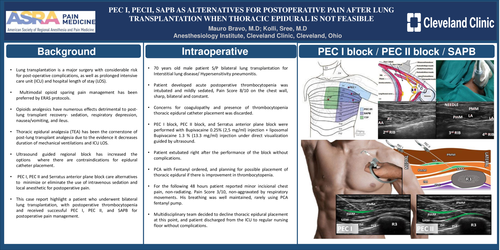
•PEC I block, PEC II block, and Serratus anterior plane block were performed with Bupivacaine 0.25% (2,5 mg/ml) injection + liposomal Bupivacaine 1.3 % (13.3 mg/ml) injection under direct visualization guided by ultrasound.
•Patient extubated right after the performance of the block without complications.
•PCA with Fentanyl ordered, and planning for possible placement of thoracic epidural if there is improvement in thrombocytopenia.
•For the following 48 hours patient reported minor incisional chest pain, non-radiating. Pain Score 3/10, non-aggravated by respiratory movements. His breathing was well maintained, rarely using PCA fentanyl pump.
•Multidisciplinary team decided to decline thoracic epidural placement at this point, and patient discharged from the ICU to regular nursing floor without complications.