457 posters, 2 videos, 2 audios, 8 topics, 45 sessions, 401 authors, 265 institutions
ePostersLive by SciGen Technologies S.A. All rights reserved.
49th Annual Regional Anesthesiology and Acute Pain Medicine Meeting
March 21-23, 2024 | The Hilton Bayfront San Diego | San Diego, California

5501
BRACHIAL PLEXOPATHY AFTER SURGICAL INTERVENTION FOR CLAVICLE FRACTURE
Poster Presenter
Authors
Affiliations
Part of Topic
Medically Challenging Cases
Brachial Plexopathy After Surgical Intervention for Clavicle Fracture
Authors: Dr. Kenneth Jezierski, Dr. Sally Ratliff, Dr. Ammar Siddiqui, Dr. Jian Hou, Dr. Jeff Xu
1) Introduction:
Determining the frequency of peripheral nerve injuries following a nerve block is challenging due to its exceptionally rare nature.[1] As reported by one author, the occurrence of peripheral nerve injuries, accompanied by short-term or long-term complications after an interscalene block, is estimated to be 0.4%.[2] Additional case series indicate that peripheral nerve injuries are nine times more likely to be associated with surgical or patient factors than with the administration of a nerve block.[1] Therefore, it is important to take a multidisciplinary approach to assessing a patient after peripheral nerve injury because this will guide further approaches to diagnosis and treatment.
2) Material and Methods:
This is a medically challenging case, but as the case report is devoid of patient identifiable information, it is exempt from IRB review requirements as per Westchester Medical Center policy.
Patient informed consent was obtained for submission of this case report.
3) Case Report:
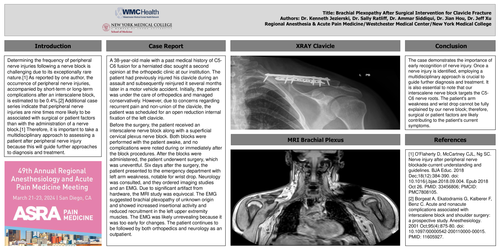
A 38-year-old male with a past medical history of C5-C6 fusion for a herniated disc sought a second opinion at the orthopedic clinic at our institution. The patient had previously injured his clavicle during an assault and subsequently reinjured it several months later in a motor vehicle accident. Initially, the patient was under the care of orthopedics and managed conservatively. However, due to concerns regarding recurrent pain and non-union of the clavicle, the patient was scheduled for an open reduction internal fixation of the left clavicle.
Before the surgery, the patient received an interscalene nerve block along with a superficial cervical plexus nerve block. Both blocks were performed with the patient awake, and no complications were noted during or immediately after the block procedures. After the blocks were administered, the patient underwent surgery, which was uneventful. Six days after the surgery, the patient presented to the emergency department with left arm weakness, notable for wrist drop. Neurology was consulted, and they ordered imaging studies and an EMG. Due to significant artifact from hardware, the MRI study was equivocal. The EMG suggested brachial plexopathy of unknown origin and showed increased insertional activity and reduced recruitment in the left upper extremity muscles. The EMG was likely unrevealing because it was too early for changes. The patient continues to be followed by both orthopedics and neurology as an outpatient.
4) Discussion:
The case demonstrates the importance of early recognition of nerve injury. Once a nerve injury is identified, employing a multidisciplinary approach is crucial to guide further diagnosis and treatment. It is also essential to note that our interscalene nerve block targets the C5-C6 nerve roots. The patient's arm weakness and wrist drop cannot be fully explained by our nerve block; therefore, surgical or patient factors are likely contributing to the patient's current symptoms.
5) References:
[1] O'Flaherty D, McCartney CJL, Ng SC. Nerve injury after peripheral nerve blockade-current understanding and guidelines. BJA Educ. 2018 Dec;18(12):384-390. doi: 10.1016/j.bjae.2018.09.004. Epub 2018 Oct 26. PMID: 33456806; PMCID: PMC7808105.
[2] Borgeat A, Ekatodramis G, Kalberer F, Benz C. Acute and nonacute complications associated with interscalene block and shoulder surgery: a prospective study. Anesthesiology. 2001 Oct;95(4):875-80. doi: 10.1097/00000542-200110000-00015. PMID: 11605927.