457 posters, 2 videos, 2 audios, 8 topics, 45 sessions, 401 authors, 265 institutions
ePostersLive by SciGen Technologies S.A. All rights reserved.
49th Annual Regional Anesthesiology and Acute Pain Medicine Meeting
March 21-23, 2024 | The Hilton Bayfront San Diego | San Diego, California

5427
CEPHALAD MIGRATION OF SPINAL CORD STIMULATOR LEAD DURING TRIAL: A CASE REPORT
Poster Presenter
Authors
Affiliations
Part of Topic
Medically Challenging Cases
CEPHALAD MIGRATION OF SPINAL CORD STIMULATOR LEAD: A CASE REPORT
Authors: Luis Miguel Escano Volquez MD, Roger Haddad MD
Henry Ford Health, Detroit, Michigan /Department of Anesthesiology, Pain Management & Perioperative Medicine
Neuromodulation is an effective modality to treat multiple conditions.
Complication rate can be up to 40% (Lead migration remains the most common)
Mechanical stress is the primary culprit of migration.
Consequence: loss of stimulation and failure of trial.
Most of the published data document permanent implants
Consequences of failed trial are detrimental to patient outcome
69 years old female
PMH: HTN, T2DM, A. Fib. Chronic low back pain, BMI:23.7
Allergies: Severe allergy to adhesives
August 2020 – Trial lead placement.
Access: T12-L1 x2
Lead placement: T8 and T9
Lead securing: Tegaderm, tension relieving loops, paper tape applied over loops.
No firm adhesive tape (Stayfix) used.
Trial day #2: No relief reported. Patient advised to present to the clinic again for evaluation.
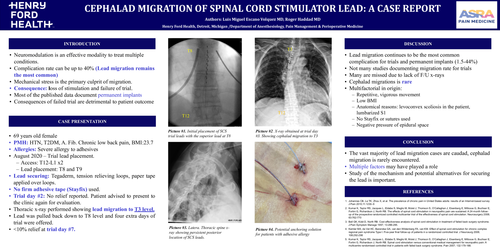
Thoracic x-ray performed showing lead migration to T3 level.
Lead was pulled back down to T8 level and four extra days of trial were offered.
<10% relief at trial day #7.
Lead migration continues to be the most common complication for trials and permanent implants (1.5-44%)
Not many studies documenting migration rate for trials
Many are missed due to lack of F/U x-rays
Cephalad migrations is rare
Multifactorial in origin:
Repetitive, vigorous movement
Low BMI
Anatomical reasons: levoconvex scoliosis in the patient, lumbarized S1
No Stayfix or sutures used
Negative pressure of epidural space
The vast majority of lead migration cases are caudad, cephalad migration is rarely encountered.
Multiple factors may have played a role
Study of the mechanism and potential alternatives for securing the lead is important.