457 posters, 2 videos, 2 audios, 8 topics, 45 sessions, 401 authors, 265 institutions
ePostersLive by SciGen Technologies S.A. All rights reserved.
49th Annual Regional Anesthesiology and Acute Pain Medicine Meeting
March 21-23, 2024 | The Hilton Bayfront San Diego | San Diego, California

5343
CHALLENGES AND ITS POTENTIAL SOLUTION IN PAIN MANAGEMENT FOR GERIATRIC RIB FRACTURES: A CASE REPORT
Poster Presenter
Authors
Affiliations
Part of Topic
Medically Challenging Cases
CHALLENGES AND ITS POTENTIAL SOLUTION IN PAIN MANAGEMENT FOR GERIATRIC RIB FRACTURES: A CASE REPORT
Pandya, Jaimin; Shabsigh, Muhammad; Xu, Jeff; Kirsch, Jordan
Department of Anesthesiology, Westchester Medical Center, New York Medical College, Valhalla, NY
The 76-year-old female, presenting as a pedestrian trauma after being struck by a motor vehicle. As this case report lacks patient identifiable information, it is exempt from IRB review per Westchester Medical Center Policy. She experienced loss of consciousness and a left-sided chest pain. Evaluation revealed fractures in the left 6th to 10th ribs, left 2nd-4th transverse process, small left pneumothorax, trace hemothorax, pulmonary contusion, and a small left frontal subarachnoid hemorrhage without significant midline shift. The patient had a medical history of hypothyroidism.
Acute pain consult was sought for rib fractures by the trauma team. Patient received a single shot serratus anterior block with an erector spinae plane (ESP) block catheter. The patient felt some alleviation, but not enough. The patient also took hydromorphone breakthrough push, oxycodone, acetaminophen, and methocarbamol. The catheter was dislodged on the second day, leading to a subsequent paravertebral block (PVB) catheter placement at T8 level.
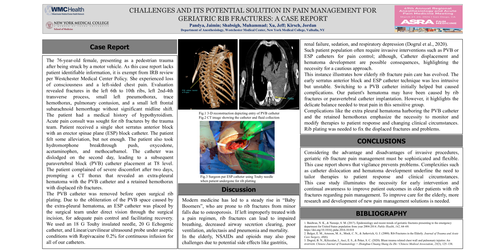
The patient complained of severe discomfort after two days, prompting a CT thorax that revealed an extra-pleural hematoma with the PVB catheter and a retained hemothorax with displaced rib fractures.
The PVB catheter was removed before open surgical rib plating. Due to the obliteration of the PVB space caused by the extra-pleural hematoma, an ESP catheter was placed by the surgical team under direct vision through the surgical incision, for adequate pain control and facilitating recovery.
We used an 18 G Touhy insulated needle, 20 G Echogenic catheter, and Linear/curvilinear ultrasound probe under aseptic conditions with Ropivacaine 0.2% for continuous infusion for all of our catheters.
Modern medicine has led to a steady rise in “Baby Boomers”, who are prone to rib fractures from minor falls due to osteoporosis. If left improperly treated with a pain regimen, rib fractures can lead to impaired breathing, decreased airway secretion clearing, poor ventilation, atelectasis and pneumonia and mortality.
In the elderly, NSAIDs and opioids may also pose challenges due to potential side effects like gastritis, renal failure, sedation, and respiratory depression (Dogrul et al., 2020).
Such patient population often require invasive interventions such as PVB or ESP catheters for pain control; although, Catheter displacement and hematoma development are possible consequences, highlighting the necessity for a cautious approach.
This instance illustrates how elderly rib fracture pain care has evolved. The early serratus anterior block and ESP catheter technique was less intrusive but unstable. Switching to a PVB catheter initially helped but caused complications. Our patient's hematoma may have been caused by rib fractures or paravertebral catheter implantation. However, it highlights the delicate balance needed to treat pain in this sensitive group.
Complications like the extra pleural hematoma harboring the PVB catheter and the retained hemothorax emphasize the necessity to monitor and modify therapies to patient response and changing clinical circumstances. Rib plating was needed to fix the displaced fractures and problems.
Considering the advantage and disadvantages of invasive procedures, geriatric rib fracture pain management must be sophisticated and flexible. This case report shows that vigilance prevents problems. Complexities such as catheter dislocation and hematoma development underline the need to tailor therapies to patient response and clinical circumstances.
This case study illuminates the necessity for early intervention and continual awareness to improve patient outcomes in older patients with rib fractures regarding pain management. To improve care for the elderly, more research and development of new pain management solutions is needed.