457 posters, 2 videos, 2 audios, 8 topics, 45 sessions, 401 authors, 265 institutions
ePostersLive by SciGen Technologies S.A. All rights reserved.
49th Annual Regional Anesthesiology and Acute Pain Medicine Meeting
March 21-23, 2024 | The Hilton Bayfront San Diego | San Diego, California

5446
ANESTHETIC AND POST-OPERATIVE PAIN MANAGEMENT CONCERNS IN A PATIENT UNDERGOING HIP SURGERY WITH A LARGE ANTERIOR MEDIASTINAL MASS
Poster Presenter
Authors
Affiliations
Part of Topic
Medically Challenging Cases
Anesthetic and Post-operative Pain Management Concerns in a Patient Undergoing Hip Surgery with a Large Anterior Mediastinal Mass
Benjamin Marshall, MD; Marc Beckerman, MD
Hip fractures are exceedingly rare in young adults and are most often caused by severe trauma or an underlying pathologic fracture. Pathologic fractures can serve as the initial indication of malignancy, more commonly associated with malignant lesions due to the increased force required to cause such fractures in benign lesions. Surgical intervention, involving either arthroplasty or internal fixation, is the primary treatment for these types of fractures. Bone metastases, often originating from primary lung tumors, present unique challenges in patients with mediastinal masses requiring surgery, necessitating careful consideration in both anesthesia planning and postoperative pain management.
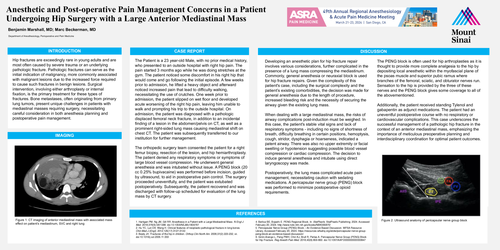
The Patient is a 23 year-old Male, with no prior medical history, who presented to an outside hospital with right hip pain. The pain started 3 months ago while he was doing stretches at the gym. The patient noticed some discomfort in his right hip that would come and go following the initial episode. A few weeks prior to admission, he lifted a heavy object and afterward noticed increased pain that lead to difficulty walking, necessitating the use of crutches. One week prior to admission, the patient slipped on wet floor and developed acute worsening of the right hip pain, leaving him unable to walk and prompting his trip to the outside hospital. On admission, the patient was diagnosed with a pathologic displaced femoral neck fracture, in addition to an incidental finding of a lesion in the abdomen/pelvis on CT, as well as a prominent right-sided lung mass causing mediastinal shift on chest CT. The patient was subsequently transferred to our institution for further management.
The orthopedic surgery team consented the patient for a right femur biopsy, resection of the lesion, and hip hemiarthroplasty. The patient denied any respiratory symptoms or symptoms of large blood vessel compression. He underwent general anesthesia and was intubated without issue. A PENG block (20 cc 0.25% bupivacaine) was performed before incision, guided by ultrasound, to aid in postoperative pain control. The surgery proceeded uneventfully, and the patient was extubated postoperatively. Subsequently, the patient recovered and was discharged with follow-up scheduled for evaluation of the lung mass by CT surgery.
Developing an anesthetic plan for hip fracture repair involves various considerations, further complicated in the presence of a lung mass compressing the mediastinum. Commonly, general anesthesia or neuraxial block is used for hip fracture repairs. Given the complexity of this patient's case, including the surgical complexity and the patient’s existing comorbidities, the decision was made for general anesthesia due to the length of procedure, increased bleeding risk and the necessity of securing the airway given the existing lung mass.
When dealing with a large mediastinal mass, the risks of airway complications post-induction must be weighed. In this case, the patient's stable vital signs and lack of respiratory symptoms - including no signs of shortness of breath, difficulty breathing in certain positions, hemoptysis, cough, stridor, dysphagia or hoarseness, indicated a patent airway. There was also no upper extremity or facial swelling or hypotension suggesting possible blood vessel compression or cardiac compression. The decision to induce general anesthesia and intubate using direct laryngoscopy was made.
Postoperatively, the lung mass complicated acute pain management, necessitating caution with sedating medications. A pericapsular nerve group (PENG) block was performed to minimize postoperative opioid requirements.
The PENG block is often used for hip arthroplasties as it is thought to provide more complete analgesia to the hip by depositing local anesthetic within the myofascial plane of the psoas muscle and superior pubic ramus where branches of the femoral, sciatic, and obturator nerves run. Sensation to the hip is provided by the three of these nerves and the PENG block gives some coverage to all of the abovementioned.
Additionally, the patient received standing Tylenol and gabapentin as adjunct medications. The patient had an uneventful postoperative course with no respiratory or cardiovascular complications. This case underscores the successful management of a pathologic hip fracture in the context of an anterior mediastinal mass, emphasizing the importance of meticulous preoperative planning and interdisciplinary coordination for optimal patient outcomes.