343 posters, 5 videos, 2 audios, 18 topics, 33 sessions, 263 authors, 202 institutions
ePostersLive by SciGen Technologies S.A. All rights reserved.
24th Annual Pain Medicine Meeting 2025
November 13-15, 2025| JW Marriott Austin, Austin, Texas

2198345
Opioid-Sparing Effects of Perioperative Dexmedetomidine: A Narrative Review of Recent Randomized Controlled Trials
Poster Presenter
Authors
Affiliations
Part of Topic
Scientific Abstracts > Acute Pain
Opioid-Sparing Effects of Perioperative Dexmedetomidine: A Narrative Review of Recent Randomized Controlled Trials
Justin Le, B.S., Grace Liu, B.S., Manav Patel, B.S., Chris Hsu, B.S., Tejas Kollu, M.D., Adam Romman, M.D.
University of Texas Medical Branch at Galveston
Introduction
Dexmedetomidine, an α2-adrenergic agonist, is widely utilized for its sedative and analgesic properties. Its clinical value in anesthetic management is derived from its unique sympatholytic and analgesic properties. This narrative review synthesizes recent trials evaluating its opioid-sparing efficacy across various administration routes and surgical contexts.
Methods
A systematic narrative review was performed utilizing the appropriate search terms to identify studies published on PubMed from 2022 to 2025. The review concentrated on studies examining the opioid-sparing effects of perioperative dexmedetomidine. The search criteria yielded 42 articles, which were assessed for inclusion by four researchers. A total of 23 articles were determined to meet the inclusion criteria.
Results
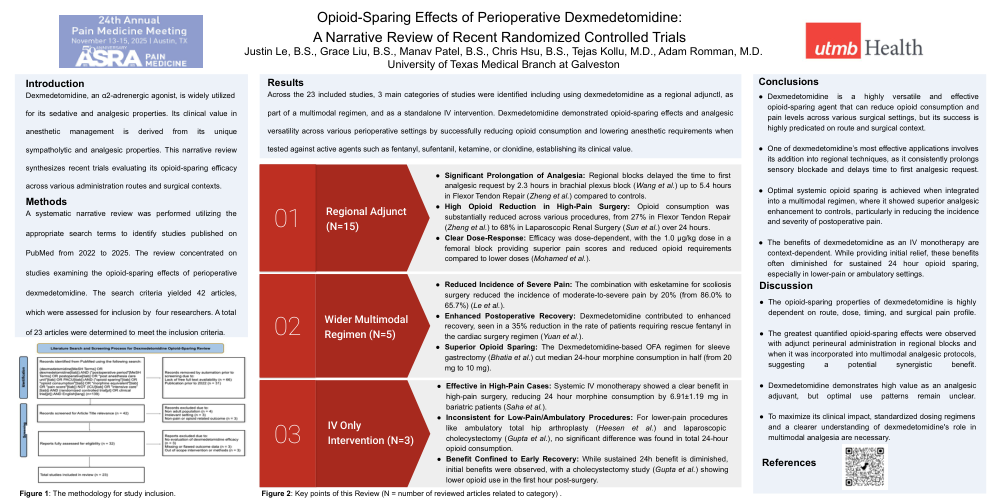
Across the 23 included studies, 3 main categories of studies were identified including using dexmedetomidine as a regional adjunctl, as part of a multimodal regimen, and as a standalone IV intervention. Dexmedetomidine demonstrated opioid-sparing effects and analgesic versatility across various perioperative settings by successfully reducing opioid consumption and lowering anesthetic requirements when tested against active agents such as fentanyl, sufentanil, ketamine, or clonidine, establishing its clinical value.
Regional Adjunct (N=15):
-
Significant Prolongation of Analgesia: Regional blocks delayed the time to first analgesic request by 2.3 hours in brachial plexus block (Wang et al.) up to 5.4 hours in Flexor Tendon Repair (Zheng et al.) compared to controls.
-
High Opioid Reduction in High-Pain Surgery: Opioid consumption was substantially reduced across various procedures, from 27% in Flexor Tendon Repair (Zheng et al.) to 68% in Laparoscopic Renal Surgery (Sun et al.) over 24 hours.
-
Clear Dose-Response: Efficacy was dose-dependent, with the 1.0 μg/kg dose in a femoral block providing superior pain scores and reduced opioid requirements compared to lower doses (Mohamed et al.).
Wider Multimodal Regimen (N=5):
-
Reduced Incidence of Severe Pain: The combination with esketamine for scoliosis surgery reduced the incidence of moderate-to-severe pain by 20% (from 86.0% to 65.7%) (Le et al.).
-
Enhanced Postoperative Recovery: Dexmedetomidine contributed to enhanced recovery, seen in a 35% reduction in the rate of patients requiring rescue fentanyl in the cardiac surgery regimen (Yuan et al.).
-
Superior Opioid Sparing: The Dexmedetomidine-based OFA regimen for sleeve gastrectomy (Bhatia et al.) cut median 24-hour morphine consumption in half (from 20 mg to 10 mg).
IV Only Intervention (N=3)
-
Effective in High-Pain Cases: Systemic IV monotherapy showed a clear benefit in high-pain surgery, reducing 24 hour morphine consumption by 6.91±1.19 mg in bariatric patients (Saha et al.).
-
Inconsistent for Low-Pain/Ambulatory Procedures: For lower-pain procedures like ambulatory total hip arthroplasty (Heesen et al.) and laparoscopic cholecystectomy (Gupta et al.), no significant difference was found in total 24-hour opioid consumption.
-
Benefit Confined to Early Recovery: While sustained 24h benefit is diminished, initial benefits were observed, with a cholecystectomy study (Gupta et al.) showing lower opioid use in the first hour post-surgery.
Conclusions
-
Dexmedetomidine is a highly versatile and effective opioid-sparing agent that can reduce opioid consumption and pain levels across various surgical settings, but its success is highly predicated on route and surgical context.
-
One of dexmedetomidine’s most effective applications involves its addition into regional techniques, as it consistently prolongs sensory blockade and delays time to first analgesic request.
-
Optimal systemic opioid sparing is achieved when integrated into a multimodal regimen, where it showed superior analgesic enhancement to controls, particularly in reducing the incidence and severity of postoperative pain.
-
The benefits of dexmedetomidine as an IV monotherapy are context-dependent. While providing initial relief, these benefits often diminished for sustained 24 hour opioid sparing, especially in lower-pain or ambulatory settings.
Discussion
-
The opioid-sparing properties of dexmedetomidine is highly dependent on route, dose, timing, and surgical pain profile.
-
The greatest quantified opioid-sparing effects were observed with adjunct perineural administration in regional blocks and when it was incorporated into multimodal analgesic protocols, suggesting a potential synergistic benefit.
-
Dexmedetomidine demonstrates high value as an analgesic adjuvant, but optimal use patterns remain unclear.
-
To maximize its clinical impact, standardized dosing regimens and a clearer understanding of dexmedetomidine's role in multimodal analgesia are necessary.
References