343 posters, 5 videos, 2 audios, 18 topics, 33 sessions, 263 authors, 202 institutions
ePostersLive by SciGen Technologies S.A. All rights reserved.
24th Annual Pain Medicine Meeting 2025
November 13-15, 2025| JW Marriott Austin, Austin, Texas

2162751
Lumbar sympathetic block for managing phantom limb pain in a squamous cell carcinoma patient post hemipelvectomy: a case report
Poster Presenter
Authors
Affiliations
Part of Topic
Scientific Abstracts > Chronic Pain
Lumbar sympathetic block for managing phantom limb pain in a squamous cell carcinoma patient post
hemipelvectomy: a case report
Abstract ID: 2162751
Abstract Category: Scientific Abstracts
Abstract Status: Complete / Locked
Author(s)
Abby Niles G. Cuenco, MD, CFP (he/him/his)
Role: Submitting Author
Maria Lourdes Josefina Cabaluna, MD, DPBPM (she/her/hers)
Role: Co-Author
Karmi Margaret Marcial, MD, DPBPM (she/her/hers)
Role: Co-Author
Abstract
Topic
Chronic Pain
Introduction
This case report details the successful management of phantom limb pain (PLP) in a 44-year-old female with persistent
phantom limb pain post hemipelvectomy due to recurrent cervical squamous cell carcinoma. The patient presented with
complications from her cancer treatment and pre-existing phantom limb pain, initially managed with a fentanyl PCA pump.
Eventually, C-ARM guided lumbar sympathetic block was administered, providing significant pain relief and improved quality of life.
Materials and Methods
Patient presented with three-year history of phantom limb pain on the lower back and hips radiating to the lower extremities.
She was assessed using the Numerical Rating Scale (NRS) and the American Chronic Pain Association Quality of Life Scale (ACPA-
QOLS) at baseline with regular intervals during treatment. Interventional pain management was eventually offered as outpatient
procedure to provide better pain relief and improved quality of life.
Patient's informed consent for case report was signed.
Case report is devoid of patient identifiable information, thereby exempted from IRB review requirements per St. Luke's
Medical Center - Global City policy.
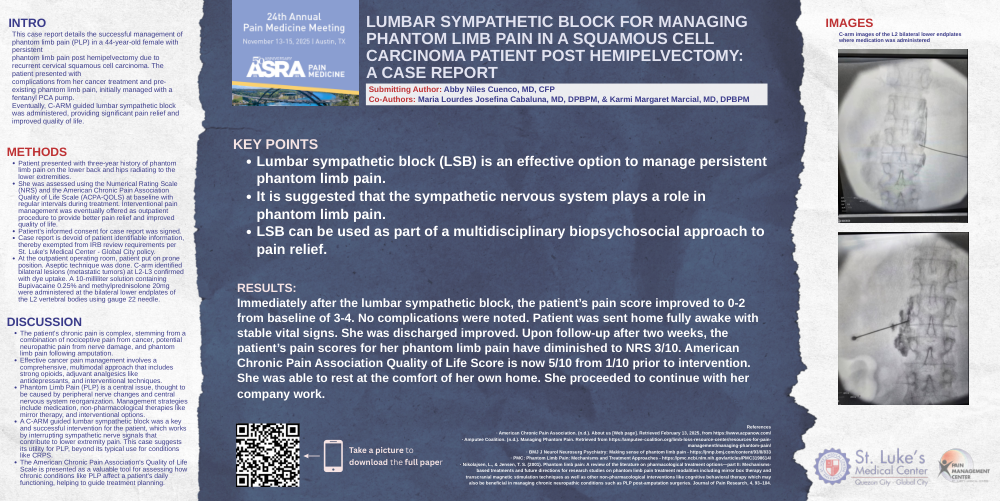
At the outpatient operating room, patient put on prone position. Aseptic technique was done. C-arm identified bilateral lesions
(metastatic tumors) at L2-L3 confirmed with dye uptake. A 10-milliliter solution containing Bupivacaine 0.25% and
methylprednisolone 20mg were administered at the bilateral lower endplates of the L2 vertebral bodies using gauge 22 needle.
Results/Case Report
Immediately after the lumbar sympathetic block, the patient’s pain score improved to 0-2 from baseline of 3-4. No
complications were noted. Patient was sent home fully awake with stable vital signs. She was discharged improved.
Upon follow-up after two weeks, the patient’s pain scores for her phantom limb pain have diminished to NRS 3/10. American
Chronic Pain Association Quality of Life Score is now 5/10 from 1/10 prior to intervention. She was able to rest at the comfort of her
own home. She proceeded to continue with her company work.
Discussion
This case shows that lumbar sympathetic block is an effective option to manage persistent phantom limb pain. This suggests
that the sympathetic nervous system plays a role in phantom limb pain. Lumbar sympathetic block can be used as part of a
multidisciplinary biopsychosocial approach to pain relief.
References
· American Chronic Pain Association. (n.d.). About us [Web page]. Retrieved February 13, 2025, from https://www.acpanow.com/
· Amputee Coalition. (n.d.). Managing Phantom Pain. Retrieved from https://amputee-coalition.org/limb-loss-resource-center/resources-for-pain-
management/managing-phantom-pain/
· BMJ J Neurol Neurosurg Psychiatry: Making sense of phantom limb pain - https://jnnp.bmj.com/content/93/8/833
· PMC: Phantom Limb Pain: Mechanisms and Treatment Approaches - https://pmc.ncbi.nlm.nih.gov/articles/PMC3198614/
· Nikolajsen, L., & Jensen, T. S. (2001). Phantom limb pain: A review of the literature on pharmacological treatment options—part II: Mechanisms-
based treatments and future directions for research studies on phantom limb pain treatment modalities including mirror box therapy and
transcranial magnetic stimulation techniques as well as other non-pharmacological interventions like cognitive behavioral therapy which may
also be beneficial in managing chronic neuropathic conditions such as PLP post-amputation surgeries. Journal of Pain Research, 4, 93–104.