343 posters, 5 videos, 2 audios, 18 topics, 33 sessions, 263 authors, 202 institutions
ePostersLive by SciGen Technologies S.A. All rights reserved.
24th Annual Pain Medicine Meeting 2025
November 13-15, 2025| JW Marriott Austin, Austin, Texas

2165195
Comparison of effectiveness of Suprascapular Nerve Vs Suprascapular and Lateral Pectoral Nerve PRF for Chronic Shoulder Pain
Poster Presenter
Part of Topic
Scientific Abstracts > Chronic Pain
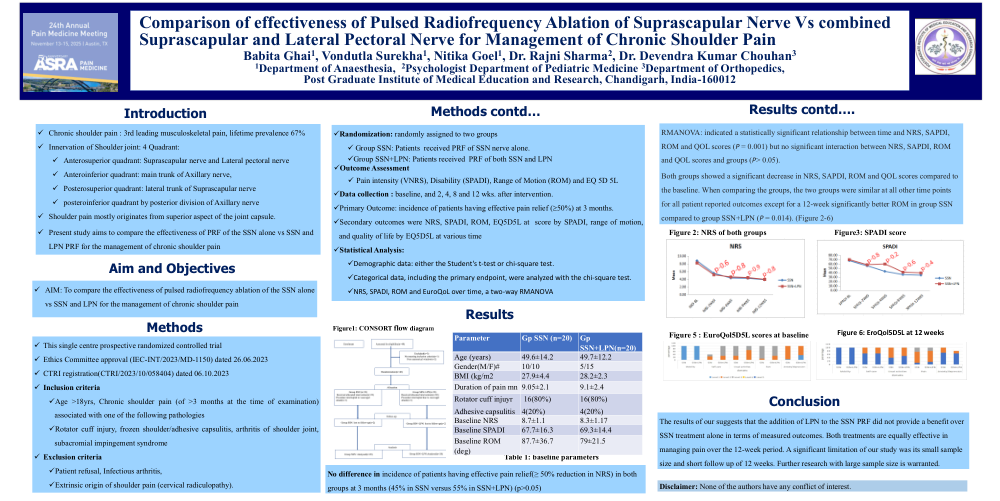
Comparison of effectiveness of Pulsed Radiofrequency Ablation of Suprascapular Nerve Vs combined
Suprascapular and Lateral Pectoral Nerve for Management of Chronic Shoulder Pain
Babita Ghai1, Vondutla Surekha1, Nitika Goel1, Dr. Rajni Sharma2, Dr. Devendra Kumar Chouhan3
1Department of Anaesthesia, 2Psychologist Department of Pediatric Medicine 3Department of Orthopedics,
Post Graduate Institute of Medical Education and Research, Chandigarh, India-160012
Introduction
Methods contd…
Results contd….
✓ Chronic shoulder pain : 3rd leading musculoskeletal pain, lifetime prevalence 67%
✓ Innervation of Shoulder joint: 4 Quadrant:
✓ Anterosuperior quadrant: Suprascapular nerve and Lateral pectoral nerve
✓ Anteroinferior quadrant: main trunk of Axillary nerve,
✓ Posterosuperior quadrant: lateral trunk of Suprascapular nerve
✓ posteroinferior quadrant by posterior division of Axillary nerve
✓ Shoulder pain mostly originates from superior aspect of the joint capsule.
✓ Present study aims to compare the effectiveness of PRF of the SSN alone vs SSN and
LPN PRF for the management of chronic shoulder pain
Aim and Objectives
✓Randomization: randomly assigned to two groups
✓ Group SSN: Patients received PRF of SSN nerve alone.
✓Group SSN+LPN: Patients received PRF of both SSN and LPN
✓Outcome Assessment
✓ Pain intensity (VNRS), Disability (SPADI), Range of Motion (ROM) and EQ 5D 5L
✓Data collection : baseline, and 2, 4, 8 and 12 wks. after intervention.
✓Primary Outcome: incidence of patients having effective pain relief (50%) at 3 months.
✓Secondary outcomes were NRS, SPADI, ROM, EQ5D5L at score by SPADI, range of motion,
and quality of life by EQ5D5L at various time
✓Statistical Analysis:
✓Demographic data: either the Student's t-test or chi-square test.
✓Categorical data, including the primary endpoint, were analyzed with the chi-square test.
✓NRS, SPADI, ROM and EuroQoL over time, a two-way RMANOVA
RMANOVA: indicated a statistically significant relationship between time and NRS, SAPDI,
ROM and QOL scores (P = 0.001) but no significant interaction between NRS, SAPDI, ROM
and QOL scores and groups (P> 0.05).
Both groups showed a significant decrease in NRS, SAPDI, ROM and QOL scores compared to
the baseline. When comparing the groups, the two groups were similar at all other time points
for all patient reported outcomes except for a 12-week significantly better ROM in group SSN
compared to group SSN+LPN (P = 0.014). (Figure 2-6)
Figure 2: NRS of both groups
Figure3: SPADI score
✓ AIM: To compare the effectiveness of pulsed radiofrequency ablation of the SSN alone
vs SSN and LPN for the management of chronic shoulder pain
Results
Methods
Figure1: CONSORT flow diagram
Figure 6: EroQol5D5L at 12 weeks
Parameter Gp SSN (n=20) Figure 5 : EuroQol5D5L scores at baseline
✓ This single centre prospective randomized controlled trial
✓ Ethics Committee approval (IEC-INT/2023/MD-1150) dated 26.06.2023
✓ CTRI registration(CTRI/2023/10/058404) dated 06.10.2023
✓ Inclusion criteria
✓Age >18yrs, Chronic shoulder pain (of >3 months at the time of examination)
associated with one of the following pathologies
✓Rotator cuff injury, frozen shoulder/adhesive capsulitis, arthritis of shoulder joint,
subacromial impingement syndrome
✓ Exclusion criteria
✓Patient refusal, Infectious arthritis,
✓Extrinsic origin of shoulder pain (cervical radiculopathy).
Gp
SSN+LPN(n=20)
Age (years) Gender(M/F)# BMI (kg/m2 49.6±14.2 10/10 27.9±4.4 49.7±12.2
5/15
28.2±2.3
Duration of pain mn 9.05±2.1 9.1±2.4
Rotator cuff injuyr
Adhesive capsulitis
Baseline NRS 16(80%)
4(20%)
8.7±1.1 16(80%)
4(20%)
8.3±1.17
Conclusion
Baseline SPADI 67.7±16.3 69.3±14.4
Baseline ROM
(deg)
87.7±36.7 79±21.5
Table 1: baseline parameters
The results of our suggests that the addition of LPN to the SSN PRF did not provide a benefit over
SSN treatment alone in terms of measured outcomes. Both treatments are equally effective in
managing pain over the 12-week period. A significant limitation of our study was its small sample
size and short follow up of 12 weeks. Further research with large sample size is warranted.
No difference in incidence of patients having effective pain relief(≥ 50% reduction in NRS) in both
groups at 3 months (45% in SSN versus 55% in SSN+LPN) (p>0.05)
Disclaimer: None of the authors have any conflict of interest.