343 posters, 5 videos, 2 audios, 18 topics, 33 sessions, 263 authors, 202 institutions
ePostersLive by SciGen Technologies S.A. All rights reserved.
24th Annual Pain Medicine Meeting 2025
November 13-15, 2025| JW Marriott Austin, Austin, Texas

2198319
The Missing Faces of Pain Medicine: Gender and Race Gaps in the Fellowship Pipeline - A Review of the Recent AAMC and NRMP Data
Poster Presenter
Authors
Affiliations
Part of Topic
Scientific Abstracts > Education
Title: The Missing Faces of Pain Medicine: Gender and Race Gaps in the Fellowship Pipeline - A Review of the Recent AAMC and NRMP Data
Authors: Lee Nguyen, MD, Ellie Tsang, BS, Chinar Sanghvi, MD, Scott Pritzlaff, MD
Introduction
Pain medicine has long exhibited disparities in gender and race representation among fellows, which have only deepened. Recent data reveal that this inequity has persisted since at least 2019, with the percentage of female pain medicine applicants ranging from 19.6-25.1% and declining [1]. Furthermore, the majority of fellows identify as White or Asian, with minimal representation from other racial groups. In an era of increasing patient diversity and marked decline in pain medicine applications, this signals a concerning decrease in the diversity of future pain medicine physicians.
Materials and Methods
Applicant and match data were collected from publicly available and de-identified reports from the Association of American Medical Colleges (AAMC) and National Resident Matching Program (NRMP) websites [2,3]. Data were analyzed from 2019-2024 from AAMC and 2023-2025 from NRMP, as these were the years publicly available. Match data from NRMP were limited to the publicly available anesthesiology results. Demographic variables included self-identified gender, race/ethnicity, and first-generation college or medical school graduate status. As the report is devoid of identifiable information, it is exempt from IRB review per institution policy.
Results
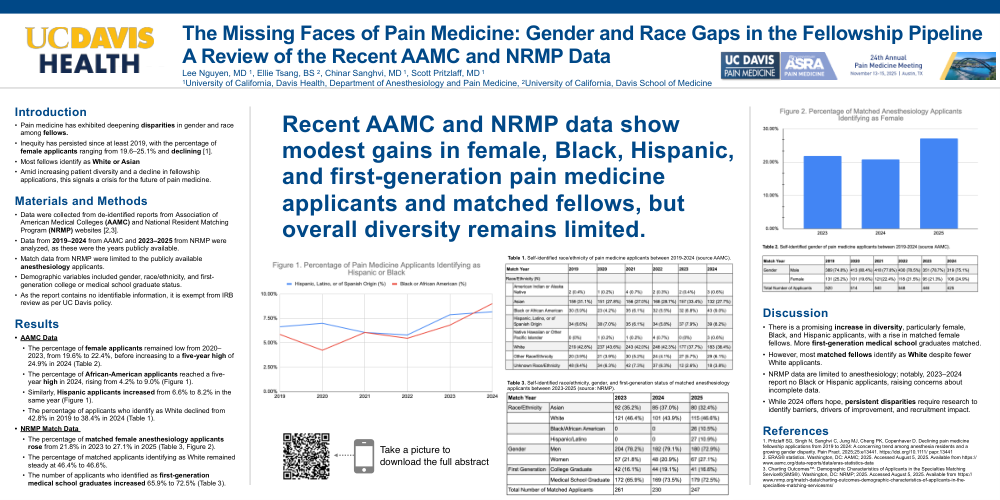
The percentage of female applicants remained steadily low from 2020-2023, ranging from 19.6%-22.4%, before increasing to a five-year high of 24.9% in 2024 (Table 1). The percentage of African-American applicants also reached a five-year high in 2024, rising from 4.2% to 9.0%. Similarly, Hispanic applicants increased from 6.6% to 8.2% that same year (Figure 1). The percentage of applicants who identify as White declined from 42.8% in 2019 to 38.4% in 2024 (Table 1). NRMP match data show that the percentage of matched female anesthesiology applicants rose from 21.8% in 2023 to 27.1% in 2025 (Table 2, Figure 2). The percentage of matched applicants identifying as Asian decreased from 35.2% to 32.4%. The percentage of matched applicants identifying as White remained steady at 46.4% to 46.6%. The number of applicants who identified as first-generation medical school graduates increased from 65.9% to 72.5% (Table 2).
Discussion
There is a promising increase in diversity among pain medicine applicants, particularly among female, Black, and Hispanic individuals, which aligns with a rise in matched female applicants. However, despite a decline in White applicants, most matched fellows still identify as White. In recent years, more first-generation medical school graduates have also matched into pain medicine. NRMP data remain limited, capturing only anesthesiology applicants and excluding other specialties; notably, the 2023 and 2024 datasets report no matched applicants identifying as Black or Hispanic, raising concerns about incomplete or missing demographic data.
Conclusions
While the 2024 data offers hope for a more inclusive future in pain medicine, persistent disparities remain. Continued research is needed to identify the systemic barriers influencing race and gender disparities, understand the factors driving recent improvements, and assess the impact of current diversity-focused recruitment.