343 posters, 5 videos, 2 audios, 18 topics, 33 sessions, 263 authors, 202 institutions
ePostersLive by SciGen Technologies S.A. All rights reserved.
24th Annual Pain Medicine Meeting 2025
November 13-15, 2025| JW Marriott Austin, Austin, Texas

2198173
Assessing Resident Attitudes Towards A Rotation-Specific Study Guide for Pain Management
Poster Presenter
Authors
Affiliations
Part of Topic
Scientific Abstracts > Education
Introduction
Residents often report that communication regarding expectations or other useful information about subspecialty rotations, such as pain medicine, is lacking. We hypothesize that residents would find a chronic pain rotation study guide useful. We examined residents' outlook towards receiving a study guide before and after their inpatient chronic pain management rotation, to determine the study guide aspects desired by residents, and determine if completing the rotation impacts the perceived utility of a study guide.
Materials and Methods
In a pre-post quasi-experimental design from March to July of 2025, 20 residents voluntarily completed a survey before their pain management rotation. Residents were asked to assess their readiness and whether a study guide would impact it. They were also asked to rank the importance of different learning tools, visual aids, and content types, as well as how often they would use a study guide if provided one. Following completion of the rotation, residents were asked again whether a study guide would have been helpful, and what aspects of a guide would be most important for them.
Results
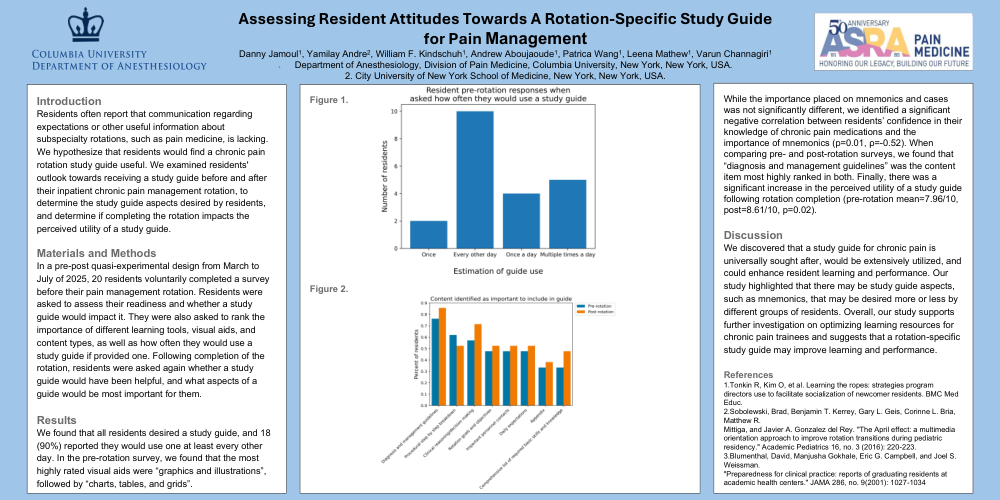
We found that all residents desired a study guide, and 18 (90%) reported they would use one at least every other day. In the pre-rotation survey, we found that the most highly rated visual aids were “graphics and illustrations”, followed by “charts, tables, and grids”.
While the importance placed on mnemonics and cases was not significantly different, we identified a significant negative correlation between residents’ confidence in their knowledge of chronic pain medications and the importance of mnemonics (p=0.01, ρ=-0.52). When comparing pre- and post-rotation surveys, we found that “diagnosis and management guidelines” was the content item most highly ranked in both. Finally, there was a significant increase in the perceived utility of a study guide following rotation completion (pre-rotation mean=7.96/10, post=8.61/10, p=0.02).
Discussion
We discovered that a study guide for chronic pain is universally sought after, would be extensively utilized, and could enhance resident learning and performance. Our study highlighted that there may be study guide aspects, such as mnemonics, that may be desired more or less by different groups of residents. Overall, our study supports further investigation on optimizing learning resources for chronic pain trainees and suggests that a rotation-specific study guide may improve learning and performance.
References
Mittiga, and Javier A. Gonzalez del Rey. "The April effect: a multimedia orientation approach to improve rotation transitions during pediatric residency." Academic Pediatrics 16, no. 3 (2016): 220-223.
"Preparedness for clinical practice: reports of graduating residents at academic health centers." JAMA 286, no. 9(2001): 1027-1034