343 posters, 5 videos, 2 audios, 18 topics, 33 sessions, 263 authors, 202 institutions
ePostersLive by SciGen Technologies S.A. All rights reserved.
24th Annual Pain Medicine Meeting 2025
November 13-15, 2025| JW Marriott Austin, Austin, Texas

2198108
Activity Goal Outcomes as Complementary Measures of Treatment Success for SCS Patients at 12 Months
Poster Presenter
Authors
Affiliations
Part of Topic
Scientific Abstracts > Chronic Pain
Activity Goals Outcomes as Complementary Measures of Treatment Success for SCS Patients at 12 Months
Melissa Murphy1, Andrew Will2, Thomas White3, Velimir Micovic4, David O’Toole5, David Provenzano6, Saurabh Dang7, Katherine Stromberg8, Grace Santa Cruz Chavez8, Cory Goracke8
1 North Texas Orthopedics & Spine Center, Dallas-Fort Worth, TX, United States; 2 Twin Cities Pain Clinic, Minneapolis, MN, United States; 3 Procura Pain and Spine PLLC, Houston, TX, United States; 4 Pain Management Consultants of Southwest Florida, Fort Myers, FL, United States; 5 Novant Health Spine Specialists, Winston-Salem, NC, United Staes; 6 Pain Diagnostics and Interventional Care, Sewickley, PA, United States; 7 Garden State Pain and Orthopedics, Clifton, NH, United States; 8 Medtronic Neuromodulation, Minneapolis, MN, United States.
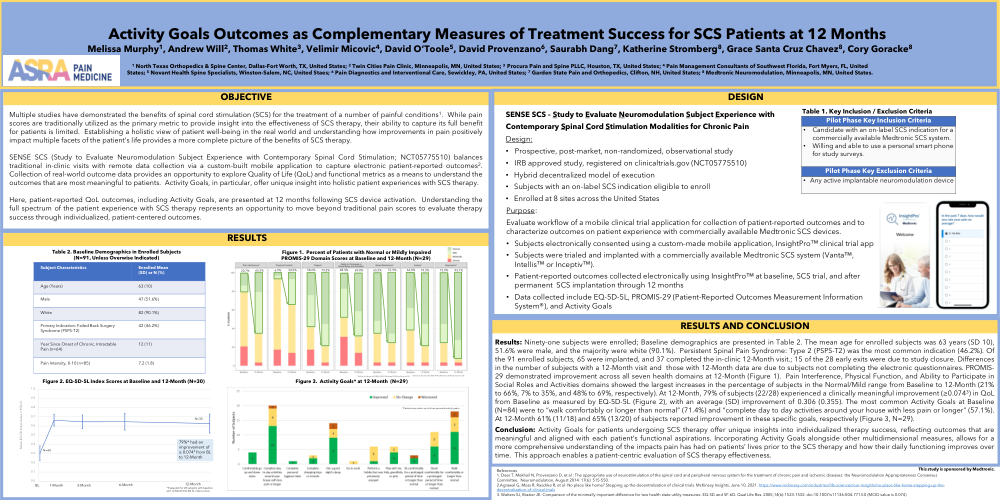
Objective: Multiple studies have demonstrated the benefits of spinal cord stimulation (SCS) for the treatment of a number of painful conditions1. While pain scores are traditionally utilized as the primary metric to provide insight into the effectiveness of SCS therapy, their ability to capture its full benefit for patients is limited. Establishing a holistic view of patient well-being in the real world and understanding how improvements in pain positively impact multiple facets of the patient’s life provides a more complete picture of the benefits of SCS therapy. SENSE SCS (Study to Evaluate Neuromodulation Subject Experience with Contemporary Spinal Cord Stimulation; NCT05775510) balances traditional in-clinic visits with remote data collection via a custom-built mobile application to capture electronic patient-reported outcomes2. Collection of real-world outcome data provides an opportunity to explore Quality of Life (QoL) and functional metrics as a means to understand the outcomes that are most meaningful to patients. Activity Goals, in particular, offer unique insight into holistic patient experiences with SCS therapy. Here, patient-reported QoL outcomes, including Activity Goals, are presented at 12 months following SCS device activation. Understanding the full spectrum of the patient experience with SCS therapy represents an opportunity to move beyond traditional pain scores to evaluate therapy success through individualized, patient-centered outcomes.
Methods: SENSE SCS – Study to Evaluate Neuromodulation Subject Experience with Contemporary Spinal Cord Stimulation Modalities for Chronic Pain
Design: Design: • Prospective, post-market, non-randomized, observational study • IRB approved study, registered on clinicaltrials.gov (NCT05775510) • Hybrid decentralized model of execution • Subjects with an on-label SCS indication eligible to enroll • Enrolled at 8 sites across the United States Purpose: Evaluate workflow of a mobile clinical trial application for collection of patient-reported outcomes and to characterize outcomes on patient experience with commercially available Medtronic SCS devices. • Subjects electronically consented using a custom-made mobile application, InsightPro clinical trial app • Subjects were trialed and implanted with a commercially available Medtronic SCS system (Vanta , Intellis or Inceptiv ). • Patient-reported outcomes collected electronically using InsightPro at baseline, SCS trial, and after permanent SCS implantation through 12 months • Data collected include EQ-5D-5L, PROMIS-29 (Patient-Reported Outcomes Measurement Information System®), and Activity Goals
Results and Conclusion: Results:Ninety-onesubjectswereenrolled; Baseline demographics are presented in Table 2. The mean age for enrolled subjects was 63 years (SD 10), 51.6% were male, and the majority were white (90.1%). Persistent Spinal Pain Syndrome: Type 2 (PSPS-T2) was the most common indication (46.2%). Of the 91 enrolled subjects, 65 were implanted, and 37 completed the in-clinic 12-Month visit.; 15 of the 28 early exits were due to study closure. Differences in the number of subjects with a 12-Month visit and those with 12-Month data are due to subjects not completing the electronic questionnaires. PROMIS29 demonstrated improvement across all seven health domains at 12-Month (Figure 1). Pain Interference, Physical Function, and Ability to Participate in Social Roles and Activities domains showed the largest increases in the percentage of subjects in the Normal/Mild range from Baseline to 12-Month (21% to 66%, 7% to 35%, and 48% to 69%, respectively). At 12-Month, 79% of subjects (22/28) experienced a clinically meaningful improvement (≥0.0743) in QoL from Baseline as measured by EQ-5D-5L (Figure 2), with an average (SD) improvement of 0.306 (0.355). The most common Activity Goals at Baseline (N=84) were to “walk comfortably or longer than normal” (71.4%) and “complete day to day activities around your house with less pain or longer” (57.1%). At 12-Month 61% (11/18) and 65% (13/20) of subjects reported improvement in these specific goals, respectively (Figure 3, N=29).
Conclusion: Activity Goals for patients undergoing SCS therapy offer unique insights into individualized therapy success, reflecting outcomes that are meaningful and aligned with each patient’s functional aspirations. Incorporating Activity Goals alongside other multidimensional measures, allows for a more comprehensive understanding of the impacts pain has had on patients’ lives prior to the SCS therapy and how their daily functioning improves over time. This approach enables a patient-centric evaluation of SCS therapy effectiveness.
References 1. Deer T, Mekhail N, Provenzano D, et al: The appropriate use of neurostimulation of the spinal cord and peripheral nervous system for the treatment of chronic pain and ischemic diseases: the Neuromodulation Appropriateness Consensus Committee. Neuromodulation, August 2014. 17(6): 515-550. 2.Agrawal G, Moss R, Raschke R, et al: No place like home? Stepping up the decentralization of clinical trials. McKinsey Insights, June 10, 2021. https://www.mckinsey.com/industries/life-sciences/our-insights/no-place-like-home-stepping-up-thedecentralization-of-clinical-trials 3. WaltersSJ,BrazierJE.Comparisonoftheminimallyimportantdifferencefortwohealthstateutilitymeasures:EQ-5DandSF-6D.QualLifeRes.2005;14(6):1523-1532.doi:10.1007/s11136-004-7713-0 (MCID value is 0.074)
This study was sponsored by Medtronic.