343 posters, 5 videos, 2 audios, 18 topics, 33 sessions, 263 authors, 202 institutions
ePostersLive by SciGen Technologies S.A. All rights reserved.
24th Annual Pain Medicine Meeting 2025
November 13-15, 2025| JW Marriott Austin, Austin, Texas

2198103
Efficacy and Tolerability of Intravenous Lidocaine versus Gabapentinoids in Neuropathic Pain: A Retrospective Cohort Study
Poster Presenter
Authors
Affiliations
Part of Topic
Scientific Abstracts > Chronic Pain
Title:
Efficacy and Tolerability of Intravenous Lidocaine Versus Gabapentinoids in Chronic Neuropathic Pain: A Retrospective Cohort Study
Introduction:
● Neuropathic pain is difficult to manage and is rising in incidence, creating a significant healthcare burden [1]
● First-line medications like gabapentinoids deliver inconsistent analgesia and are often poorly tolerated [1]
● Lidocaine, a sodium channel blocker typically used as a local anesthetic, has shown promise when used intravenously for the treatment of neuropathic pain, but comparisons with the standard of care remain limited [2,3]
Methods:
● We conducted a retrospective cohort study of neuropathic pain patients at the Columbia University Pain Clinic between January 1st, 2020, and March 1st, 2025
● 20 patients who received lidocaine infusions were compared with 20 patients who received gabapentinoids
● Outcomes included:
○ Greatest pain reduction reported within 12 months of beginning treatment
○ Adverse medication effects
● Patients also taking opioids, TCAs, or SNRIs were excluded
Results:
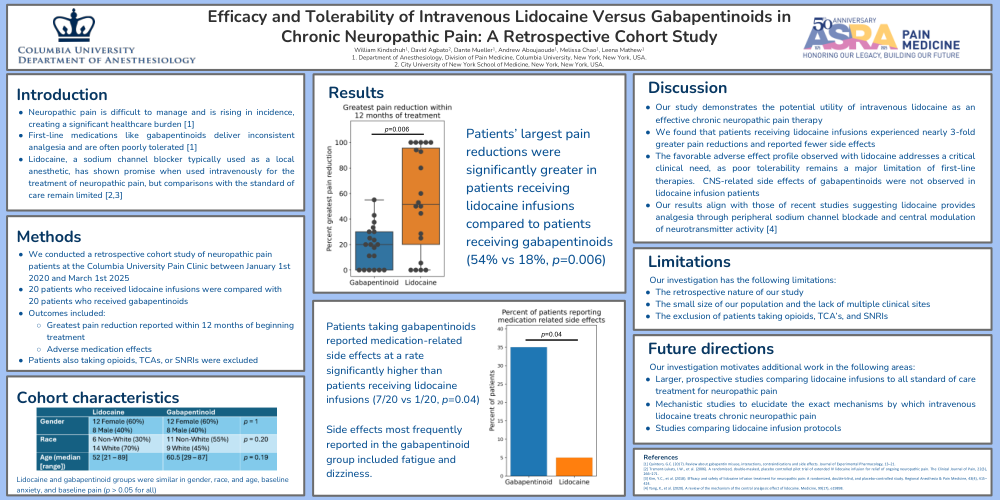
● Patients’ largest pain reductions were significantly greater in patients receiving lidocaine infusions compared to patients receiving gabapentinoids (54% vs 18%, p=0.006)
● Patients taking gabapentinoids reported medication-related side effects at a rate significantly higher than patients receiving lidocaine infusions (7/20 vs 1/20, p=0.04)
● Side effects most frequently reported in the gabapentinoid group included fatigue and dizziness
Discussion:
● Our study demonstrates the potential utility of intravenous lidocaine as an effective chronic neuropathic pain therapy
● We found that patients receiving lidocaine infusions experienced nearly 3-fold greater pain reductions and reported fewer side effects
● The favorable adverse effect profile observed with lidocaine addresses a critical clinical need, as poor tolerability remains a major limitation of first-line therapies. CNS-related side effects of gabapentinoids were not observed in lidocaine infusion patients
● Our results align with those of recent studies suggesting lidocaine provides analgesia through peripheral sodium channel blockade and central modulation of neurotransmitter activity [4]
Limitations:
Our investigation has the following limitations:
● The retrospective nature of our study
● The small size of our population and the lack of multiple clinical sites
● The exclusion of patients taking opioids, TCA’s, and SNRIs
Future directions:
Our investigation motivates additional work in the following areas:
● Larger, prospective studies comparing lidocaine infusions to all standard of care treatment for neuropathic pain
● Mechanistic studies to elucidate the exact mechanisms by which intravenous lidocaine treats chronic neuropathic pain
● Studies comparing lidocaine infusion protocols
References:
[1] Quintero, G.C. (2017). Review about gabapentin misuse, interactions, contraindications and side effects. Journal of Experimental Pharmacology, 13–21.
[2] Tremont-Lukats, I.W., et al. (2006). A randomized, double-masked, placebo controlled pilot trial of extended IV lidocaine infusion for relief of ongoing neuropathic pain. The Clinical Journal of Pain, 22(3), 266–271.
[3] Kim, Y.C., et al. (2018). Efficacy and safety of lidocaine infusion treatment for neuropathic pain: A randomized, double-blind, and placebo-controlled study. Regional Anesthesia & Pain Medicine, 43(4), 415– 424.
[4] Yang, X., et al. (2020). A review of the mechanism of the central analgesic effect of lidocaine. Medicine, 99(17), e19898.