343 posters, 5 videos, 2 audios, 18 topics, 33 sessions, 263 authors, 202 institutions
ePostersLive by SciGen Technologies S.A. All rights reserved.
24th Annual Pain Medicine Meeting 2025
November 13-15, 2025| JW Marriott Austin, Austin, Texas

2198064
Role of Opioids Administered During Anesthesia in Acute Pain and Opioid Consumption: A Meta-Analysis
Poster Presenter
Authors
Affiliations
Part of Topic
Scientific Abstracts > Acute Pain
Role of Opioids Administered During Anesthesia in Acute Pain and Opioid Consumption: A Meta-Analysis
Akbota Ayazbekova, MD, Abdurrehman Khan, Adina Yerzhan, MD, Amy Monroe, MPH, MBA, Jacques E. Chelly, MD, PhD, MBA
University of Pittsburgh, Department of Anesthesiology and Perioperative Medicine
Background: The use of opioids in surgical patients has been reported as a risk factor for increasing postoperative pain and opioid use.1 Recent studies have investigated the role of opioids during anesthesia by comparing opioid-based anesthesia (OBA) to opioid-free anesthesia (OFA) on postoperative outcomes.1, 2 This resulted in advocating OFA as a way to reduce pain and prevent postoperative complications including opioid-related side effects, such as worsened postoperative pain and increased opioid requirements.3 However, the validity of such claims has been questioned by those who favor OBA. This study aims to compare OFA and OBA in their relative effects on postoperative acute pain and opioid consumption using a meta-analysis.
Methods: PubMed, Cochrane and Embase libraries were used to search up to June 12, 2025, for studies that included opioid-free anesthesia. Studies that included randomized controlled trials (RCTs) conducted in adult humans were selected, while observational studies, studies including epidural and spinal anesthesia, and RCTs currently awaiting approval were excluded. Included RCTs conducted over a period of June 2000 and September 2024.
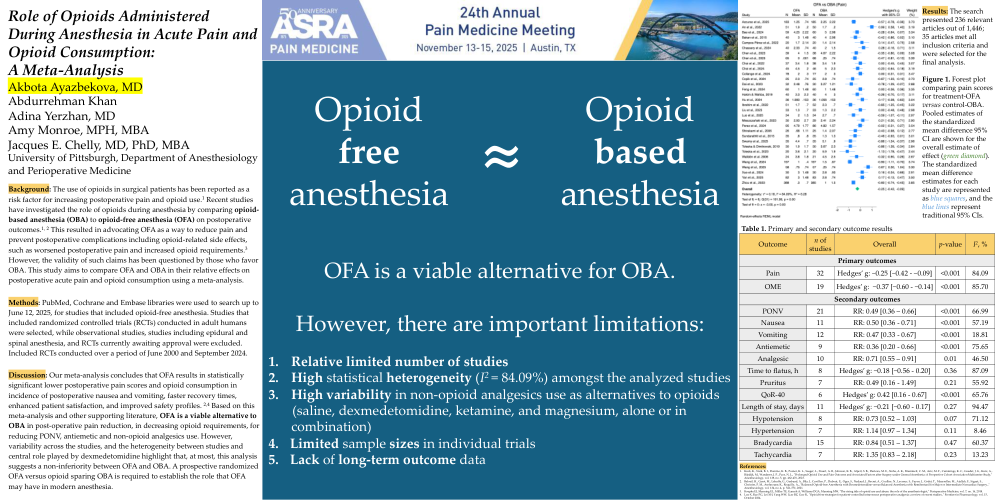
Results: The search presented 236 relevant articles out of 1,446; 35 articles met all inclusion criteria and were selected for the final analysis.
Discussion: Our meta-analysis concludes that OFA results in statistically significant lower postoperative pain scores and opioid consumption in incidence of postoperative nausea and vomiting, faster recovery times, enhanced patient satisfaction, and improved safety profiles. 2,4 Based on this meta-analysis and other supporting literature, OFA is a viable alternative to OBA in post-operative pain reduction, in decreasing opioid requirements, for reducing PONV, antiemetic and non-opioid analgesics use. However, variability across the studies, and the heterogeneity between studies and central role played by dexmedetomidine highlight that, at most, this analysis suggests a non-inferiority between OFA and OBA. A prospective randomized OFA versus opioid sparing OBA is required to establish the role that OFA may have in modern anesthesia.