343 posters, 5 videos, 2 audios, 18 topics, 33 sessions, 263 authors, 202 institutions
ePostersLive by SciGen Technologies S.A. All rights reserved.
24th Annual Pain Medicine Meeting 2025
November 13-15, 2025| JW Marriott Austin, Austin, Texas

2197846
Insights from a multi-year improvement journey in system-wide patient-provider agreement completion for chronic opioid therapy
Poster Presenter
Authors
Affiliations
Part of Topic
Scientific Abstracts > Chronic Pain
Insights from a multi-year improvement journey in system-wide patient-provider agreement completion for chronic opioid therapy
David M. Dickerson, MD1,2, Steve Reinhart, MBA 3, Nia Moragne, MPH1, Andrew R. Locke 1, Tom Hensing, MD 2,4, Lakshmi Halasyamani, MD 2,4
1Department of Anesthesiology, Critical Care & Pain Medicine, Endeavor Health, Evanston, IL; 2Pritzker School of Medicine, University of Chicago, Chicago, IL; 3 Department of Ambulatory Quality, Endeavor Health, Evanston, IL
4Department of Medicine, Endeavor Health, Evanston, IL
Introduction
Guidelines for safe opioid prescribing recommend a myriad of elements to ensure safe and appropriate use.1,2 Patient-provider agreements (PPA) detail practices for patients and clinicians, aligning mutual expectations and patient care. 3
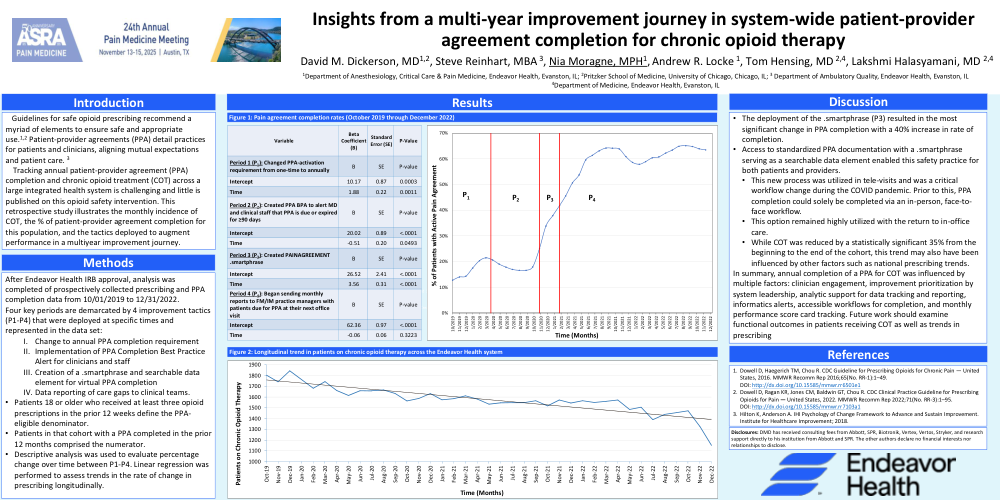
Tracking annual patient-provider agreement (PPA) completion and chronic opioid treatment (COT) across a large integrated health system is challenging and little is published on this opioid safety intervention. This retrospective study illustrates the monthly incidence of COT, the % of patient-provider agreement completion for this population, and the tactics deployed to augment performance in a multiyear improvement journey.
Methods
After Endeavor Health IRB approval, analysis was completed of prospectively collected prescribing and PPA completion data from 10/01/2019 to 12/31/2022.
Four key periods are demarcated by 4 improvement tactics (P1-P4) that were deployed at specific times and represented in the data set:
In summary, annual completion of a PPA for COT was influenced by multiple factors: clinician engagement, improvement prioritization by system leadership, analytic support for data tracking and reporting, informatics alerts, accessible workflows for completion, and monthly performance score card tracking. Future work should examine functional outcomes in patients receiving COT as well as trends in prescribing