343 posters, 5 videos, 2 audios, 18 topics, 33 sessions, 263 authors, 202 institutions
ePostersLive by SciGen Technologies S.A. All rights reserved.
24th Annual Pain Medicine Meeting 2025
November 13-15, 2025| JW Marriott Austin, Austin, Texas

2197610
Sacroiliac Joint Fusion using Single Compressive Lateral Transfixing Implant in a retrospective case series of Ten Veterans.
Poster Presenter
Authors
Affiliations
Part of Topic
Scientific Abstracts > Education
Video
Title: Sacroiliac Joint Fusion using Single Compressive Lateral Transfixing Implant in a retrospective case series of Ten Veterans.
Project Chair: Mazhar Rasul, MD Principal Investigator/Submitting Author: Mazhar Rasul, MD Co-Author(s): N/A.
Introduction: Sacroiliac joint (SIJ) dysfunction is a common source of chronic low-back pain, implicated in approximately 15% to 30% of cases. It is especially prevalent among individuals with prior lumbar fusion, spinal deformity, or biomechanical instability. Minimally invasive surgical approaches to SIJ fusion, most commonly lateral and posterior have gained popularity for patients who fail conservative therapy. However, questions remain regarding the optimal surgical technique, particularly with respect to the number and type of implants required to achieve durable stabilization. Biomechanical models suggest that a single transfixing lateral implant may achieve equivalent or superior primary stability when compared to multi-implant constructs. While promising, limited clinical evidence exists to validate this hypothesis. This retrospective series evaluates short and mid-term clinical outcomes following SIJ fusion with a single compressive lateral trans iliac implant in a cohort of veterans with refractory SIJ-mediated pain.
Material and Methods:
Patient informed consents were obtained for submission of case report. All patient Protected Health Information has been de-identified.
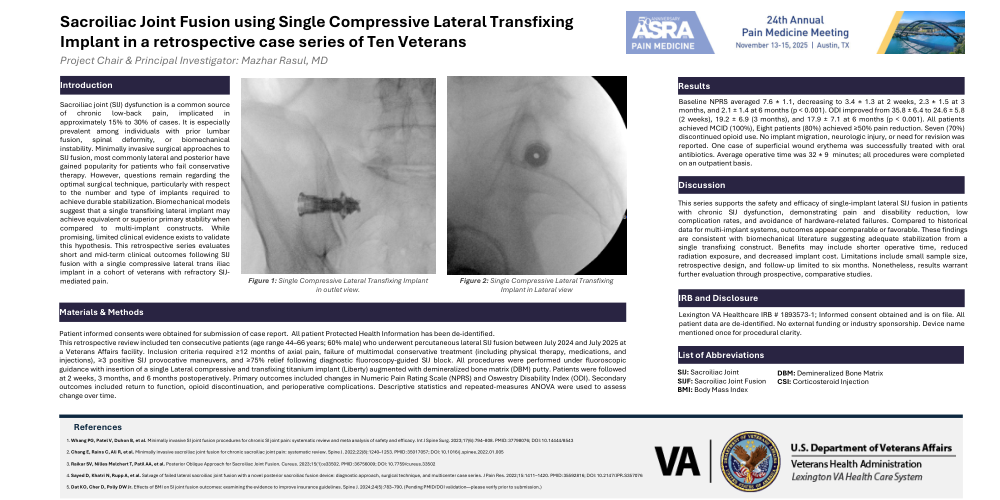
This retrospective review included ten consecutive patients (age range 44–66 years; 60% male) who underwent percutaneous lateral SIJ fusion between July 2024 and July 2025 at a Veterans Affairs facility. Inclusion criteria required ≥12 months of axial pain, failure of multimodal conservative treatment (including physical therapy, medications, and injections), ≥3 positive SIJ provocative maneuvers, and ≥75% relief following diagnostic fluoroscopy-guided SIJ block. All procedures were performed under fluoroscopic guidance with insertion of a single Lateral compressive and transfixing titanium implant (Liberty) augmented with demineralized bone matrix (DBM) putty. Patients were followed at 2 weeks, 3 months, and 6 months postoperatively. Primary outcomes included changes in Numeric Pain Rating Scale (NPRS) and Oswestry Disability Index (ODI). Secondary outcomes included return to function, opioid discontinuation, and perioperative complications. Descriptive statistics and repeated-measures ANOVA were used to assess change over time.
Results: Baseline NPRS averaged 7.6 ± 1.1, decreasing to 3.4 ± 1.3 at 2 weeks, 2.3 ± 1.5 at 3 months, and 2.1 ± 1.4 at 6 months (p < 0.001). ODI improved from 35.8 ± 6.4 to 24.6 ± 5.8 (2 weeks), 19.2 ± 6.9 (3 months), and 17.9 ± 7.1 at 6 months (p < 0.001). All patients achieved MCID (100%), Eight patients (80%) achieved ≥50% pain reduction. Seven (70%) discontinued opioid use. No implant migration, neurologic injury, or need for revision was reported. One case of superficial
wound erythema was successfully treated with oral antibiotics. Average operative time was 32 ± 9 minutes; all procedures were completed on an outpatient basis.
Discussion: This series supports the safety and efficacy of single-implant lateral SIJ fusion in patients with chronic SIJ dysfunction, demonstrating pain and disability reduction, low complication rates, and avoidance of hardware-related failures. Compared to historical data for multi-implant systems, outcomes appear comparable or favorable. These findings are consistent with biomechanical literature suggesting adequate stabilization from a single transfixing construct. Benefits may include shorter operative time, reduced radiation exposure, and decreased implant cost. Limitations include small sample size, retrospective design, and follow-up limited to six months. Nonetheless, results warrant further evaluation through prospective, comparative studies.