343 posters, 5 videos, 2 audios, 18 topics, 33 sessions, 263 authors, 202 institutions
ePostersLive by SciGen Technologies S.A. All rights reserved.
24th Annual Pain Medicine Meeting 2025
November 13-15, 2025| JW Marriott Austin, Austin, Texas

2197508
Evaluating a Low-Cost, 3D-Printed Median Nerve Block Phantom for Ultrasound-Guided Procedural Training
Poster Presenter
Authors
Affiliations
Part of Topic
Scientific Abstracts > Education
Development and Evaluation of a Low-Cost, 3D-Printed Median Nerve Block Phantom for Ultrasound Education
Authors: Mina Botros, BS; Lauren Sinsioco, BS; Edward Lopez, MD; Natalie Truong, MD; Timothy Young, MD; Amye Farag, MD
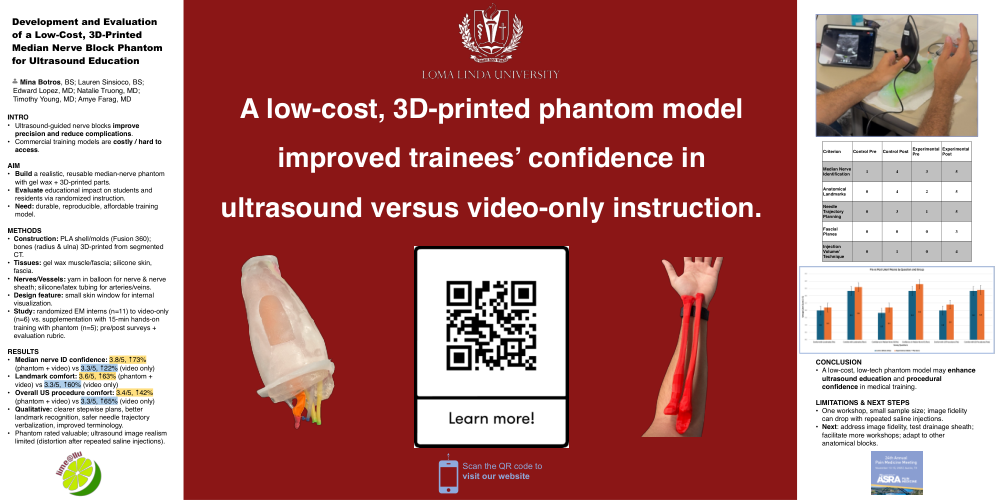
Main Finding: A low-cost, 3D-printed phantom model improved trainees’ confidence in ultrasound versus video-only instruction.
Website Link: https://sites.google.com/view/build-a-block/home
Intro:
Ultrasound-guided nerve blocks improve precision and reduce complications.
Commercial training models are costly/hard to access.
Aim:
Build a realistic, reusable median-nerve phantom with gel wax + 3D-printed parts.
Evaluate educational impact on students and residents via randomized instruction.
Need: durable, reproducible, affordable training model.
Methods:
Construction: PLA shell/molds (Fusion 360); bones (radius & ulna) 3D-printed from segmented CT.
Tissues: gel wax muscle/fascia; silicone skin, fascia.
Nerves/Vessels: yarn in balloon for nerve & nerve sheath; silicone/latex tubing for arteries/veins.
Design feature: small skin window for internal visualization.
Study: randomized EM interns (n=11) to video-only (n=6) vs. supplementation with 15-min hands-on training with phantom (n=5); pre/post surveys + evaluation rubric.
Results:
Median nerve ID confidence: 3.8/5, ↑73% (phantom + video) vs 3.3/5, ↑22% (video only)
Landmark comfort: 3.6/5, ↑63% (phantom + video) vs 3.3/5, ↑60% (video only)
Overall US procedure comfort: 3.4/5, ↑42% (phantom + video) vs 3.3/5, ↑65% (video only)
Qualitative: clearer stepwise plans, better landmark recognition, safer needle trajectory verbalization, improved terminology.
Phantom rated valuable; ultrasound image realism limited (distortion after repeated saline injections).
Conclusion:
A low-cost, low-tech phantom model may enhance ultrasound education and procedural confidence in medical training.
Limitations & Next Steps:
One workshop, small sample size; image fidelity can drop with repeated saline injections.
Next: address image fidelity, test drainage sheath; facilitate more workshops; adapt to other anatomical blocks.