343 posters, 5 videos, 2 audios, 18 topics, 33 sessions, 263 authors, 202 institutions
ePostersLive by SciGen Technologies S.A. All rights reserved.
24th Annual Pain Medicine Meeting 2025
November 13-15, 2025| JW Marriott Austin, Austin, Texas

2197170
Cancer Patient Perspectives on the Opioid Treatment Agreement: Tool for Safety or Symbol of Distrust?
Poster Presenter
Authors
Affiliations
Part of Topic
Scientific Abstracts > Chronic Pain
Background
•Opioid treatment agreement (OTAs) are standard in chronic non-cancer pain management but not routinely used in cancer pain care.
•As cancer survival improves, more patients experience persistent cancer- and non-cancer-related pain requiring long-term opioid use.
•Hypothesis: OTAs are acceptable to cancer patients with chronic pain and could be integrated into routine care for survivors on opioids.
Methods
•Design: IRB-exempt study (Protocol #20220101).
•Setting & Period: Tertiary cancer center, Jan 2023–Dec 2024.
•Participants: English-speaking adults with chronic cancer-related pain at new patient visits to outpatient pain clinic.
•Procedures:
•Structured survey assessing OTA understanding, perceived risk reduction, and purpose.
•One open-ended question on how participants would explain the OTA to others.
•Surveys completed in person or by phone within 4 weeks of initial visit.
•Analysis:
•Quantitative: Descriptive statistics (frequency, %; mean ± SD or median [IQR/range]).
•Qualitative: Thematic review of open-ended responses.
•Cognitive debriefing interviews (n = 10) informed final questionnaire refinement.
Results
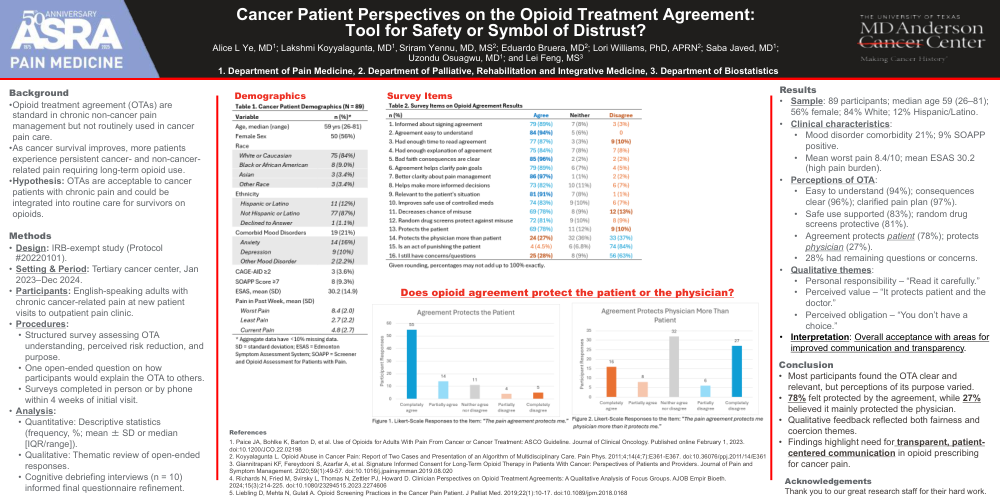
•Sample: 89 participants; median age 59 (26–81); 56% female; 84% White; 12% Hispanic/Latino.
•Clinical characteristics:
•Mood disorder comorbidity 21%; 9% SOAPP positive.
•Mean worst pain 8.4/10; mean ESAS 30.2 (high pain burden).
•Perceptions of OTA:
•Easy to understand (94%); consequences clear (96%); clarified pain plan (97%).
•Safe use supported (83%); random drug screens protective (81%).
•Agreement protects patient (78%); protects physician (27%).
•28% had remaining questions or concerns.
•Qualitative themes:
•Personal responsibility – “Read it carefully.”
•Perceived value – “It protects patient and the doctor.”
•Perceived obligation – “You don’t have a choice.”
•Interpretation: Overall acceptance with areas for improved communication and transparency.
Conclusion
•Most participants found the OTA clear and relevant, but perceptions of its purpose varied.
•78% felt protected by the agreement, while 27% believed it mainly protected the physician.
•Qualitative feedback reflected both fairness and coercion themes.
•Findings highlight need fortransparent, patient-centered communication in opioid prescribing for cancer pain.