Loading...

343 posters, 5 videos, 2 audios, 18 topics, 33 sessions, 263 authors, 202 institutions

ePostersLive by SciGen Technologies S.A. All rights reserved.

24th Annual Pain Medicine Meeting 2025

November 13-15, 2025| JW Marriott Austin, Austin, Texas

24th Annual Pain Medicine Meeting 2025 banner

2197100

Effect of Battlefield Acupuncture on Procedural Anxiety and Pain in Fluoroscopically-Guided Interventional Pain Procedures
Poster Presenter

Chiamaka Ukoha

Part of Topic

Scientific Abstracts > Chronic Pain

Effect of Battlefield Acupuncture on Procedural Anxiety and Pain in Fluoroscopically-Guided Interventional Pain Procedures

BACKGROUND

•    Many patients experience elevated anxiety and procedural discomfort during spinal injections for pain.

•    Conventional anxiolytics can be effective but are often limited by contraindications, staffing shortages, or institutional restrictions.

•    Battlefield Acupuncture (BFA) is a form of neuromodulation that targets specific auricular acupoints.

•    While prior studies support BFA’s use for acute pain relief, its impact on peri-procedural anxiety and pain remains underexplored.

•    Hypothesis: Administering BFA prior to interventional pain procedures will reduce procedural anxiety and improve pain outcomes.


METHODS

Design: Prospective pilot study of adult patients undergoing fluoroscopic pain procedures.

IRB: Approved (STUDY00005896); written informed consent obtained.

Intervention: BFA applied using ASP needles at 5 auricular points on each ear (Figure 1).

Timing: Needles placed before procedure.

Measures:

•Anxiety: Depression Anxiety Stress Scale–10 (DASS-10)
•Pain: Defense and Veterans Pain Rating Scale (DVPRS)
•Overall change: Global Rating of Change (GRoC)

Assessments:

•Baseline (pre-BFA)
•Post-BFA (immediate)
•Post-procedure
•1 month and 2 months post-procedure

Analysis:

•ANOVA for DVPRS at all time points
•Logistic regression for predictors of anxiety and pain improvement
•Significance: p < 0.05
 

RESULTS

•Twelve participants (BFA001–BFA012) were enrolled between April and September 2025.
•Procedures: transforaminal epidural steroid injections, caudal epidural injections, facet injections, and sacroiliac joint injections.
•DASS-10 scores remained largely stable (Table 1) following BFA, with minimal change observed immediately post-treatment (Δ = –0.75, p > 0.05) .
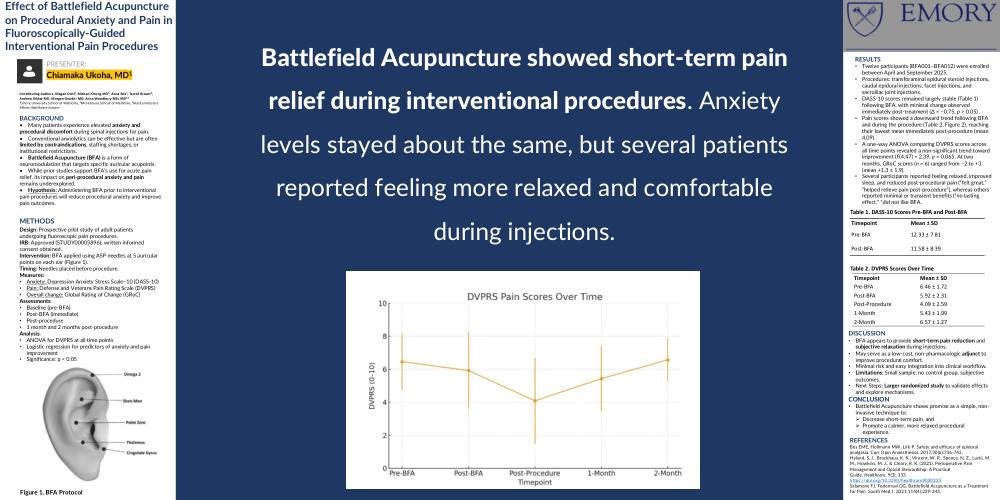
•Pain scores showed a downward trend following BFA and during the procedure (Table 2, Figure 2), reaching their lowest mean immediately post-procedure (mean 4.09).
•A one-way ANOVA comparing DVPRS scores across all time points revealed a non-significant trend toward improvement (F(4,47) = 2.39, p = 0.065. At two months, GRoC scores (n = 6) ranged from –2 to +3 (mean +1.3 ± 1.9).
•Several participants reported feeling relaxed, improved sleep, and reduced post-procedural pain (“felt great,” “helped relieve pain post-procedure”), whereas others reported minimal or transient benefits (“no lasting effect,” “did not like BFA.


DISCUSSION

•BFA appears to provide short-term pain reduction and subjective relaxation during injections.
•May serve as a low-cost, non-pharmacologic adjunct to improve procedural comfort.
•Minimal risk and easy integration into clinical workflow.
•Limitations: Small sample, no control group, subjective outcomes.
•Next Steps: Larger randomized study to validate effects and explore mechanisms.

CONCLUSION

•Battlefield Acupuncture shows promise as a simple, non-invasive technique to:
ØDecrease short-term pain, and
ØPromote a calmer, more relaxed procedural experience.
24th Annual Pain Medicine Meeting 2025 banner
Copyright © 2015-2026, ePostersLive® SciGen is a registered trademark of SciGen Technologies S.A. Patent pending.

This website and third-party tools we use rely on cookies for the best user experience. By selecting "I agree", you agree to cookie usage as described in our Privacy Policy.