343 posters, 5 videos, 2 audios, 18 topics, 33 sessions, 263 authors, 202 institutions
ePostersLive by SciGen Technologies S.A. All rights reserved.
24th Annual Pain Medicine Meeting 2025
November 13-15, 2025| JW Marriott Austin, Austin, Texas

2196372
Regional Anesthesia for Postoperative Pain in Adults with Congenital Heart Disease Undergoing Cardiac Surgery: A Case Series
Poster Presenter
Authors
Affiliations
Part of Topic
Scientific Abstracts > Case Series
Title: Regional Anesthesia for Postoperative Pain in Adults with Congenital Heart Disease Undergoing Cardiac Surgery: A Case Series (130 characters max)
Introduction:
Adults with congenital heart disease (ACHD) undergoing cardiac surgery are increasingly common and present unique anesthetic challenges due to complex cardiac physiology and high perioperative risk. While regional anesthesia reduces time to extubation and hospital length of stay (LOS) in pediatric congenital heart surgery (1), similar literature in ACHD is limited. This case series details individualized regional anesthesia as part of multimodal analgesia to optimize outcomes in this unique population.
Methods
This information has been reviewed by the Chair of the Providence Health Care Research Ethics Board and has been determined to be exempt from the requirements for researcher ethics approval both in accordance with UBC Human Research Policy LR9 and in accordance with the provisions of the Tri-Council Policy Statement: Ethical Conduct for Research involving Humans, Article 2.5:
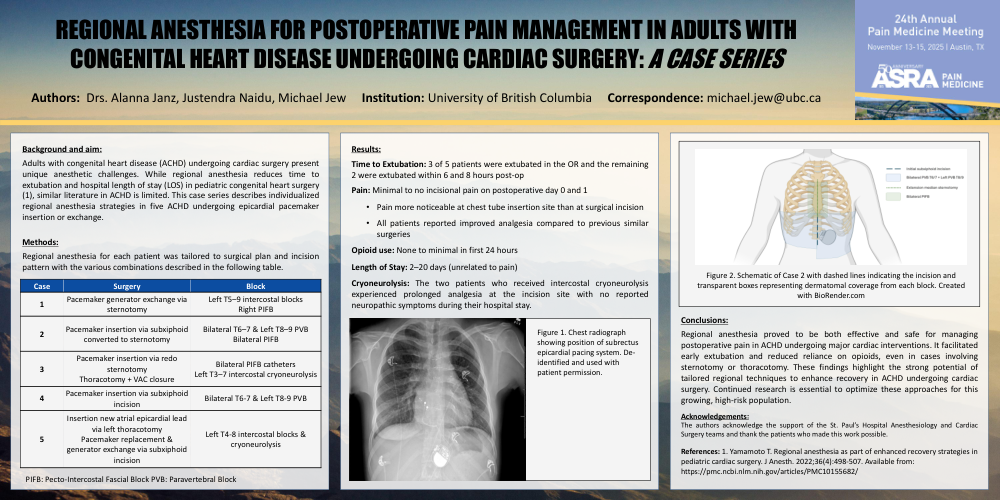
Five ACHD patients underwent epicardial pacemaker procedures, either new insertion or generator exchange, via sternotomy, subxiphoid, or thoracotomy approaches. Regional anesthesia techniques were customized to the surgical incision: intercostal nerve blocks, paravertebral blocks (PVB), parasternal intercostal fascial blocks (PIFB), and intercostal cryoneurolysis were employed in various combinations. Continuous catheters were used in one case. Cryoneurolysis was applied in two cases to prolong analgesia. Regional analgesic techniques were tailored individually based on initial surgical plan and adapted post-op for any extension or change to surgical incision.
Results
All five patients were extubated within 0–8 hours postoperatively. Pain at the surgical incision site was minimal during the first 24 hours. Patients uniformly reported superior analgesia compared to previous similar surgeries. Opioid use in the first 24 hours was minimal to none. The most prominent pain was associated with chest tube insertion sites rather than the incisions themselves.
Length of stay ranged from 2 to 20 days, but none of the extended stays were due to pain issues. No complications related to the regional techniques were noted. Notably, the two patients who received intercostal cryoneurolysis experienced prolonged analgesia at the incision site with no reported neuropathic symptoms during their hospital stay.
Overall, regional anesthesia techniques, including both traditional nerve blocks and cryoneurolysis, appeared to significantly improve perioperative pain management in this high-risk population, despite the complexity and invasiveness of the surgical approaches.
Discussion
Regional anesthesia provided safe, effective, and opioid-sparing postoperative analgesia in ACHD patients undergoing complex epicardial pacemaker procedures. Despite major incisions, early extubation and minimal incisional pain were consistently observed. Cryoneurolysis showed promise for extended analgesia. These findings support a multimodal regional approach in ACHD surgical care, though further prospective research is warranted to assess long-term outcomes and optimize protocols in this growing and surgically complex population.
References:
Yamamoto T. Regional anesthesia as part of enhanced recovery strategies in pediatric cardiac surgery. J Anesth. 2022;36(4):498-507. Available from:https://pmc.ncbi.nlm.nih.gov/articles/PMC10155682/