343 posters, 5 videos, 2 audios, 18 topics, 33 sessions, 263 authors, 202 institutions
ePostersLive by SciGen Technologies S.A. All rights reserved.
24th Annual Pain Medicine Meeting 2025
November 13-15, 2025| JW Marriott Austin, Austin, Texas

2196002
Mind the Cleft: Closing the Gap, One Step at a Time
Poster Presenter
Authors
Affiliations
Part of Topic
Scientific Abstracts > Chronic Pain
INTRO
A 23-year-old female with schizencephaly, cerebral palsy, and right hemiplegic gait with clonus presented for spasticity management. Despite ongoing therapy, she had persistent right upper limb spasticity. She was scheduled for botulinum toxin (Botox) injections, previously effective, and received treatment in the pronator teres, brachioradialis, and biceps brachii. Her goals included improving fine motor skills and learning to drive. She reported functional improvement post-injection, including greater range of motion and better control in daily activities.
METHODS
As the case report is devoid of patient identifiable information, it is exempt from IRB review requirements as per Nassau University Medical Center policy.
RESULTS
Patient was 1 on Modified Ashworth Scale with elbow flexion and extension, 1+ in wrist extension, 1 in PIP flexion and extension, 2 in wrist supination. The right upper extremity had full passive ROM, strength 4/5 in wrist extension, 4/5 throughout remainder, 3/5 finger abduction. The right lower extremity had no muscle atrophy, hip flexion 5/5, knee extension 5/5, dorsiflexion: 4/5, plantarflexion: 4/5. Ankle clonus was present on the right.
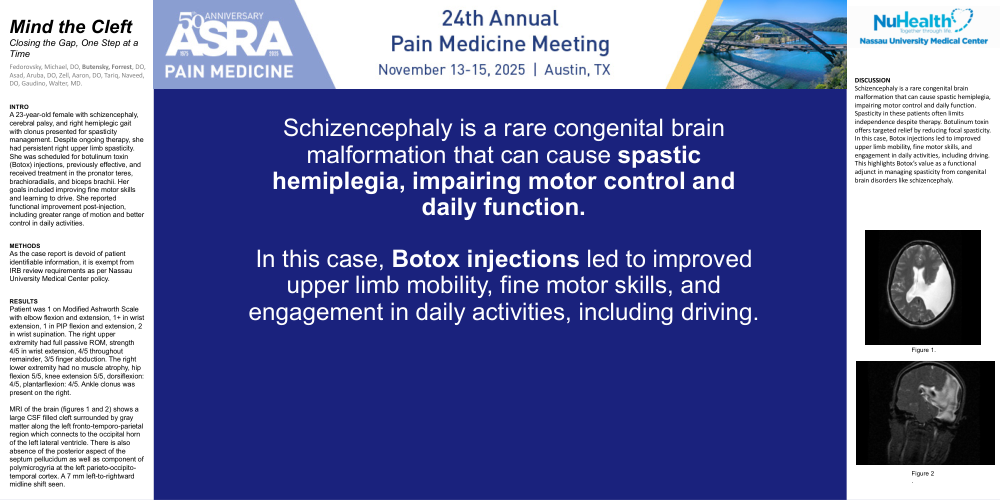
MRI of the brain (figures 1 and 2) shows a large CSF filled cleft surrounded by gray matter along the left fronto-temporo-parietal region which connects to the occipital horn of the left lateral ventricle. There is also absence of the posterior aspect of the septum pellucidum as well as component of polymicrogyria at the left parieto-occipito-temporal cortex. A 7 mm left-to-rightward midline shift seen.
DISCUSSION
Schizencephaly is a rare congenital brain malformation that can cause spastic hemiplegia, impairing motor control and daily function. Spasticity in these patients often limits independence despite therapy. Botulinum toxin offers targeted relief by reducing focal spasticity. In this case, Botox injections led to improved upper limb mobility, fine motor skills, and engagement in daily activities, including driving. This highlights Botox’s value as a functional adjunct in managing spasticity from congenital brain disorders like schizencephaly.