343 posters, 5 videos, 2 audios, 18 topics, 33 sessions, 263 authors, 202 institutions
ePostersLive by SciGen Technologies S.A. All rights reserved.
24th Annual Pain Medicine Meeting 2025
November 13-15, 2025| JW Marriott Austin, Austin, Texas

2195728
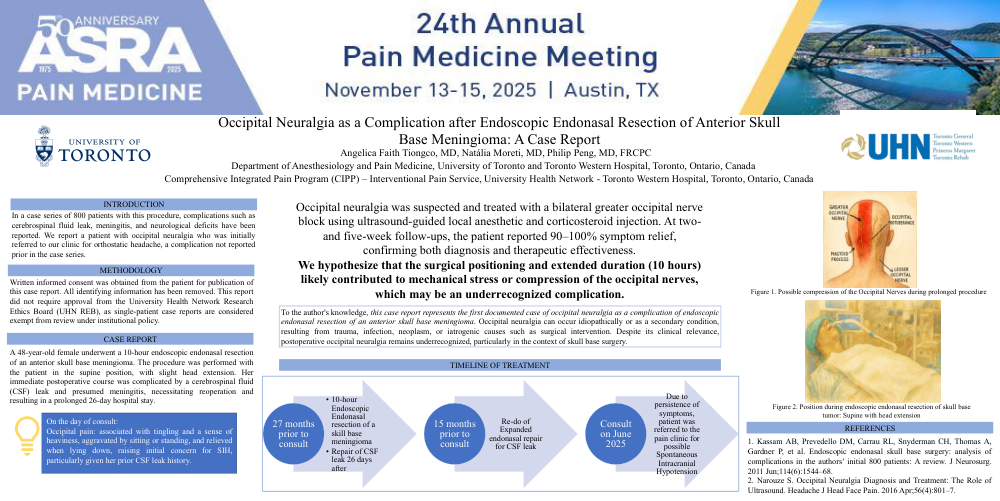
Occipital Neuralgia as a Complication after Endoscopic Endonasal Resection of Anterior Skull Base Meningioma: A Case Report
Poster Presenter
Authors
Affiliations
Part of Topic
Scientific Abstracts > Chronic Pain
Occipital Neuralgia as a Complication after Endoscopic Endonasal Resection of Anterior Skull Base Meningioma: A Case Report
Introduction
Endoscopic endonasal approach to the anterior skull base is an appealing method for skull-based surgery because of the low degree of invasiveness compared with conventional craniotomy. In a case series of 800 (1) patients with this procedure, complications such as cerebrospinal fluid leak, meningitis, and neurological deficits have been reported. We reported a patient with occipital neuralgia who was initially referred to our clinic for orthostatic headache.
Materials and Methods
Written informed consent was obtained from the patient for publication of this case report. All identifying information has been removed. This report did not require approval from the University Health Network Research Ethics Board (UHN REB), as single-patient case reports are considered exempt from review under institutional policy.
Results/Case Report
A 48-year-old female underwent a 10-hour endoscopic endonasal resection of an anterior skull base meningioma. The procedure was performed with the patient in the supine position, with slight head extension and rotation. Her immediate postoperative course was complicated by a cerebrospinal fluid (CSF) leak and presumed meningitis, necessitating reoperation and resulting in a prolonged 26-day hospital stay. Initially, her preoperative left-eye visual blurring improved, but later recurred and progressively worsened. Approximately 15 months after surgery, she presented to the pain clinic with persistent headache symptoms characterized by variable location—predominantly occipital, but occasionally frontal. The occipital pain was associated with tingling and a sense of heaviness, aggravated by sitting or standing, and relieved when lying down, raising initial concern for spontaneous intracranial hypotension (SIH), particularly given her prior CSF leak history.
Discussion
Given the clinical findings, occipital neuralgia was suspected and treated with a bilateral greater occipital nerve block using ultrasound-guided local anesthetic and corticosteroid injection. At two- and five-week follow-ups, the patient reported 90–100% symptom relief, confirming both diagnosis and therapeutic effectiveness. To the author’s knowledge, this is the first reported case of occipital neuralgia following endoscopic endonasal resection of an anterior skull base meningioma, likely due to prolonged surgery (10 hours) and positioning.
References
1. Kassam AB, Prevedello DM, Carrau RL, Snyderman CH, Thomas A, Gardner P, et al. Endoscopic endonasal skull base surgery: analysis of complications in the authors’ initial 800 patients: A review. J Neurosurg. 2011 Jun;114(6):1544–68.
2. Narouze S. Occipital Neuralgia Diagnosis and Treatment: The Role of Ultrasound. Headache J Head Face Pain. 2016 Apr;56(4):801–7.
2. Narouze S. Occipital Neuralgia Diagnosis and Treatment: The Role of Ultrasound. Headache J Head Face Pain. 2016 Apr;56(4):801–7.