343 posters, 5 videos, 2 audios, 18 topics, 33 sessions, 263 authors, 202 institutions
ePostersLive by SciGen Technologies S.A. All rights reserved.
24th Annual Pain Medicine Meeting 2025
November 13-15, 2025| JW Marriott Austin, Austin, Texas

2195638
Suspected Early CRPS After Ulnar Nerve Revision Surgery: 60-Day Peripheral Nerve Stimulation for Pain and Functional Recovery
Poster Presenter
Authors
Affiliations
Part of Topic
Scientific Abstracts > Chronic Pain
Suspected Early CRPS After Ulnar Nerve Revision Surgery: 60-Day Peripheral Nerve Stimulation for Pain and Functional Recovery
Background
Complex Regional Pain Syndrome (CRPS) is a disabling pain condition that often follows trauma. CRPS type II (CRPS-2) is defined by the presence of continuing regional pain with confirmed peripheral nerve injury, and it can progress rapidly from acute inflammatory features to chronic sensorimotor and trophic changes with substantial functional loss. Early recognition and targeted interventions are therefore critical to reduce long-term disability and improve outcomes.
Case
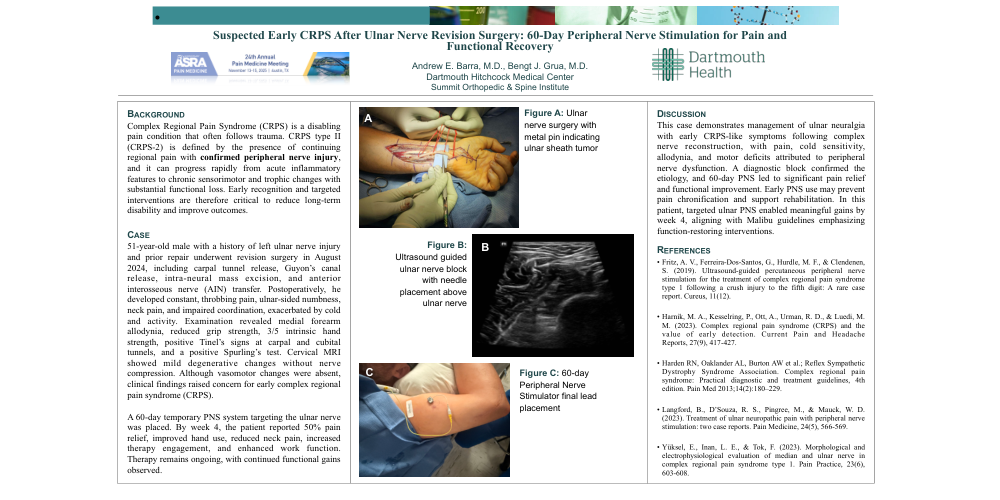
51-year-old male with a history of left ulnar nerve injury and prior repair underwent revision surgery in August 2024, including carpal tunnel release, Guyon’s canal release, intra-neural mass excision, and anterior interosseous nerve (AIN) transfer. Postoperatively, he developed constant, throbbing pain, ulnar-sided numbness, neck pain, and impaired coordination, exacerbated by cold and activity. Examination revealed medial forearm allodynia, reduced grip strength, 3/5 intrinsic hand strength, positive Tinel’s signs at carpal and cubital tunnels, and a positive Spurling’s test. Cervical MRI showed mild degenerative changes without nerve compression. Although vasomotor changes were absent, clinical findings raised concern for early complex regional pain syndrome (CRPS).
A 60-day temporary PNS system targeting the ulnar nerve was placed. By week 4, the patient reported 50% pain relief, improved hand use, reduced neck pain, increased therapy engagement, and enhanced work function. Therapy remains ongoing, with continued functional gains observed.
Discussion
This case demonstrates management of ulnar neuralgia with early CRPS-like symptoms following complex nerve reconstruction, with pain, cold sensitivity, allodynia, and motor deficits attributed to peripheral nerve dysfunction. A diagnostic block confirmed the etiology, and 60-day PNS led to significant pain relief and functional improvement. Early PNS use may prevent pain chronification and support rehabilitation. In this patient, targeted ulnar PNS enabled meaningful gains by week 4, aligning with Malibu guidelines emphasizing function-restoring interventions.
References
Fritz, A. V., Ferreira-Dos-Santos, G., Hurdle, M. F., & Clendenen, S. (2019). Ultrasound-guided percutaneous peripheral nerve stimulation for the treatment of complex regional pain syndrome type 1 following a crush injury to the fifth digit: A rare case report. Cureus, 11(12).
Harnik, M. A., Kesselring, P., Ott, A., Urman, R. D., & Luedi, M. M. (2023). Complex regional pain syndrome (CRPS) and the value of early detection. Current Pain and Headache Reports, 27(9), 417-427.
Harden RN, Oaklander AL, Burton AW et al.; Reflex Sympathetic Dystrophy Syndrome Association. Complex regional pain syndrome: Practical diagnostic and treatment guidelines, 4th edition. Pain Med 2013;14(2):180–229.
Langford, B., D’Souza, R. S., Pingree, M., & Mauck, W. D. (2023). Treatment of ulnar neuropathic pain with peripheral nerve stimulation: two case reports. Pain Medicine, 24(5), 566-569.
Yüksel, E., Inan, L. E., & Tok, F. (2023). Morphological and electrophysiological evaluation of median and ulnar nerve in complex regional pain syndrome type 1. Pain Practice, 23(6), 603-608.