343 posters, 5 videos, 2 audios, 18 topics, 33 sessions, 263 authors, 202 institutions
ePostersLive by SciGen Technologies S.A. All rights reserved.
24th Annual Pain Medicine Meeting 2025
November 13-15, 2025| JW Marriott Austin, Austin, Texas

2195052
Quantitative Sensory Testing (QST) in Predicting Outcomes for Spinal Cord Stimulation (SCS) for Neuropathic Pain
Poster Presenter
Authors
Affiliations
Part of Topic
Scientific Abstracts > Chronic Pain
Quantitative Sensory Testing (QST) in Predicting Outcomes for Spinal Cord Stimulation (SCS) for Neuropathic PainIntroduction
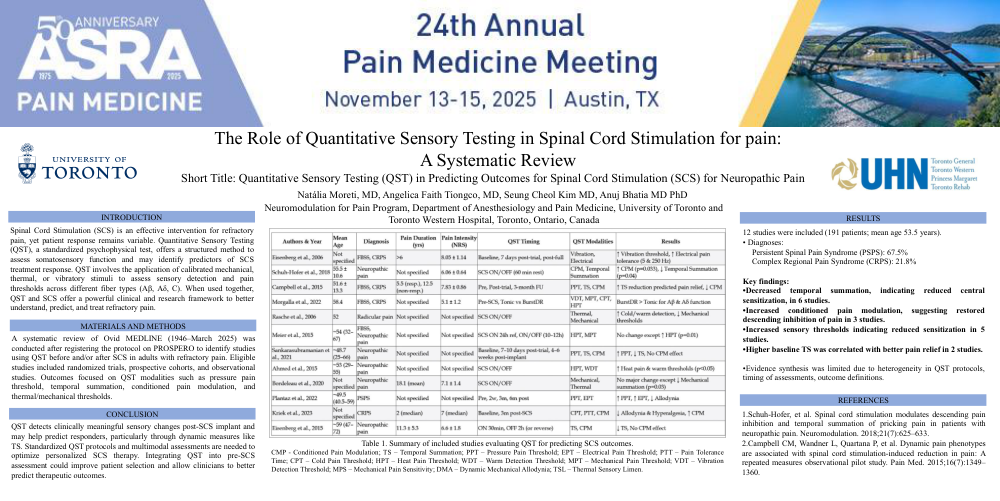
SCS is an effective intervention for refractory pain, yet patient response remains variable. QST, a standardized psychophysical test, offers a structured method to assess somatosensory function and may identify predictors of SCS treatment response. QST involves the application of calibrated mechanical, thermal, or vibratory stimuli to assess sensory detection and pain thresholds across different fiber types (Aβ, Aδ, C). QST and SCS offer a powerful clinical and research framework to better treat refractory pain.
Materials and Methods
A systematic review of Ovid MEDLINE (1946–March 2025) was conducted after registering the protocol on PROSPERO to identify studies using QST before and/or after SCS in adults with refractory pain. Eligible studies included randomized trials, prospective cohorts, and observational studies. Outcomes focused on QST modalities such as pressure pain threshold (PPT), temporal summation (TS), conditioned pain modulation (CPM), and thermal/mechanical thresholds. As this study involved the analysis of previously published data and did not involve human subjects directly, it was exempt from institutional review board (IRB) of the University Health Network REB approval.
Results/Case Report
Twelve studies (n=191; mean age 53.5 years) were included (Figure). Diagnoses included Persistent Spinal Pain Syndrome (PSPS) (67.5%) and Complex Regional Pain Syndrome (CRPS) (21.8%). The key findings included decreased TS indicating reduced central sensitization in 6 studies, increased CPM suggesting restored descending inhibition of pain in 3 studies, increased sensory thresholds indicating reduced sensitization in 5 studies. Higher baseline TS correlated with better pain relief in 2 studies (Table 1). Heterogeneity in QST protocols, timing, and outcome definitions limited evidence synthesis.
Discussion
QST detects clinically meaningful sensory changes post-SCS implant and may help predict responders, particularly through dynamic measures like TS. Standardized QST protocols and multimodal assessments are needed to optimize personalized SCS therapy. Integrating QST into pre-SCS assessment could improve patient selection and allow clinicians to better predict therapeutic outcomes.
References
1.Schuh-Hofer, et al. Spinal cord stimulation modulates descending pain inhibition and temporal summation of pricking pain in patients with neuropathic pain. Neuromodulation. 2018;21(7):625–633.
2.Campbell CM, Wandner L, Quartana P, et al. Dynamic pain phenotypes are associated with spinal cord stimulation-induced reduction in pain: A repeated measures observational pilot study. Pain Med. 2015;16(7):1349–1360.