343 posters, 5 videos, 2 audios, 18 topics, 33 sessions, 263 authors, 202 institutions
ePostersLive by SciGen Technologies S.A. All rights reserved.
24th Annual Pain Medicine Meeting 2025
November 13-15, 2025| JW Marriott Austin, Austin, Texas

2194462
A retrospective cohort analysis of mobility impairments and disability in complex regional pain syndrome type 1
Poster Presenter
Authors
Affiliations
Part of Topic
Scientific Abstracts > Chronic Pain
Abstract
Introduction
Complex regional pain syndrome type 1 (CRPS-1) is a rare, chronic condition following injury without an identifiable nerve lesion. Pain and physical impairment can persist years after diagnosis.1 CRPS-1 is not in the Social Security Administration Blue Book of impairments qualifying for disability but was added as a Medically Determinable Impairment (MDI) in 2024.2 We examined diagnoses of mobility impairment and transition to presumptive Social Security Disability Insurance (SSDI) among patients after first CRPS-1 diagnosis.
Methods
We conducted a retrospective cohort analysis using Komodo Health's primarily claims-derived Healthcare Map®, a longitudinal and nationally representative health service utilization database with >330 million de-identified, insured US-patients. We identified incident CRPS-1 patients (ICD10 G90.5x) diagnosed 01/01/17-12/31/24, excluding those with open claims and CRPS-2/causalgia diagnosis (ICD10 G56.4x or G57.7x). Two reviewers adjudicated ICD10 codes in the 18 months after CRPS-1 diagnosis for those indicating impaired function/mobility/disability (Table 1). We calculated prevalence of individual impairment codes, and cumulative incidence of patients with any impaired mobility/function/disability using a competing risk model controlling for insurance disenrollment/end of study. We calculated 12-month cumulative incidence of presumptive SSDI (competing risk model), defined as patients <65 years old transitioning to Medicare (excluding those with ESRD and ALS, who automatically qualify), compared to US population statistics.3 This analysis is devoid of identifiable patient information and is exempt from IRB review requirements as per Ambros Therapeutics policy.
Results
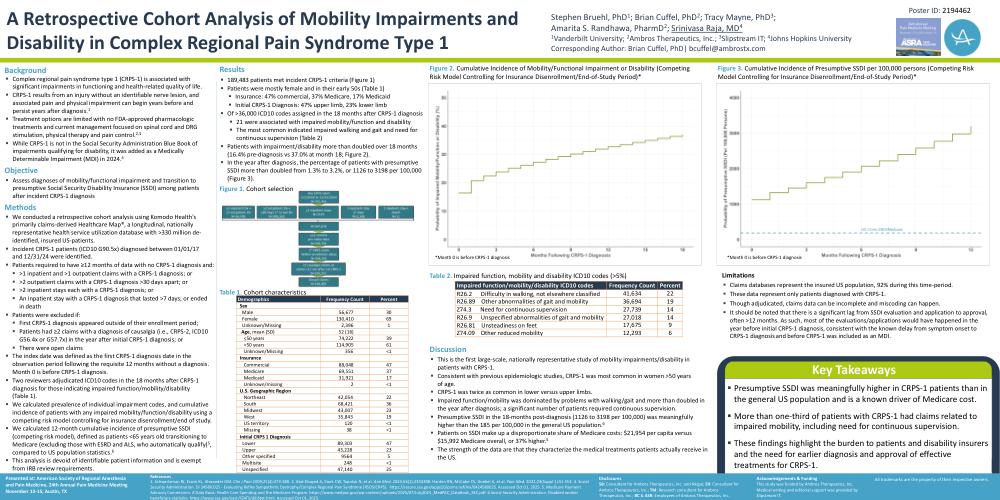
189,483 patients met incident CRPS-1 criteria (female, 69%; mean age, 52±16 yrs; insurance: 47% commercial, 37% Medicare, 17% Medicaid). Of >36,000 ICD10 codes assigned in the 18 months after CRPS-1 diagnosis, 21 were associated with impaired mobility/function and disability; the most common indicating impaired walking and gait and need for continuous supervision (Table 1). The percentage of patients diagnosed with impairment/disability more than doubled (16.4% pre-diagnosis vs 37.0% at month 18; Figure 1). In the year after diagnosis, the percentage of patients with presumptive SSDI more than doubled from 1.3% to 3.2%, or 1126 to 3198 per 100,000 (Figure 2), which is meaningfully higher than the 185 per 100,000 US population norm.4 It should be noted that there is a significant lag from SSDI evaluation and application to approval, often >12 months. As such, most of the evaluations/applications would have happened in the year before initial CRPS-1 diagnosis, consistent with the known delay from symptom onset to CRPS-1 diagnosis4and before CRPS-1 was included as an MDI.
Discussion
This is the first large-scale, nationally representative study of mobility impairments/disability in CRPS-1. Within 18 months post-diagnosis, >1/3 patients had claims related to impaired mobility, including wheelchair requirement, bed confinement, and/or need for continuous supervision. Presumptive SSDI in the year post-diagnosis was elevated versus US population norms. These findings highlight the burden to patients and Medicare and the need for earlier diagnosis and approval of effective treatments for CRPS-1.
References
- Johnson S, Cowell F, Gillespie S, Goebel A. Complex regional pain syndrome—what is the outcome? A systematic review of the course and impact of CRPS at 12 months from symptom onset and beyond. Eur J Pain. 2022;26(6):1203-1220.
- Social Security Administration. DI 24580.025 - Evaluating Reflex Sympathetic Dystrophy/Complex Regional Pain Syndrome (RSDS/CRPS). https://secure.ssa.gov/apps10/poms.nsf/lnx/0424580025#b. Accessed July 31, 2025.
- Social Security Administration. Disabled worker beneficiary statistics. https://www.ssa.gov/oact/STATS/dibStat.html. Accessed July 31, 2025.
- Allen G, Galer BS, Schwartz L. Epidemiology of complex regional pain syndrome: a retrospective chart review of 134 patients. Pain. 1999;80(3):539-544.
Poster
Background
- Complex regional pain syndrome type 1 (CRPS-1) is associated with significant impairments in functioning and health-related quality of life.
- CRPS-1 results from an injury without an identifiable nerve lesion, and associated pain and physical impairment can begin years before and persist years after diagnosis.1
- Treatment options are limited with no FDA-approved pharmacologic treatments and current management focused on spinal cord and DRG stimulation, physical therapy and pain control.2,3
- While CRPS-1 is not in the Social Security Administration Blue Book of impairments qualifying for disability, it was added as a Medically Determinable Impairment (MDI) in 2024.4
Objective
- Assess diagnoses of mobility/functional impairment and transition to presumptive Social Security Disability Insurance (SSDI) among patients after incident CRPS-1 diagnosis
Methods
- We conducted a retrospective cohort analysis using Komodo Health's primarily claims-derived Healthcare Map®, a longitudinal, nationally representative health service utilization database with >330 million de-identified, insured US-patients.
- Incident CRPS-1 patients (ICD10 G90.5x) diagnosed between 01/01/17
and 12/31/24 were identified. - Patients required to have ≥12 months of data with no CRPS-1 diagnosis and:
- >1 inpatient and >1 outpatient claims with a CRPS-1 diagnosis; or
- >2 outpatient claims with a CRPS-1 diagnosis >30 days apart; or
- >2 inpatient stays each with a CRPS-1 diagnosis; or
- An inpatient stay with a CRPS-1 diagnosis that lasted >7 days; or ended
in death
- Patients were excluded if:
- First CRPS-1 diagnosis appeared outside of their enrollment period;
- Patients had ≥2 claims with a diagnosis of causalgia (i.e., CRPS-2, ICD10 G56.4x or G57.7x) in the year after initial CRPS-1 diagnosis; or
- There were open claims
- The index date was defined as the first CRPS-1 diagnosis date in the observation period following the requisite 12 months without a diagnosis. Month 0 is before CRPS-1 diagnosis.
- Two reviewers adjudicated ICD10 codes in the 18 months after CRPS-1 diagnosis for those indicating impaired function/mobility/disability
(Table 1). - We calculated prevalence of individual impairment codes, and cumulative incidence of patients with any impaired mobility/function/disability using a competing risk model controlling for insurance disenrollment/end of study.
- We calculated 12-month cumulative incidence of presumptive SSDI (competing risk model), defined as patients <65 years old transitioning to Medicare (excluding those with ESRD and ALS, who automatically qualify)5, compared to US population statistics.6
- This analysis is devoid of identifiable patient information and is exempt
from IRB review requirements.
Results
- 189,483 patients met incident CRPS-1 criteria (Figure 1)
- Patients were mostly female and in their early 50s (Table 1)
- Insurance: 47% commercial, 37% Medicare, 17% Medicaid
- Initial CRPS-1 Diagnosis: 47% upper limb, 23% lower limb
- Of >36,000 ICD10 codes assigned in the 18 months after CRPS-1 diagnosis
- 21 were associated with impaired mobility/function and disability
- The most common indicated impaired walking and gait and need for continuous supervision (Table 2)
- Patients with impairment/disability more than doubled over 18 months (16.4% pre-diagnosis vs 37.0% at month 18; Figure 2).
- In the year after diagnosis, the percentage of patients with presumptive SSDI more than doubled from 1.3% to 3.2%, or 1126 to 3198 per 100,000 (Figure 3).
Discussion
- This is the first large-scale, nationally representative study of mobility impairments/disability in patients with CRPS-1.
- Consistent with previous epidemiologic studies, CRPS-1 was most common in women >50 years
of age. - CRPS-1 was twice as common in lower versus upper limbs.
- Impaired function/mobility was dominated by problems with walking/gait and more than doubled in the year after diagnosis; a significant number of patients required continuous supervision.
- Presumptive SSDI in the 18-months post-diagnosis (1126 to 3198 per 100,000) was meaningfully higher than the 185 per 100,000 in the general US population.6
- Patients on SSDI make up a disproportionate share of Medicare costs: $21,954 per capita versus $15,992 Medicare overall, or 37% higher.5
- The strength of the data are that they characterize the medical treatments patients actually receive in the US.
Limitations
- Claims databases represent the insured US population, 92% during this time-period.
- Thesedata represent only patients diagnosed with CRPS-1.
- Though adjudicated, claims data can be incomplete and miscoding can happen.
- It should be noted that there is a significant lag from SSDI evaluation and application to approval, often >12 months. As such, most of the evaluations/applications would have happened in the year before initial CRPS-1 diagnosis, consistent with the known delay from symptom onset to CRPS-1 diagnosisand before CRPS-1 was included as an MDI
Key Takeaways
- Presumptive SSDI was meaningfully higher in CRPS-1 patients than in the general US population and is a known driver of Medicare cost.
- More than one-third of patients with CRPS-1 had claims related to impaired mobility, including need for continuous supervision.
- These findings highlight the burden to patients and disability insurers and the need for earlier diagnosis and approval of effective treatments for CRPS-1.
References
1. Schwartzman RJ, Erwin KL, Alexander GM. Clin J Pain 2009;25(4):273-280. 2. Abd-Elsayed A, Stark CW, Topoluk N, et al. Ann Med. 2024;56(1):2334398. Harden RN, McCabe CS, Goebel A, et al. Pain Med. 2022;23(Suppl 1):S1-S53. 4. Social Security Administration. DI 24580.025 - Evaluating Reflex Sympathetic Dystrophy/Complex Regional Pain Syndrome (RSDS/CRPS). https://secure.ssa.gov/apps10/poms.nsf/lnx/0424580025. Accessed Oct 01, 2025. 5. Medicare Payment Advisory Commission. A Data Book: Health Care Spending and the Medicare Program. https://www.medpac.gov/wp-content/uploads/2025/07/July2025_MedPAC_DataBook_SEC.pdf. 6.Social Security Administration. Disabled worker beneficiary statistics. https://www.ssa.gov/oact/STATS/dibStat.html. Accessed Oct 01, 2025.