343 posters, 5 videos, 2 audios, 18 topics, 33 sessions, 263 authors, 202 institutions
ePostersLive by SciGen Technologies S.A. All rights reserved.
24th Annual Pain Medicine Meeting 2025
November 13-15, 2025| JW Marriott Austin, Austin, Texas

2194205
Unveiling the Pain: Predictors of Painful Diabetic Peripheral Neuropathy in a British Population Cohort
Poster Presenter
Authors
Affiliations
Part of Topic
Scientific Abstracts > Chronic Pain
Background
-Diabetes mellitus is a significant global health concern, currently affecting approximately 382 million people, with projections rising to 592 million by 2035, and 50% patients will develop diabetic peripheral neuropathy (DPN) throughout their lives.
-Approximately one-third of DPN patients experience pain, while others may remain asymptomatic despite having substantial neurological deficits.
-Research has focused on identifying factors that differentiate between painful and painless DPN but has not thoroughly examined patient factors such as other pain conditions comorbidities, health behaviors, and social determinants of health (SDOH).
Objective
To identify patient factors associated with pain in individuals with diabetic peripheral neuropathy.
Methods
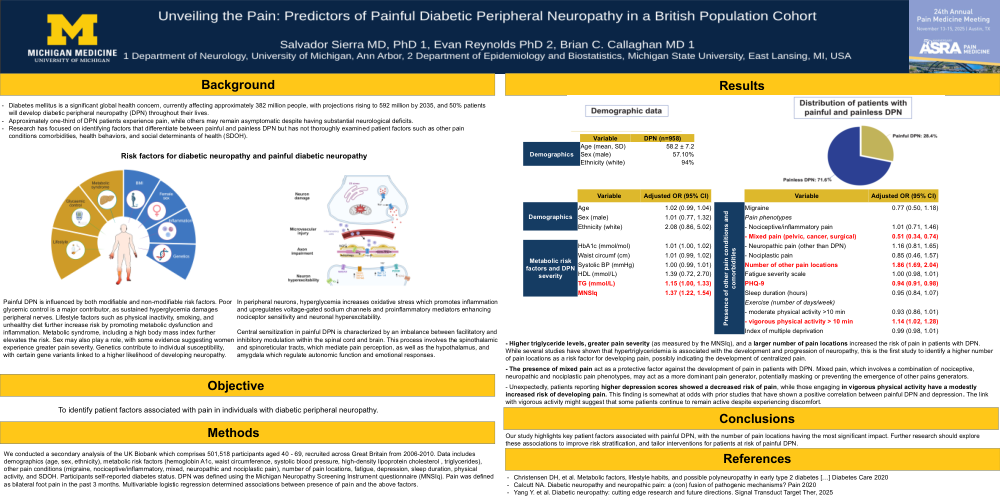
We conducted a secondary analysis of the UK Biobank which comprises 501,518 participants aged 40 - 69, recruited across Great Britain from 2006-2010. Data includes demographics (age, sex, ethnicity), metabolic risk factors (hemoglobin A1c, waist circumference, systolic blood pressure, high-density lipoprotein cholesterol , triglycerides), other pain conditions (migraine, nociceptive/inflammatory, mixed, neuropathic and nociplastic pain), number of pain locations, fatigue, depression, sleep duration, physical activity, and SDOH. Participants self-reported diabetes status. DPN was defined using the Michigan Neuropathy Screening Instrument questionnaire (MNSIq). Pain was defined as bilateral foot pain in the past 3 months. Multivariable logistic regression determined associations between presence of pain and the above factors.
Results
- Higher triglyceride levels, greater pain severity (as measured by the MNSIq), and a larger number of pain locations increased the risk of pain in patients with DPN. While several studies have shown that hypertriglyceridemia is associated with the development and progression of neuropathy, this is the first study to identify a higher number of pain locations as a risk factor for developing pain, possibly indicating the development of centralized pain.
-The presence of mixed pain act as a protective factor against the development of pain in patients with DPN. Mixed pain, which involves a combination of nociceptive, neuropathic and nociplastic pain phenotypes, may act as a more dominant pain generator, potentially masking or preventing the emergence of other pains.
- Unexpectedly, patients reporting higher depression scores showed a decreased risk of pain, while those engaging in vigorous physical activity have a modestly increased risk of developing pain. This finding is somewhat at odds with prior studies that have shown a positive correlation between painful DPN and depression. The link with vigorous activity might suggest that some patients continue to remain active despite experiencing discomfort.
Conclusion
Our study highlights key patient factors associated with painful DPN, with the number of pain locations having the most significant impact. Further research should explore these associations to improve risk stratification, and tailor interventions for patients at risk of painful DPN.
References
-Christensen DH, et al. Metabolic factors, lifestyle habits, and possible polyneuropathy in early type 2 diabetes […] Diabetes Care 2020
-Calcutt NA. Diabetic neuropathy and neuropathic pain: a (con) fusion of pathogenic mechanisms? Pain 2020
-Yang Y. et al. Diabetic neuropathy: cutting edge research and future directions. Signal Transduct Target Ther, 2025