343 posters, 5 videos, 2 audios, 18 topics, 33 sessions, 263 authors, 202 institutions
ePostersLive by SciGen Technologies S.A. All rights reserved.
24th Annual Pain Medicine Meeting 2025
November 13-15, 2025| JW Marriott Austin, Austin, Texas

2194059
60-Day PNS Provides Relief from Occipital Head Pain in the Presence of Migraine: A Prospective, Single-Arm Multicenter Pilot Study
Poster Presenter
Authors
Affiliations
Part of Topic
Scientific Abstracts > Chronic Pain
Percutaneous 60-Day Peripheral Nerve Stimulation Provides Effective Pain Relief from Occipital Head Pain in the Presence of Migraine: Results from a Prospective, Single-Arm, Multicenter Pilot Study
Narayan Kissoon MD1
Matthew Pingree MD1
Genaro Gutierrez MD2
Zachary McCormick MD3
Christopher Gilmore MD4
Mitchell Engle MD5
William Huffman PhD6
Nathan Crosby PhD6
Joseph Boggs PhD6
1. Mayo Clinic, Rochester, MN. 2. Pain Specialists of America, Austin, TX. 3. University of Utah School of Medicine, Salt Lake City, UT. 4. Center for Clinical Research, Winston-Salem, NC. 5. Institute of Precision Pain Medicine, Corpus Christi, TX. 6. SPR, Cleveland, OH
Introduction
• Refractory occipital head pain due to cervicogenic headache (CGH) or occipital neuralgia (ON) can produce substantial disability, including significant reductions in physical function, and mental health,1,2 which is compounded in the presence of migraine and migraine symptoms (e.g., photophobia, nausea).3
• There is a substantial need for effective treatment options for patients with concurrent occipital head pain and migraine.
• A recent prospective, single-arm study found percutaneous 60-day peripheral nerve stimulation (PNS) produced significant relief in patients with CGH or ON, enabling improvement in quality of life and function.4
• However, that study cohort excluded patients with migraine or migraine-like features
• The goal of this study cohort was to collect data on the efficacy and safety of the 60-day PNS treatment among patients with CGH or ON with concurrent migraine.
Methods
• IRB-approved, multicenter, prospective case series (n=11).
• Key eligibility criteria: occipital head pain due to CGH or ON, presence of migraine-like features, baseline average pain and pain interference ≥4/10, and Beck Depression Inventory ≤20.
• Percutaneous leads placed targeting the greater and third occipital nerves (e.g., at the C2 lamina) for 60 days.
• Participants controlled stimulation intensity using a handheld remote.
• Treatment success in this analysis: the proportion of participants with ≥50% reduction in average pain intensity and/or pain interference at end of treatment (EOT) and follow-up visits.
• Additional outcomes:
• Patient Global Impression of Change (PGIC)
• Neck Disability Index (NDI)
• Migraine Disability Assessment (MIDAS).
• Prospective long-term follow-up is ongoing
Results
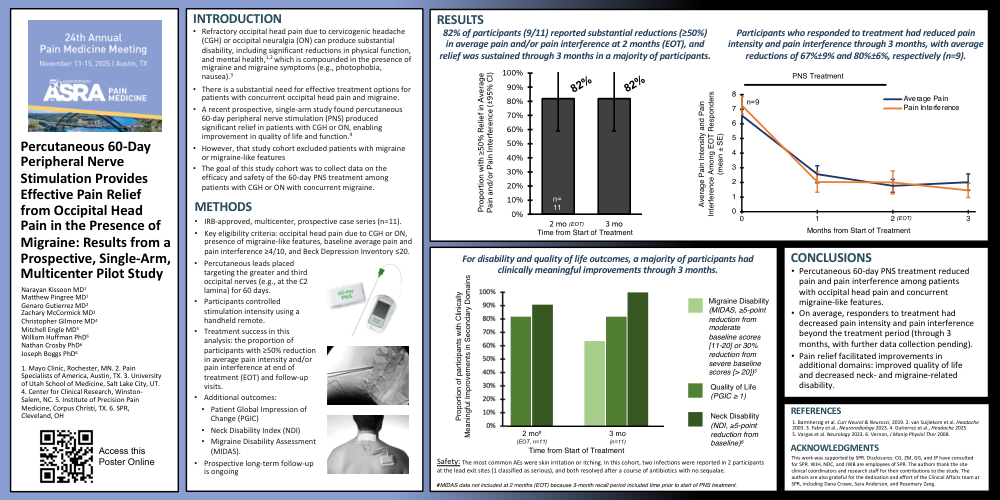
82% of participants (9/11) reported substantial reductions (≥50%) in average pain and/or pain interference at 2 months (EOT), and relief was sustained through 3 months in a majority of participants.
Participants who responded to treatment had reduced pain intensity and pain interference through 3 months, with average eductions of 67%±9% and 80%±6%, respectively (n=9).
For disability and quality of life outcomes, a majority of participants had clinically meaningful improvements through 3 months.
Safety: The most common AEs were skin irritation or itching. In this cohort, two infections were reported in 2 participants at the lead exit sites (1 classified as serious), and both resolved after a course of antibiotics with no sequalae.
Conclusions
• Percutaneous 60-day PNS treatment reduced pain and pain interference among patients with occipital head pain and concurrent migraine-like features.
• On average, responders to treatment had decreased pain intensity and pain interference beyond the treatment period (through 3 months, with further data collection pending).
• Pain relief facilitated improvements in additional domains: improved quality of life and decreased neck- and migraine-related disability.
References
1. Barmherzig et al. Curr Neurol & Neurosci, 2019. 2. van Suijlekom et al. Headache 2003. 3. Fabry et al., Neuroradiology 2023. 4. Gutierrez et al., Headache 2025. 5. Vargas et al. Neurology 2023. 6. Vernon, J Manip Physiol Ther 2008.
Acknowledgments
This work was supported by SPR. Disclosures: CG, ZM, GG, and JP have consulted for SPR. WJH, NDC, and JWB are employees of SPR. The authors thank the site clinical coordinators and research staff for their contributions to the study. The authors are also grateful for the dedication and effort of the Clinical Affairs team at SPR, including Dana Crowe, Sara Anderson, and Rosemary Zang.