343 posters, 5 videos, 2 audios, 18 topics, 33 sessions, 263 authors, 202 institutions
ePostersLive by SciGen Technologies S.A. All rights reserved.
24th Annual Pain Medicine Meeting 2025
November 13-15, 2025| JW Marriott Austin, Austin, Texas

2188740
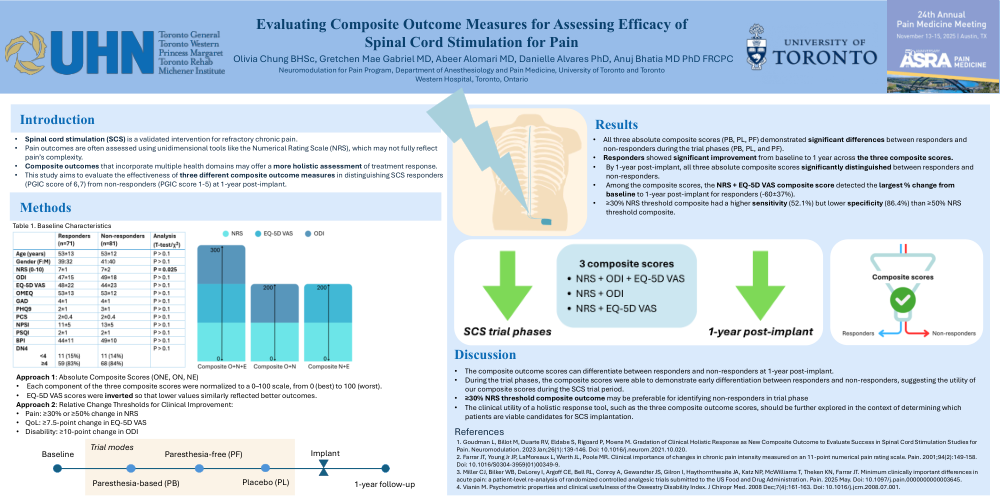
Evaluating Composite Outcome Measures for Assessing Efficacy of Spinal Cord Stimulation for Pain: A Retrospective Cohort Study
Poster Presenter
Authors
Affiliations
Part of Topic
Scientific Abstracts > Chronic Pain
Introduction
•Spinal cord stimulation (SCS) is a validated intervention for refractory chronic pain.
•Pain outcomes are often assessed using unidimensional tools like the Numerical Rating Scale (NRS), which may not fully reflect pain’s complexity.
•Composite outcomes that incorporate multiple health domains may offer a more holistic assessment of treatment response.
•This study aims to evaluate the effectiveness of three different composite outcome measures in distinguishing SCS responders (PGIC score of 6,7) from non-responders (PGIC score 1-5) at 1-year post-implant.
Methods
Approach 1: Absolute Composite Scores (ONE, ON, NE)
•Each component of the three composite scores were normalized to a 0–100 scale, from 0 (best) to 100 (worst).
•EQ-5D VAS scores were inverted so that lower values similarly reflected better outcomes.
Approach 2: Relative Change Thresholds for Clinical Improvement:
•Pain: ≥30% or ≥50% change in NRS
•QoL: ≥7.5-point change in EQ-5D VAS
•Disability: ≥10-point change in ODI
Results
•All three absolute composite scores (PB, PL, PF) demonstrated significant differences between responders and non-responders during the trial phases (PB, PL, and PF).
•Responders showed significant improvement from baseline to 1 year across the three composite scores.
•By 1-year post-implant, all three absolute composite scores significantly distinguished between responders and non-responders.
•Among the composite scores, the NRS + EQ-5D VAS composite score detected the largest % change from baseline to 1-year post-implant for responders (-60±37%).
•≥30% NRS threshold composite had a higher sensitivity (52.1%) but lower specificity (86.4%) than ≥50% NRS threshold composite.
Discussion
•The composite outcome scores can differentiate between responders and non-responders at 1-year post-implant.
•During the trial phases, the composite scores were able to demonstrate early differentiation between responders and non-responders, suggesting the utility of our composite scores during the SCS trial period.
•≥30% NRS threshold composite outcome may be preferable for identifying non-responders in trial phase
•The clinical utility of a holistic response tool, such as the three composite outcome scores, should be further explored in the context of determining which patients are viable candidates for SCS implantation.