343 posters, 5 videos, 2 audios, 18 topics, 33 sessions, 263 authors, 202 institutions
ePostersLive by SciGen Technologies S.A. All rights reserved.
24th Annual Pain Medicine Meeting 2025
November 13-15, 2025| JW Marriott Austin, Austin, Texas

2186167
Subthreshold Spinal Cord Stimulation (SCS) for Failed Back Surgery Syndrome (FBSS)
Poster Presenter
Authors
Affiliations
Part of Topic
Scientific Abstracts > Chronic Pain
Introduction:
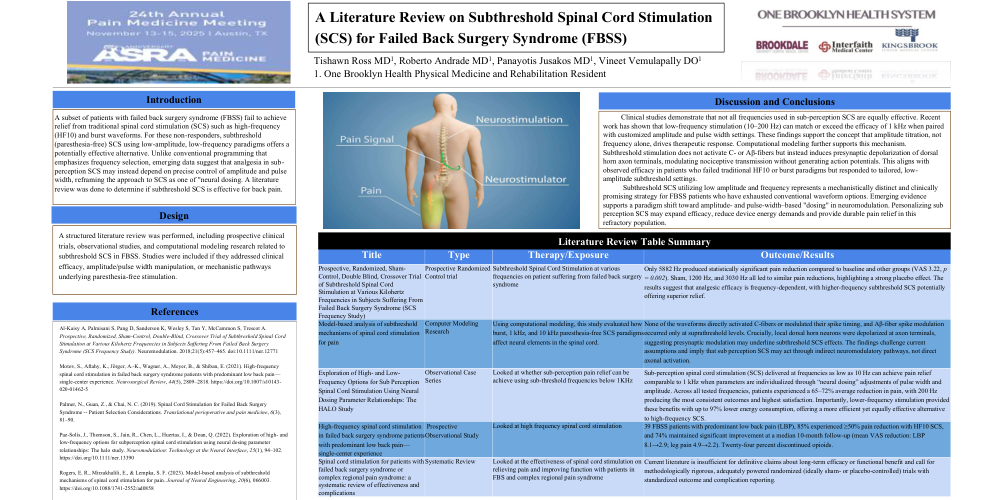
A subset of patients with failed back surgery syndrome (FBSS) fail to achieve relief from traditional spinal cord stimulation (SCS) such as high-frequency (HF10) and burst waveforms. For these non-responders, subthreshold (paresthesia-free) SCS using low-amplitude, low-frequency paradigms offers a potentially effective alternative. Unlike conventional programming that emphasizes frequency selection, emerging data suggest that analgesia in sub-perception SCS may instead depend on precise control of amplitude and pulse width, reframing the approach to SCS as one of "neural dosing. A literature review was done to determine if subthreshold SCS is effective for back pain.
Design:
A structured literature review was performed, including prospective clinical trials, observational studies, and computational modeling research related to subthreshold SCS in FBSS. Studies were included if they addressed clinical efficacy, amplitude/pulse width manipulation, or mechanistic pathways underlying paresthesia-free stimulation.
Literature Review Summary:
1." Prospective, Randomized, Sham-Control, Double Blind, Crossover Trial of Subthreshold Spinal Cord Stimulation at Various Kilohertz Frequencies in Subjects Suffering From Failed Back Surgery Syndrome (SCS Frequency Study)" is a prospective Randomized control Trial that looked at Subthreshold Spinal Cord Stimulation at various frequencies on patient suffering from failed back surgery syndrome. It found only 5882 Hz produced statistically significant pain reduction compared to baseline and other groups (VAS 3.22, p = 0.002). Sham, 1200 Hz, and 3030 Hz all led to similar pain reductions, highlighting a strong placebo effect. The results suggest that analgesic efficacy is frequency-dependent, with higher-frequency subthreshold SCS potentially offering superior relief.
2. "Model-based analysis of subthreshold mechanisms of spinal cord stimulation for pain" . Using computational modeling this study evaluated how burst, 1 kHz, and 10 kHz paresthesia-free SCS paradigms affect neural elements in the spinal cord. It found that none of the waveforms directly activated C-fibers or modulated their spike timing, and Aβ-fiber spike modulation occurred only at suprathreshold levels. Crucially, local dorsal horn neurons were depolarized at axon terminals, suggesting presynaptic modulation may underline subthreshold SCS effects. The findings challenge current assumptions and imply that sub perception SCS may act through indirect neuromodulatory pathways, not direct axonal activation.
3. "Exploration of High- and Low-Frequency Options for Sub Perception Spinal Cord Stimulation Using Neural Dosing Parameter Relationships: The HALO Study" looked at whether sub-perception pain relief can be achieve using sub-threshold frequencies below 1KHz. It found that sub-perception spinal cord stimulation (SCS) delivered at frequencies as low as 10 Hz can achieve pain relief comparable to 1 kHz when parameters are individualized through “neural dosing” adjustments of pulse width and amplitude. Across all tested frequencies, patients experienced a 65–72% average reduction in pain, with 200 Hz producing the most consistent outcomes and highest satisfaction. Importantly, lower-frequency stimulation provided these benefits with up to 97% lower energy consumption, offering a more efficient yet equally effective alternative to high-frequency SCS.
4. "High-frequency spinal cord stimulation in failed back surgery syndrome patients with predominant low back pain—single-center experience" looked at high frequency spinal cord stimulation. It found that 39 FBSS patients with predominant low back pain (LBP), 85% experienced ≥50% pain reduction with HF10 SCS, and 74% maintained significant improvement at a median 10-month follow-up (mean VAS reduction: LBP 8.1→2.9; leg pain 4.9→2.2). Twenty-four percent discontinued opioids.
5. "Spinal cord stimulation for patients with failed back surgery syndrome or complex regional pain syndrome: a systematic review of effectiveness and complications" looked at effectiveness of spinal cord stimulation on relieving pain and improving function with patients in FBS and complex regional pain syndrome. It found current literature is insufficient for definitive claims about long-term efficacy or functional benefit and call for methodologically rigorous, adequately powered randomized (ideally sham- or placebo-controlled) trials with standardized outcome and complication reporting.
Discussion/Conclusion:
Clinical studies demonstrate that not all frequencies used in sub-perception SCS are equally effective. Recent work has shown that low-frequency stimulation (10–200 Hz) can match or exceed the efficacy of 1 kHz when paired with customized amplitude and pulse width settings. These findings support the concept that amplitude titration, not frequency alone, drives therapeutic response. Computational modeling further supports this mechanism. Subthreshold stimulation does not activate C- or Aβ-fibers but instead induces presynaptic depolarization of dorsal horn axon terminals, modulating nociceptive transmission without generating action potentials. This aligns with observed efficacy in patients who failed traditional HF10 or burst paradigms but responded to tailored, low-amplitude subthreshold settings.
Subthreshold SCS utilizing low amplitude and frequency represents a mechanistically distinct and clinically promising strategy for FBSS patients who have exhausted conventional waveform options. Emerging evidence supports a paradigm shift toward amplitude- and pulse-width–based "dosing" in neuromodulation. Personalizing sub perception SCS may expand efficacy, reduce device energy demands and provide durable pain relief in this refractory population.
References:
Al-Kaisy A, Palmisani S, Pang D, Sanderson K, Wesley S, Tan Y, McCammon S, Trescot A. Prospective, Randomized, Sham-Control, Double-Blind, Crossover Trial of Subthreshold Spinal Cord Stimulation at Various Kilohertz Frequencies in Subjects Suffering From Failed Back Surgery Syndrome (SCS Frequency Study). Neuromodulation. 2018;21(5):457–465. doi:10.1111/ner.12771
Motov, S., Aftahy, K., Jörger, A.-K., Wagner, A., Meyer, B., & Shiban, E. (2021). High-frequency spinal cord stimulation in failed back surgery syndrome patients with predominant low back pain—single-center experience. Neurosurgical Review, 44(5), 2809–2818. https://doi.org/10.1007/s10143-020-01462-5
Palmer, N., Guan, Z., & Chai, N. C. (2019). Spinal Cord Stimulation for Failed Back Surgery Syndrome -- Patient Selection Considerations. Translational perioperative and pain medicine, 6(3), 81–90.
Paz-Solís, J., Thomson, S., Jain, R., Chen, L., Huertas, I., & Doan, Q. (2022). Exploration of high- and low-frequency options for subperception spinal cord stimulation using neural dosing parameter relationships: The halo study. Neuromodulation: Technology at the Neural Interface, 25(1), 94–102. https://doi.org/10.1111/ner.13390
Rogers, E. R., Mirzakhalili, E., & Lempka, S. F. (2023). Model-based analysis of subthreshold mechanisms of spinal cord stimulation for pain. Journal of Neural Engineering, 20(6), 066003. https://doi.org/10.1088/1741-2552/ad0858