343 posters, 5 videos, 2 audios, 18 topics, 33 sessions, 263 authors, 202 institutions
ePostersLive by SciGen Technologies S.A. All rights reserved.
24th Annual Pain Medicine Meeting 2025
November 13-15, 2025| JW Marriott Austin, Austin, Texas

2186132
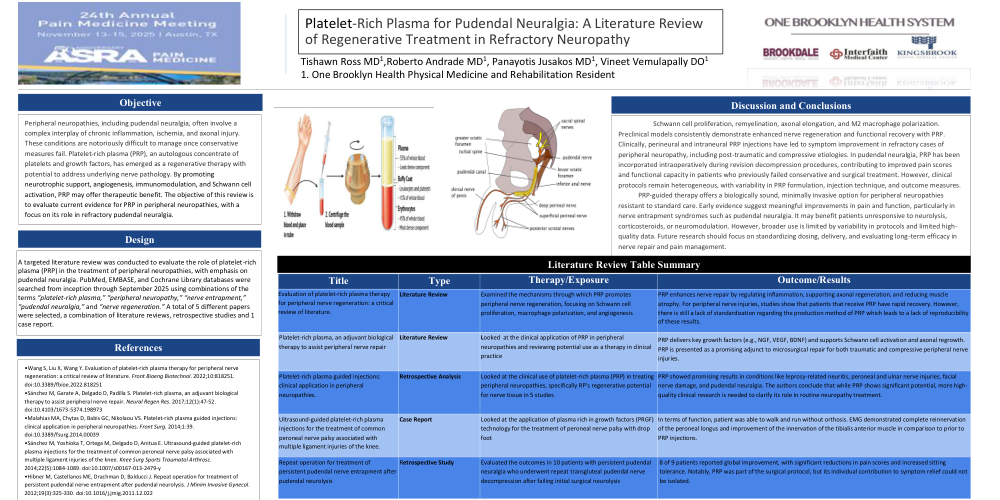
Platelet-Rich Plasma for Pudendal Neuralgia: A Literature Review of Regenerative Treatment in Refractory Neuropathy
Poster Presenter
Authors
Affiliations
Part of Topic
Scientific Abstracts > Chronic Pain
Peripheral neuropathies, including pudendal neuralgia, often involve a complex interplay of chronic inflammation, ischemia, and axonal injury. These conditions are notoriously difficult to manage once conservative measures fail. Platelet-rich plasma (PRP), an autologous concentrate of platelets and growth factors, has emerged as a regenerative therapy with potential to address underlying nerve pathology. By promoting neurotrophic support, angiogenesis, immunomodulation, and Schwann cell activation, PRP may offer therapeutic benefit. The objective of this review is to evaluate current evidence for PRP in peripheral neuropathies, with a focus on its role in refractory pudendal neuralgia.
A targeted literature review was conducted to evaluate the role of platelet-rich plasma (PRP) in the treatment of peripheral neuropathies, with emphasis on pudendal neuralgia. PubMed, EMBASE, and Cochrane Library databases were searched from inception through September 2025 using combinations of the terms “platelet-rich plasma,” “peripheral neuropathy,” “nerve entrapment,” “pudendal neuralgia,” and “nerve regeneration.” A total of 5 different papers were selected, a combination of literature reviews, retrospective studies and 1 case report.
Studies Looked at:
"Evaluation of platelet-rich plasma therapy for peripheral nerve regeneration: a critical review of literature" examined the mechanisms through which PRP promotes peripheral nerve regeneration, focusing on Schwann cell proliferation, macrophage polarization, and angiogenesis. It found that PRP enhances nerve repair by regulating inflammation, supporting axonal regeneration, and reducing muscle atrophy. For peripheral nerve injuries, studies show that patients that receive PRP have rapid recovery. However, there is still a lack of standardization regarding the production method of PRP which leads to a lack of reproducibility of these results.
"Platelet-rich plasma, an adjuvant biological therapy to assist peripheral nerve repair" looked at the clinical application of PRP in peripheral neuropathies and reviewing potential use as a therapy in clinical practice. It found that PRP delivers key growth factors (e.g., NGF, VEGF, BDNF) and supports Schwann cell activation and axonal regrowth. PRP is presented as a promising adjunct to microsurgical repair for both traumatic and compressive peripheral nerve injuries.
"Platelet-rich plasma guided injections: clinical application in peripheral neuropathies" looked at the clinical use of platelet-rich plasma (PRP) in treating peripheral neuropathies, specifically RP’s regenerative potential for nerve tissue in 5 studies. It found that PRP showed promising results in conditions like leprosy-related neuritis, peroneal and ulnar nerve injuries, facial nerve damage, and pudendal neuralgia. The authors conclude that while PRP shows significant potential, more high-quality clinical research is needed to clarify its role in routine neuropathy treatment.
"Ultrasound-guided platelet-rich plasma injections for the treatment of common peroneal nerve palsy associated with multiple ligament injuries of the knee" reported on the application of plasma rich in growth factors (PRGF) technology for the treatment of peroneal nerve palsy with drop foot. At the end, the patient was able to to walk and run without orthosis. EMG demonstrated complete reinnervation of the peroneal longus and improvement of the innervation of the tibialis anterior muscle in comparison to prior to PRP injections.
"Repeat operation for treatment of persistent pudendal nerve entrapment after pudendal neurolysis" looked at the outcomes in 10 patients with persistent pudendal neuralgia who underwent repeat transgluteal pudendal nerve decompression after failing initial surgical neurolysis. It found that 8 of 9 patients reported global improvement, with significant reductions in pain scores and increased sitting tolerance. Notably, PRP was part of the surgical protocol, but its individual contribution to symptom relief could not be isolated.
Schwann cell proliferation, remyelination, axonal elongation, and M2 macrophage polarization. Preclinical models consistently demonstrate enhanced nerve regeneration and functional recovery with PRP. Clinically, perineural and intraneural PRP injections have led to symptom improvement in refractory cases of peripheral neuropathy, including post-traumatic and compressive etiologies. In pudendal neuralgia, PRP has been incorporated intraoperatively during revision decompression procedures, contributing to improved pain scores and functional capacity in patients who previously failed conservative and surgical treatment. However, clinical protocols remain heterogeneous, with variability in PRP formulation, injection technique, and outcome measures.
PRP-guided therapy offers a biologically sound, minimally invasive option for peripheral neuropathies resistant to standard care. Early evidence suggest meaningful improvements in pain and function, particularly in nerve entrapment syndromes such as pudendal neuralgia. It may benefit patients unresponsive to neurolysis, corticosteroids, or neuromodulation. However, broader use is limited by variability in protocols and limited high-quality data. Future research should focus on standardizing dosing, delivery, and evaluating long-term efficacy in nerve repair and pain management.