343 posters, 5 videos, 2 audios, 18 topics, 33 sessions, 263 authors, 202 institutions
ePostersLive by SciGen Technologies S.A. All rights reserved.
24th Annual Pain Medicine Meeting 2025
November 13-15, 2025| JW Marriott Austin, Austin, Texas

2184566
Pivotal phase 3 trial of neridronate in Complex Regional Pain Syndrome Type 1: CRPS-RISE study design and methodology
Poster Presenter
Authors
Affiliations
Part of Topic
Scientific Abstracts > Chronic Pain
TITLE:
Pivotal Phase 3 Trial of Neridronate in Complex Regional Pain Syndrome Type-1: CRPS-RISE Study Design and Methodology
AUTHORS:
Srinivasa N. Raja, MD, Michael Rowbotham, MD, Gail Cawkwell, MD, PhD, Amarita S. Randhawa, PharmD, Monica Salamea, Stephen Bruehl, PhD
BACKGROUND:
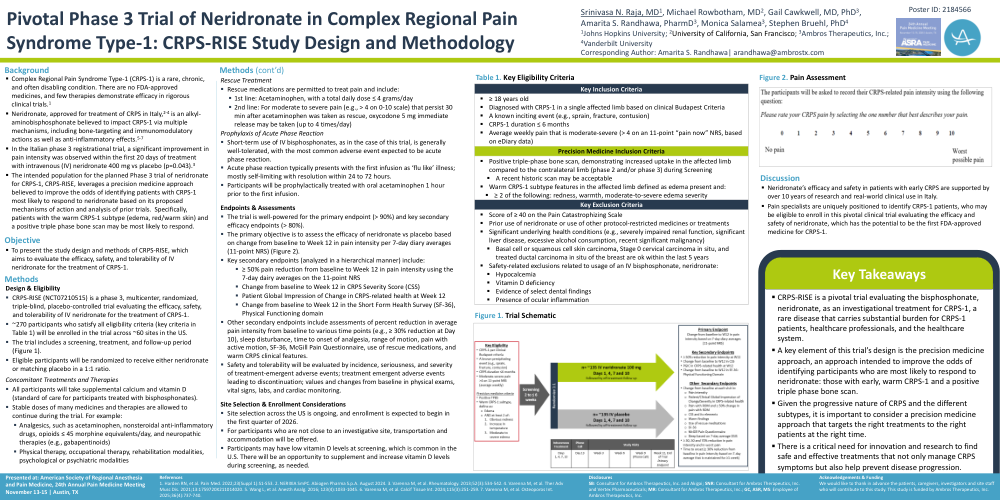
• Complex Regional Pain Syndrome Type-1 (CRPS-1) is a rare, chronic, and often disabling condition. There are no FDA-approved medicines, and few therapies demonstrate efficacy in rigorous clinical trials.[1]
• Neridronate, approved for treatment of CRPS in Italy,[2-4] is an alkyl-aminobisphosphonate believed to impact CRPS-1 via multiple mechanisms, including bone-targeting and immunomodulatory actions as well as anti-inflammatory effects.[5-7]
• In the Italian phase 3 registrational trial, a significant improvement in pain intensity was observed within the first 20 days of treatment with intravenous (IV) neridronate 400 mg vs placebo (p=0.043).[3]
• The intended population for the planned Phase 3 trial of neridronate for CRPS-1, CRPS-RISE, leverages a precision medicine approach believed to improve the odds of identifying patients with CRPS-1 most likely to respond to neridronate based on its proposed mechanisms of action and analysis of prior trials. Specifically, patients with the warm CRPS-1 subtype (edema, red/warm skin) and a positive triple phase bone scan may be most likely to respond.
Concomitant Treatments and Therapies
• All participants will take supplemental calcium and vitamin D (standard of care for participants treated with bisphosphonates).
• Stable doses of many medicines and therapies are allowed to continue during the trial. For example:
• Analgesics, such as acetaminophen, nonsteroidal anti-inflammatory drugs, opioids ≤ 45 morphine equivalents/day, and neuropathic therapies (e.g., gabapentinoids)
• Physical therapy, occupational therapy, rehabilitation modalities, psychological or psychiatric modalities
• Short-term use of IV bisphosphonates, as in the case of this trial, is generally well-tolerated, with the most common adverse event expected to be acute phase reaction.
Site Selection & Enrollment Considerations:
• Site selection across the US is ongoing, and enrollment is expected to begin in the first quarter of 2026.
• For participants who are not close to an investigative site, transportation and accommodation will be offered.
• Participants may have low vitamin D levels at screening, which is common in the U.S. There will be an opportunity to supplement and increase vitamin D levels during screening, as needed.
• Pain specialists are uniquely positioned to identify CRPS-1 patients, who may be eligible to enroll in this pivotal clinical trial evaluating the efficacy and safety of neridronate, which has the potential to be the first FDA-approved medicine for CRPS-1.
• A key element of this trial's design is the precision medicine approach, an approach intended to improve the odds of identifying participants who are most likely to respond to neridronate: those with early, warm CRPS-1 and a positive triple phase bone scan.
• Given the progressive nature of CRPS and the different subtypes, it is important to consider a precision medicine approach that targets the right treatments to the right patients at the right time.
• There is a critical need for innovation and research to find safe and effective treatments that not only manage CRPS symptoms but also help prevent disease progression.
2. NERIXIA SmPC. Abiogen Pharma S.p.A. August 2024.
3. Varenna M, et al. Rheumatology. 2013;52(3):534-542.
4. Varenna M, et al. Ther Adv Musc Dis. 2021;13:1759720X211014020.
5. Wang L, et al. Anesth Analg. 2016; 123(4):1033-1045.
6. Varenna M, et al. Calcif Tissue Int. 2024;115(3):251-259.
7. Varenna M, et al. Osteoporos Int. 2025;36(4):737-740.