343 posters, 5 videos, 2 audios, 18 topics, 33 sessions, 263 authors, 202 institutions
ePostersLive by SciGen Technologies S.A. All rights reserved.
24th Annual Pain Medicine Meeting 2025
November 13-15, 2025| JW Marriott Austin, Austin, Texas

2182238
Durable Outcomes of Percutaneous 60-Day Peripheral Nerve Stimulation for Low Back Pain: A 5-Year Cross-Sectional Follow-Up Survey
Poster Presenter
Authors
Affiliations
Part of Topic
Scientific Abstracts > Chronic Pain
Durable Outcomes of Percutaneous 60-Day Peripheral Nerve Stimulation for Low Back Pain: A 5-Year Cross-Sectional Follow-Up Survey
Samir J. Sheth, MD1, Denise D. Lester, MD, FASAM2, Jaudat Mahmood, MD3, Sarah E. Trampota, MD4, G. Lawson Smith, MD5, Raheleh Rahimi Darabad, MD6, Brandon D. Swan7, Meredith J. McGee, PhD7, Joseph W. Boggs, PhD7
1Sutter Health Systems, Roseville, CA; 2Central Virginia VA Health Care System, Richmond, VA; 3Shannon Medical Center, San Angelo, TX; 4Advantage Pain Management, San Antonio, TX; 5University of Arkansas for Medical Sciences, Little Rock, AR; 6Indiana University Health, Indianapolis, IN; 7SPR, Cleveland, OH
Introduction
Low back pain (LBP) is a leading cause of disability worldwide, and treatment often necessitates invasive interventions that carry significant risks and economic burdens. Percutaneous 60-day Peripheral Nerve Stimulation (PNS) is a minimally invasive treatment that can provide durable pain relief enabling functional improvements.1,2 Building on prior prospective and randomized clinical trials in LBP,3,4 this cross-sectional survey evaluated the durability of improvements among a real-world cohort of patients with low back pain treated with 60-day PNS.
Methods
IRB-approved cross-sectional follow-up survey of patients who:
• had LBP that was treated with Percutaneous 60-day PNS
‣ received 2 leads targeting lumbar medial branches
• were at least 6 months from the start of treatment
• responded with ≥50% pain relief at the end of treatment (EOT)
• did not have documented confounding factors contributing to pain at baseline (e.g., post-op, trauma, SIJ, cancer, etc.)
• opted-in during treatment to share data with the device manufacturer
Online survey: Eligible participants received an invitation & multiple email, SMS, and/or phone call reminders to complete the survey.
• The survey response rate was 44% (603/1360)
Key outcomes included patient-reported percent pain relief, average and worst pain scores, and patient global impression of change (PGIC) in quality of life, physical function, mood, and sleep.
Participants also reported on the use or avoidance of other treatments and interventions for their LBP since completing the Percutaneous 60-day PNS treatment.
Results
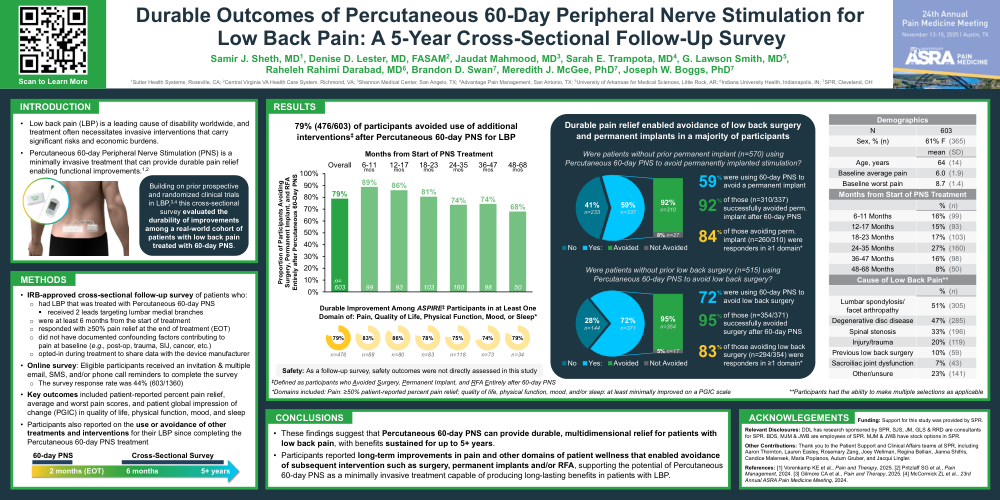
A total of 603 eligible survey participants completed the survey with a mean follow-up of 26 months (range: 6-68 months), including 50 participants who were four or more years (≥48 months) post-treatment. Overall, 79% (476/603) of survey participants required no subsequent interventions (i.e., radiofrequency ablation (RFA), permanent implant, or surgery) following Percutaneous 60-day PNS. Among survey participants who avoided subsequent interventions, 79% (377/476) reported durable improvements in at least one domain (≥50% pain relief and/or clinically meaningful improvement of quality of life, function, mood, and/or sleep) at the time of follow up, including 79% (27/34) of participants that were 48-68 months post-treatment.
Safety outcomes were not assessed in this follow-up survey.
Conclusions
These findings suggest that Percutaneous 60-day PNS can provide durable, multidimensional relief for patients with low back pain, with benefits sustained for up to 5+ years. Participants reported long-term improvements in pain and other domains of patient wellness that enabled avoidance of subsequent intervention such as surgery, permanent implants and/or RFA, supporting the potential of Percutaneous 60-day PNS as a minimally invasive treatment capable of producing long-lasting benefits in patients with LBP.
References
[1] Vorenkamp KE et al., Pain and Therapy, 2025.
[2] Pritzlaff SG et al., Pain Management, 2024.
[3] Gilmore CA et al., Pain and Therapy, 2025.
[4] McCormick ZL et al., 23rd Annual ASRA Pain Medicine Meeting, 2024.
Acknowledgements
Support for this study was provided by SPR. DDL has research sponsored by SPR. SJS, JM, GLS & RRD are consultants for SPR. BDS, MJM & JWB are employees of SPR. MJM & JWB have stock options in SPR. Thank you to the Patient Support and Clinical Affairs teams at SPR, including Aaron Thornton, Lauren Easley, Rosemary Zang, Joey Wellman, Regina Bellian, Jianna Shifris, Candice Malensek, Maria Popianos, Autum Gruber, and Jacqui Lingler.