343 posters, 5 videos, 2 audios, 18 topics, 33 sessions, 263 authors, 202 institutions
ePostersLive by SciGen Technologies S.A. All rights reserved.
24th Annual Pain Medicine Meeting 2025
November 13-15, 2025| JW Marriott Austin, Austin, Texas

2181647
60-Day PNS vs. Standard Interventional Management for Chronic Low Back Pain: RESET RCT 6-Month Results
Poster Presenter
Authors
Affiliations
Part of Topic
Scientific Abstracts > Chronic Pain
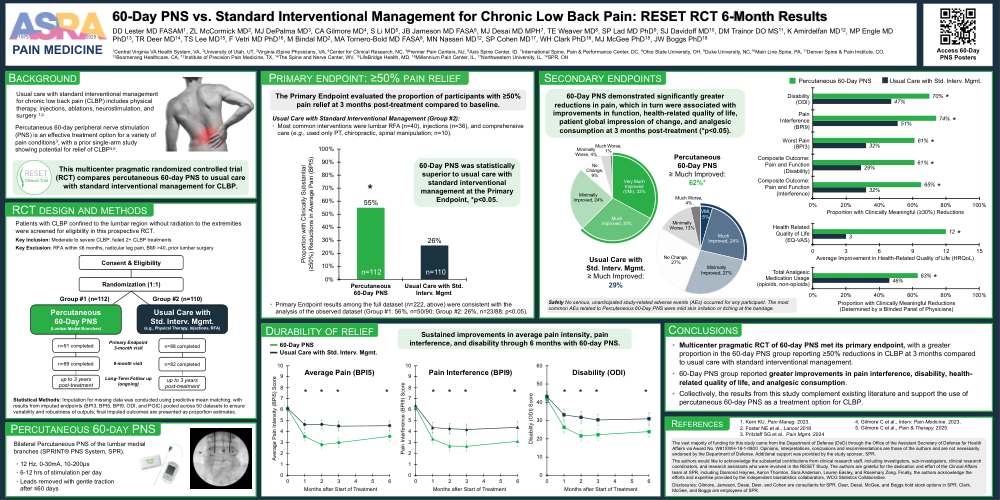
Background: Usual care with standard interventional management for chronic low back pain (CLBP) includes physical therapy, injections, ablations, neurostimulation, and surgery (1,2). Percutaneous 60-day peripheral nerve stimulation (PNS) is an effective treatment option for a variety of pain conditions (3), with a prior single-arm study showing potential for relief of CLBP (4,5). This multicenter pragmatic randomized controlled trial (RCT) compares percutaneous 60-day PNS to usual care with standard interventional management for CLBP.
Design and Methods: Participants in this IRB-approved RCT reported surgically naïve, moderate to severe CLBP without radiculopathy at baseline, and were randomized to Group 1 (Percutaneous 60-Day PNS, SPR® SPRINT® PNS System) or Group 2 (Standard Interventional Management). Of the 222 randomized, 179 (91 in Group 1, 88 in Group 2) completed Primary Endpoint and 171 (89 in Group 1, 82 in Group 2) completed the 6-month follow-up. Group 1 underwent PNS lead implantation targeting the lumbar medial branches (stimulation for 6-12 hrs/day, ≤60 days). Group 2 received physician-directed interventions (e.g., ablations, injections, physical therapy). All participants continued to receive treatments as needed, without limitation.
Statistical Methods: Imputation for missing data was conducted using predictive mean matching, with results from imputed endpoints (BPI3, BPI5, BPI9, ODI, and PGIC) pooled across 50 datasets to ensure variability and robustness of outputs; final imputed outcomes are presented as proportion estimates.
Usual Care with Standard Interventional Management (Group #2): Most common interventions were lumbar RFA (n=40), injections (n=36), and comprehensive care (e.g., used only PT, chiropractic, spinal manipulation; n=10).
Primary Endpoint: The Primary Endpoint evaluated the proportion of participants with ≥50% pain relief at 3 months post-treatment compared to baseline. 60-Day PNS was statistically superior to usual care with standard interventional management at the Primary Endpoint, *p<0.05.
Secondary Endpoints: 60-Day PNS demonstrated significantly greater reductions in pain, which in turn were associated with improvements in function, health-related quality of life, patient global impression of change, and analgesic consumption at 3 months post-treatment (*p<0.05). Sustained improvements in average pain intensity, pain interference, and disability through 6 months with 60-day PNS.
Safety: No serious, unanticipated study-related adverse events (AEs) occurred for any participant. The most common AEs related to Percutaneous 60-Day PNS were mild skin irritation or itching at the bandage.
Conclusions: Multicenter pragmatic RCT of 60-day PNS met its primary endpoint, with a greater proportion in the 60-day PNS group reporting ≥50% reductions in CLBP at 3 months compared to usual care with standard interventional management. 60-Day PNS group reported greater improvements in pain interference, disability, health-related quality of life, and analgesic consumption. Collectively, the results from this study complement existing literature and support the use of percutaneous 60-day PNS as a treatment option for CLBP.
References: 1. Kern KU. Pain Manag. 2023. 2. Foster NE et al., Lancet 2018 3. Pritzlaff SG et al., Pain Mgmt. 2024 4. Gilmore C et al., Interv. Pain Medicine. 2023. 5. Gilmore C et al., Pain & Therapy. 2025.
The vast majority of funding for this study came from the Department of Defense (DoD) through the Office of the Assistant Secretary of Defense for Health Affairs via Award No. W81XWH-18-1-0800. Opinions, interpretations, conclusions and recommendations are those of the authors and are not necessarily endorsed by the Department of Defense.Additional support was provided by the study sponsor, SPR.
The authors would like to acknowledge the substantial contributions from clinical research staff, including investigators, sub-investigators, clinical research coordinators, and research assistants who were involved in the RESET Study. The authors are grateful for the dedication and effort of the Clinical Affairs team at SPR, including Diamond Haynes, Aaron Thornton, Sara Anderson, Lauren Easley, and Rosemary Zang. Finally, the authors acknowledge the efforts and expertise provided by the independentbiostatistics collaborators, WCG Statistics Collaborative.
Disclosures: Gilmore, Jameson, Desai, Deer, and Cohen are consultants for SPR. Deer, Desai, McGee, and Boggs hold stock options in SPR. Clark, McGee, and Boggs are employees of SPR.