501 posters, 2 videos, 1 audios, 8 topics, 37 sessions, 395 authors, 307 institutions
ePostersLive by SciGen Technologies S.A. All rights reserved.
23rd Annual Pain Medicine Meeting 2024
November 21-23, 2024 | Caesars Palace, Las Vegas, Nevada

6126
DEFEATING SECURITY MECHANISMS ON PATIENT CONTROLLED ANALGESIA PUMP: CONSIDERATIONS FOR INVESTIGATING PUMP ABERRANCIES
Poster Presenter
Authors
Affiliations
Part of Topic
Safety/QA/QI Projects
Introduction
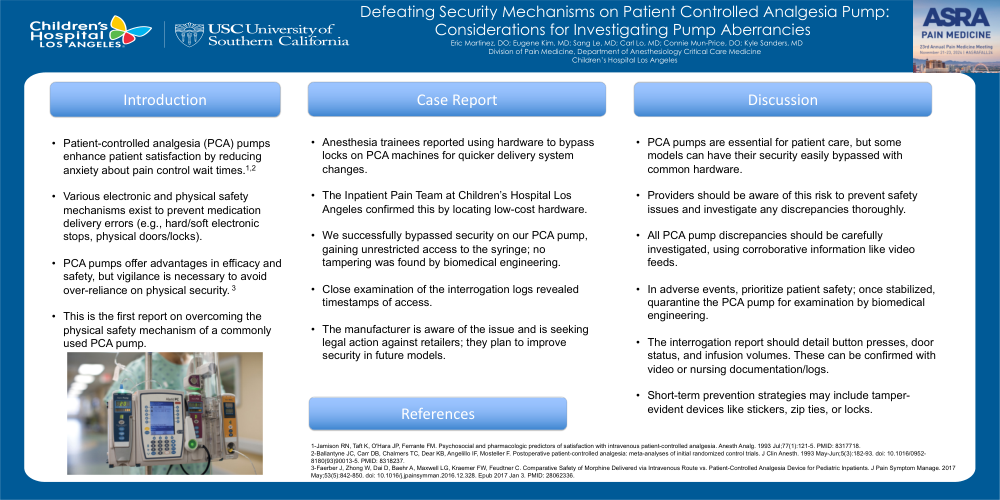
•Patient-controlled analgesia (PCA) pumps enhance patient satisfaction by reducing anxiety about pain control wait times.1,2
•
•Various electronic and physical safety mechanisms exist to prevent medication delivery errors (e.g., hard/soft electronic stops, physical doors/locks).
•
•PCA pumps offer advantages in efficacy and safety, but vigilance is necessary to avoid over-reliance on physical security. 3
•
•This is the first report on overcoming the physical safety mechanism of a commonly used PCA pump.
Case report
•Anesthesia trainees reported using hardware to bypass locks on PCA machines for quicker delivery system changes.
•
•The Inpatient Pain Team at Children’s Hospital Los Angeles confirmed this by locating low-cost hardware.
•
•We successfully bypassed security on our PCA pump, gaining unrestricted access to the syringe; no tampering was found by biomedical engineering.
•
•Close examination of the interrogation logs revealed timestamps of access.
•
•The manufacturer is aware of the issue and is seeking legal action against retailers; they plan to improve security in future models.
Discussion
•PCA pumps are essential for patient care, but some models can have their security easily bypassed with common hardware.
•
•Providers should be aware of this risk to prevent safety issues and investigate any discrepancies thoroughly.
•
•All PCA pump discrepancies should be carefully investigated, using corroborative information like video feeds.
•
•In adverse events, prioritize patient safety; once stabilized, quarantine the PCA pump for examination by biomedical engineering.
•
•The interrogation report should detail button presses, door status, and infusion volumes. These can be confirmed with video or nursing documentation/logs.
•
•Short-term prevention strategies may include tamper-evident devices like stickers, zip ties, or locks.