501 posters, 2 videos, 1 audios, 8 topics, 37 sessions, 395 authors, 307 institutions
ePostersLive by SciGen Technologies S.A. All rights reserved.
23rd Annual Pain Medicine Meeting 2024
November 21-23, 2024 | Caesars Palace, Las Vegas, Nevada

5752
CASE BASED SPINE WORKSHOP FOR A PM&R RESIDENCY: A RESIDENT LED INITIATIVE
Poster Presenter
Authors
Affiliations
NYU Langone Health, New York University Grossman School of Medicine
Part of Topic
Safety/QA/QI Projects
Case Based Spine Workshop for a PM&R Residency: A Resident led Initiative
Introduction
As medical education regarding spinal pathologies continues to evolve, we, a group of PM&R residents, aimed to enhance our program’s spine curriculum by developing an interactive hands-on workshop. This workshop was designed to allow residents to explore the intricate nuances of spine pathologies. Our goals were to improve residents' understanding of similarly presenting diagnoses, identify key history and physical examination findings to guide clinical decision-making, examine characteristic imaging for different pathologies, and discuss treatment algorithms for managing these complex conditions. Additionally, we sought to improve resident understanding, proficiency and comfort in performing interventional spine procedures.
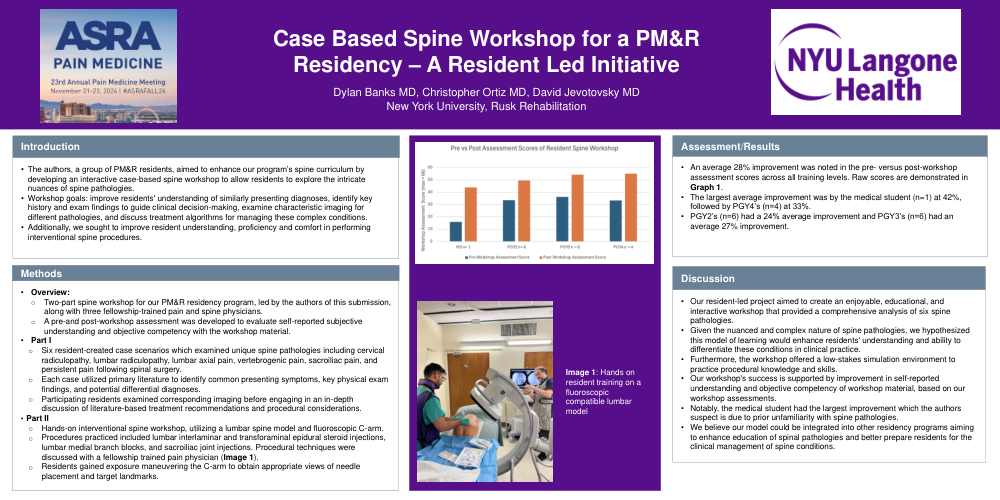
We developed a two-part spine workshop for our PM&R residency program. The workshop was led by the authors of this submission, along with three fellowship-trained pain and spine physicians. A pre- and post-workshop assessment was developed to evaluate self-reported subjective understanding and objective competency with the workshop material.
Part 1 consisted of six resident-created case scenarios which examined unique spine pathologies. Pathologies included cervical radiculopathy, lumbar radiculopathy, lumbar axial pain, vertebrogenic pain, sacroiliac pain, and persistent pain following spinal surgery. Each case utilized primary literature to identify common presenting symptoms, key physical exam findings, and potential differential diagnoses. Participating residents then examined corresponding imaging before engaging in an in-depth discussion of literature-based treatment recommendations and procedural considerations.
Part 2 incorporated a hands-on interventional spine workshop, utilizing a lumbar spine model and fluoroscopic C-arm. The practiced procedures included lumbar interlaminar and transforaminal epidural steroid injections, lumbar medial branch blocks, and sacroiliac joint injections. Procedural techniques were discussed before participating residents practiced performing these procedures on the fluoroscopic-compatible spine model under the guidance of a fellowship trained pain physician (Image 1). Residents also gained exposure maneuvering the C-arm to obtain appropriate views of needle placement and target landmarks.
Results
Seventeen trainees participated in the workshop, including medical students and residents up to PGY-4 level. An average 28% improvement was noted in the pre- versus post-workshop assessment scores. The largest average perceived improvement was by the medical student (n=1) at 42%, followed by PGY4’s (n=4) at 33%. PGY2’s (n=6) had a 24% average perceived improvement and PGY3’s (n=6) had an average 27% perceived improvement.
Discussion
Our resident-led project aimed to create an enjoyable, educational, and interactive workshop that provided a comprehensive analysis of six spine pathologies. Given the nuanced and complex nature of spine pathologies, we hypothesized this model of learning would enhance residents' understanding and ability to differentiate these conditions in clinical practice. Furthermore, the workshop offered a low-stakes simulation environment to practice procedural knowledge and skills. Our workshop's success is supported by improvement in self-reported understanding and objective competency of workshop material, based on our workshop assessments. Notably, the medical student had the largest improvement which the authors suspect is due to prior unfamiliarity with spine pathologies. We believe our model could be integrated into other residency programs aiming to enhance education on spinal pathologies and better prepare physiatrists for future interventional spine training.