501 posters, 2 videos, 1 audios, 8 topics, 37 sessions, 395 authors, 307 institutions
ePostersLive by SciGen Technologies S.A. All rights reserved.
23rd Annual Pain Medicine Meeting 2024
November 21-23, 2024 | Caesars Palace, Las Vegas, Nevada

5858
TRANSFORMING PAIN MEDICINE FELLOWSHIP: ADAPTING TO INCREASING DEMANDS AND DYNAMIC CHANGES IN HEALTHCARE
Poster Presenter
Authors
Affiliations
Part of Topic
Safety/QA/QI Projects
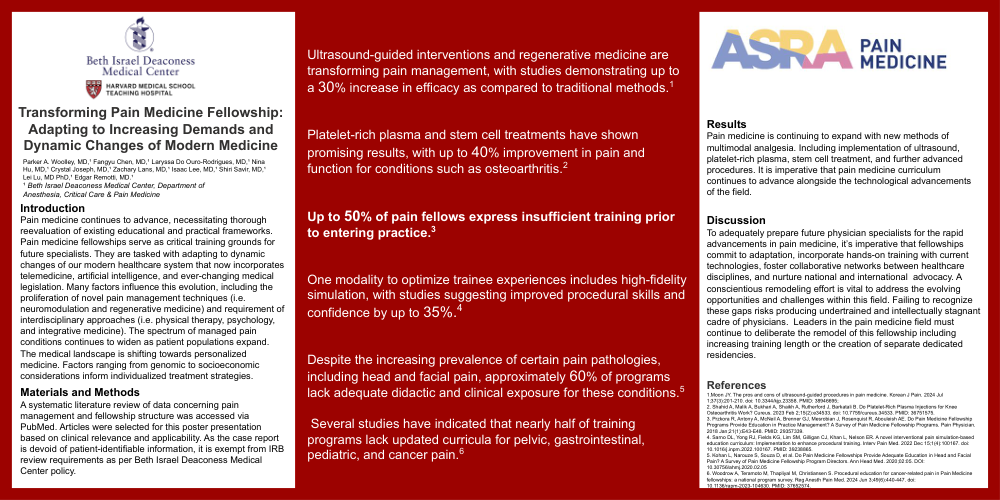
Transforming Pain Medicine Fellowship: Adapting to Increasing Demands and Dynamic Changes of Modern Medicine
Parker A. Woolley, MD,¹ Fangyu Chen, MD,¹ Laryssa Do Ouro-Rodrigues, MD,¹ Nina Hu, MD,¹ Crystal Joseph, MD,¹ Zachary Lans, MD,¹ Isaac Lee, MD,¹ Shiri Savir, MD,¹ Lei Lu, MD PhD,¹ Edgar Remotti, MD.¹
¹ Beth Israel Deaconess Medical Center, Department of
Anesthesia, Critical Care & Pain Medicine
Introduction
Pain medicine continues to advance, necessitating thorough reevaluation of existing educational and practical frameworks. Pain medicine fellowships serve as critical training grounds for future specialists. They are tasked with adapting to dynamic changes of our modern healthcare system that now incorporates telemedicine, artificial intelligence, and ever-changing medical legislation. Many factors influence this evolution, including the proliferation of novel pain management techniques (i.e. neuromodulation and regenerative medicine) and requirement of interdisciplinary approaches (i.e. physical therapy, psychology, and integrative medicine). The spectrum of managed pain conditions continues to widen as patient populations expand. The medical landscape is shifting towards personalized medicine. Factors ranging from genomic to socioeconomic considerations inform individualized treatment strategies.
Materials and Methods
A systematic literature review of data concerning pain management and fellowship structure was accessed via PubMed. Articles were selected for this poster presentation based on clinical relevance and applicability. As the case report is devoid of patient-identifiable information, it is exempt from IRB review requirements as per Beth Israel Deaconess Medical Center policy.
Ultrasound-guided interventions and regenerative medicine are transforming pain management, with studies demonstrating up to a 30% increase in efficacy as compared to traditional methods.1
Platelet-rich plasma and stem cell treatments have shown promising results, with up to 40% improvement in pain and function for conditions such as osteoarthritis.2
Up to 50% of pain fellows express insufficient training prior to entering practice.3
One modality to optimize trainee experiences includes high-fidelity simulation, with studies suggesting improved procedural skills and confidence by up to 35%.4
Despite the increasing prevalence of certain pain pathologies, including head and facial pain, approximately 60% of programs lack adequate didactic and clinical exposure for these conditions.5
Several studies have indicated that nearly half of training programs lack updated curricula for pelvic, gastrointestinal, pediatric, and cancer pain.6
Results
Pain medicine is continuing to expand with new methods of multimodal analgesia. Including implementation of ultrasound, platelet-rich plasma, stem cell treatment, and further advanced procedures. It is imperative that pain medicine curriculum continues to advance alongside the technological advancements of the field.
Discussion
To adequately prepare future physician specialists for the rapid advancements in pain medicine, it’s imperative that fellowships commit to adaptation, incorporate hands-on training with current technologies, foster collaborative networks between healthcare disciplines, and nurture national and international advocacy. A conscientious remodeling effort is vital to address the evolving opportunities and challenges within this field. Failing to recognize these gaps risks producing undertrained and intellectually stagnant cadre of physicians. Leaders in the pain medicine field must continue to deliberate the remodel of this fellowship including increasing training length or the creation of separate dedicated residencies.
References
1.Moon JY. The pros and cons of ultrasound-guided procedures in pain medicine. Korean J Pain. 2024 Jul 1;37(3):201-210. doi: 10.3344/kjp.23358. PMID: 38946695;
2. Shahid A, Malik A, Bukhari A, Shaikh A, Rutherford J, Barkatali B. Do Platelet-Rich Plasma Injections for Knee Osteoarthritis Work? Cureus. 2023 Feb 2;15(2):e34533. doi: 10.7759/cureus.34533. PMID: 36751575.
3. Przkora R, Antony A, McNeil A, Brenner GJ, Mesrobian J, Rosenquist R, Abouleish AE. Do Pain Medicine Fellowship Programs Provide Education in Practice Management? A Survey of Pain Medicine Fellowship Programs. Pain Physician. 2018 Jan;21(1):E43-E48. PMID: 29357339.
4. Sarno DL, Yong RJ, Fields KG, Lim SM, Gilligan CJ, Khan L, Nelson ER. A novel interventional pain simulation-based education curriculum: Implementation to enhance procedural training. Interv Pain Med. 2022 Dec 15;1(4):100167. doi: 10.1016/j.inpm.2022.100167. PMID: 39238865.
5. Kohan L, Narouze S, Souza D, et al. Do Pain Medicine Fellowships Provide Adequate Education in Head and Facial Pain? A Survey of Pain Medicine Fellowship Program Directors. Ann Head Med. 2020;02:05. DOI: 10.30756/ahmj.2020.02.05
6. Woodrow A, Teramoto M, Thapliyal M, Christiansen S. Procedural education for cancer-related pain in Pain Medicine fellowships: a national program survey. Reg Anesth Pain Med. 2024 Jun 3;49(6):440-447. doi: 10.1136/rapm-2023-104630. PMID: 37652574.