501 posters, 2 videos, 1 audios, 8 topics, 37 sessions, 395 authors, 307 institutions
ePostersLive by SciGen Technologies S.A. All rights reserved.
23rd Annual Pain Medicine Meeting 2024
November 21-23, 2024 | Caesars Palace, Las Vegas, Nevada

6306
STANDARDIZING ANXIETY ASSESSMENT DOCUMENTATION TO IMPROVE CONSISTENCY AND QUALITY IN CHRONIC PAIN MANAGEMENT
Poster Presenter
Authors
Affiliations
Part of Topic
Safety/QA/QI Projects
Standardizing Anxiety Assessment Documentation to Improve Consistency and Quality in Chronic Pain Management
Authors: Lau, Stephanie MD., Handa, Arshi MD
Background
Anxiety is a common comorbidity in chronic pain patients and can significantly affect their treatment outcomes. Variability in documenting anxiety assessments can lead to inconsistent care and suboptimal management of anxiety. This quality improvement (QI) project aims to standardize anxiety assessment documentation across a pain management clinic.
Objective
To improve the consistency and quality of anxiety assessment documentation by implementing a standardized anxiety assessment tool and training program for healthcare providers.
Methods
This QI project was conducted over a three-month period at a pain management clinic. A standardized anxiety assessment tool, the Generalized Anxiety Disorder 7-item (GAD-7) scale, was introduced for all patient interactions. Healthcare providers received training on the importance of consistent anxiety assessment and proper documentation practices. The consistency and completeness of anxiety assessment documentation were evaluated through random chart audits conducted before and after the intervention.
Results
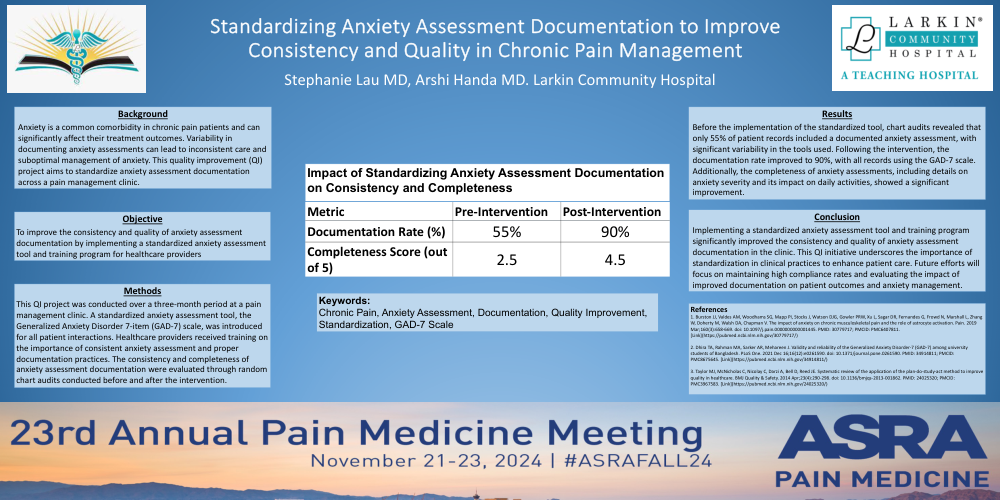
Before the implementation of the standardized tool, chart audits revealed that only 55% of patient records included a documented anxiety assessment, with significant variability in the tools used. Following the intervention, the documentation rate improved to 90%, with all records using the GAD-7 scale. Additionally, the completeness of anxiety assessments, including details on anxiety severity and its impact on daily activities, showed a significant improvement.
| Metric | Pre-Intervention | Post-Intervention |
|-------------------------------|------------------|-------------------|
| Documentation Rate (%) | 55 | 90 |
| Completeness Score (out of 5) | 2.5 | 4.5 |
Conclusion
Implementing a standardized anxiety assessment tool and training program significantly improved the consistency and quality of anxiety assessment documentation in the clinic. This QI initiative underscores the importance of standardization in clinical practices to enhance patient care. Future efforts will focus on maintaining high compliance rates and evaluating the impact of improved documentation on patient outcomes and anxiety management.
Keywords
Chronic Pain, Anxiety Assessment, Documentation, Quality Improvement, Standardization, GAD-7 Scale
References
1. Burston JJ, Valdes AM, Woodhams SG, Mapp PI, Stocks J, Watson DJG, Gowler PRW, Xu L, Sagar DR, Fernandes G, Frowd N, Marshall L, Zhang W, Doherty M, Walsh DA, Chapman V. The impact of anxiety on chronic musculoskeletal pain and the role of astrocyte activation. Pain. 2019 Mar;160(3):658-669. doi: 10.1097/j.pain.0000000000001445. PMID: 30779717; PMCID: PMC6407811. [Link](https://pubmed.ncbi.nlm.nih.gov/30779717/)
2. Dhira TA, Rahman MA, Sarker AR, Mehareen J. Validity and reliability of the Generalized Anxiety Disorder-7 (GAD-7) among university students of Bangladesh. PLoS One. 2021 Dec 16;16(12):e0261590. doi: 10.1371/journal.pone.0261590. PMID: 34914811; PMCID: PMC8675645. [Link](https://pubmed.ncbi.nlm.nih.gov/34914811/)
3. Taylor MJ, McNicholas C, Nicolay C, Darzi A, Bell D, Reed JE. Systematic review of the application of the plan-do-study-act method to improve quality in healthcare. BMJ Quality & Safety. 2014 Apr;23(4):290-298. doi: 10.1136/bmjqs-2013-001862. PMID: 24025320; PMCID: PMC3967583. [Link](https://pubmed.ncbi.nlm.nih.gov/24025320/)