501 posters, 2 videos, 1 audios, 8 topics, 37 sessions, 395 authors, 307 institutions
ePostersLive by SciGen Technologies S.A. All rights reserved.
23rd Annual Pain Medicine Meeting 2024
November 21-23, 2024 | Caesars Palace, Las Vegas, Nevada

5825
STELLATE GANGLION BLOCK (SGB) FOR REFRACTORY VENTRICULAR TACHYCARDIA (VT) AND VENTRICULAR FIBRILLATION (VF)
Poster Presenter
Authors
Affiliations
Part of Topic
Safety/QA/QI Projects
Stellate Ganglion Block (SGB) for refractory ventricular tachycardia (VT) and ventricular fibrillation (VF)
Laryssa Do ouro-rodrigues, Lei Lu, Edgar Remotti, Michael Li, Shergill Sukhman, Matyal Robina, Timothy Maher,Jyotsna Nagda, Sanjeet Narang, Shiri Savir
BIDMC
Introduction
Electrical storm (3 or more episodes of sustained VT/VF or appropriate ICD therapies in < 24 hours) is associated with high mortality and morbidity. Temporary sympathetic blockade through percutaneous SGB has been shown to reduce the recurrences of VT/VF in this population with low rates of complications.
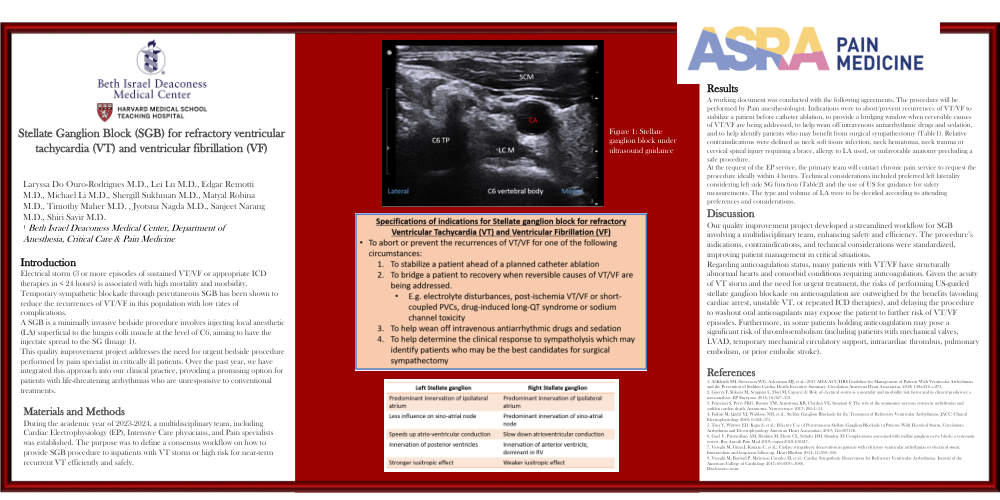
A SGB is a minimally invasive bedside procedure involves injecting local anesthetic (LA) superficial to the lungus colli muscle at the level of C6, aiming to have the injectate spread to the SG (Image 1).
This quality improvement project addresses the need for urgent bedside procedure performed by pain specialist in critically ill patients. Over the past year, we have integrated this approach into our clinical practice, providing a promising option for patients with life-threatening arrhythmias who are unresponsive to conventional treatments.
Materials and Methods
During the academic year of 2023-2024, a multidisciplinary team, including Cardiac Electrophysiology (EP), Intensive Care physicians, and Pain specialists was established. The purpose was to define a consensus workflow on how to provide SGB procedure to inpatients with VT storm or high risk for near-term recurrent VT efficiently and safely.
Results/Case Report
A working document was conducted with the following agreements. The procedure will be performed by Pain anesthesiologist. Indications were to abort/prevent recurrences of VT/VF to stabilize a patient before catheter ablation, to provide a bridging window when reversible causes of VT/VF are being addressed, to help wean off intravenous antiarrhythmic drugs and sedation, and to help identify patients who may benefit from surgical sympathectomy (Table1). Relative contraindications were defined as neck soft tissue infection, neck hematoma, neck trauma or cervical spinal injury requiring a brace, allergy to LA used, or unfavorable anatomy precluding a safe procedure.
At the request of the EP service, the primary team will contact chronic pain service to request the procedure ideally within 4 hours. Technical considerations included preferred left laterality considering left side SG function (Table2) and the use of US for guidance for safety measurements. The type and volume of LA were to be decided according to attending preferences and considerations.
Discussion
Our quality improvement project developed a streamlined workflow for SGB involving a multidisciplinary team, enhancing safety and efficiency. The procedure’s indications, contraindications, and technical considerations were standardized, improving patient management in critical situations.
Regarding anticoagulation status, many patients with VT/VF have structurally abnormal hearts and comorbid conditions requiring anticoagulation. Given the acuity of VT storm and the need for urgent treatment, the risks of performing US-guided stellate ganglion blockade on anticoagulation are outweighed by the benefits (avoiding cardiac arrest, unstable VT, or repeated ICD therapies), and delaying the procedure to washout oral anticoagulants may expose the patient to further risk of VT/VF episodes. Furthermore, in some patients holding anticoagulation may pose a significant risk of thromboembolism (including patients with mechanical valves, LVAD, temporary mechanical circulatory support, intracardiac thrombus, pulmonary embolism, or prior embolic stroke).
References
1. Al-Khatib SM, Stevenson WG, Ackerman MJ, et al.: 2017 AHA/ACC/HRS Guideline for Management of Patients With Ventricular Arrhythmias and the Prevention of Sudden Cardiac Death: Executive Summary. Circulation American Heart Association, 2018; 138:e210–e271.
2. Guerra F, Shkoza M, Scappini L, Flori M, Capucci A: Role of electrical storm as a mortality and morbidity risk factor and its clinical predictors: a meta-analysis. EP Europace 2014; 16:347–353.
3. Franciosi S, Perry FKG, Roston TM, Armstrong KR, Claydon VE, Sanatani S: The role of the autonomic nervous system in arrhythmias and sudden cardiac death. Autonomic Neuroscience 2017; 205:1–11.
4. Fudim M, Qadri YJ, Waldron NH, et al.: Stellate Ganglion Blockade for the Treatment of Refractory Ventricular Arrhythmias. JACC: Clinical Electrophysiology 2020; 6:562–571.
5. Tian Y, Wittwer ED, Kapa S, et al.: Effective Use of Percutaneous Stellate Ganglion Blockade in Patients With Electrical Storm. Circulation: Arrhythmia and Electrophysiology American Heart Association, 2019; 12:e007118.
6. Goel V, Patwardhan AM, Ibrahim M, Howe CL, Schultz DM, Shankar H: Complications associated with stellate ganglion nerve block: a systematic review. Reg Anesth Pain Med 2019; :rapm-2018-100127.
7. Vaseghi M, Gima J, Kanaan C, et al.: Cardiac sympathetic denervation in patients with refractory ventricular arrhythmias or electrical storm: Intermediate and long-term follow-up. Heart Rhythm 2014; 11:360–366.
9. Vaseghi M, Barwad P, Malavassi Corrales FJ, et al.: Cardiac Sympathetic Denervation for Refractory Ventricular Arrhythmias. Journal of the American College of Cardiology 2017; 69:3070–3080.
Disclosures No
Tables / Images