501 posters, 2 videos, 1 audios, 8 topics, 37 sessions, 395 authors, 307 institutions
ePostersLive by SciGen Technologies S.A. All rights reserved.
23rd Annual Pain Medicine Meeting 2024
November 21-23, 2024 | Caesars Palace, Las Vegas, Nevada

5725
DANGERS OF CERVICAL EPIDURAL IN AN UNCORRECTED CRITICALLY STENOTIC AORTIC VALVE.
Poster Presenter
Authors
Affiliations
Part of Topic
Medically Challenging Cases
Dangers of cervical epidural in an uncorrected critically stenotic aortic valve.
Andrew T. Kinoshita MPH, Matthew D. Tran, Brent Yeung MD, Navid Alem MD
INTRODUCTION
This case presents a patient with cervical spinal stenosis and cervical radiculopathy that has concomitant severe aortic stenosis. The patient is insistent on cervical epidural steroid injection despite potential complications from hemodynamic changes during the procedure that would be especially dangerous given their uncorrected critically stenotic aortic valve.
MATERIALS & METHODS
Informed consent was obtained. As the case report is devoid of patient identifiable information, it is exempt from IRB review requirements as per UCI policy.
RESULTS / CASE REPORT
An 83-year-old female patient presented to clinic with complaint of cervical radiculopathy and history of hypertension, hyperlipidemia, coronary artery disease (CAD) with no angina, angioplasty 14 years ago, and severe aortic stenosis. The patient was taking 81 mg aspirin daily for CAD. “Electric shock-like” left neck and shoulder pain had been present for two months, averaging 8/10 on pain scale with radiation down the arm to the second and third fingers. Pain was exacerbated with movement, and improved with rest, elbow flexure, and heat. Weakness, numbness, and tingling were endorsed in the left extremity, and sensation was diminished along the C7 dermatome distribution. Pain medications included limited celecoxib 200 mg BID, gabapentin 100 mg QAM and 200 mg QHS, diclofenac 1% gel QID PRN, and lidocaine patches PRN. The patient was trialing physical therapy, but left shoulder corticosteroid injection had yielded no benefit.
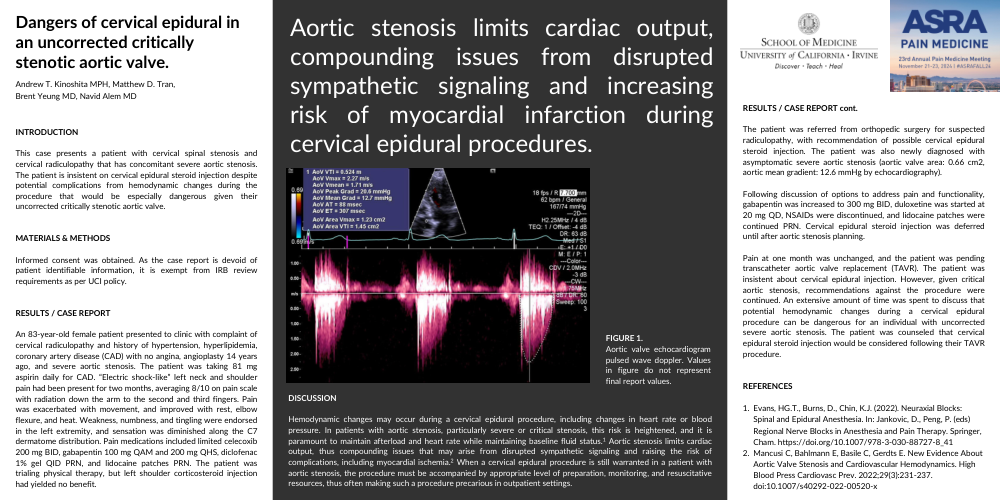
The patient was referred from orthopedic surgery for suspected radiculopathy, with recommendation of possible cervical epidural steroid injection. The patient was also newly diagnosed with asymptomatic severe aortic stenosis (aortic valve area: 0.66 cm2, aortic mean gradient: 12.6 mmHg by echocardiography).
Following discussion of options to address pain and functionality, gabapentin was increased to 300 mg BID, duloxetine was started at 20 mg QD, NSAIDs were discontinued, and lidocaine patches were continued PRN. Cervical epidural steroid injection was deferred until after aortic stenosis planning.
Pain at one month was unchanged, and the patient was pending transcatheter aortic valve replacement (TAVR). The patient was insistent about cervical epidural injection. However, given critical aortic stenosis, recommendations against the procedure were continued. An extensive amount of time was spent to discuss that potential hemodynamic changes during a cervical epidural procedure can be dangerous for an individual with uncorrected severe aortic stenosis. The patient was counseled that cervical epidural steroid injection would be considered following their TAVR procedure.
DISCUSSION
Hemodynamic changes may occur during a cervical epidural procedure, including changes in heart rate or blood pressure. In patients with aortic stenosis, particularly severe or critical stenosis, this risk is heightened, and it is paramount to maintain afterload and heart rate while maintaining baseline fluid status.1 Aortic stenosis limits cardiac output, thus compounding issues that may arise from disrupted sympathetic signaling and raising the risk of complications, including myocardial ischemia.2 When a cervical epidural procedure is still warranted in a patient with aortic stenosis, the procedure must be accompanied by appropriate level of preparation, monitoring, and resuscitative resources, thus often making such a procedure precarious in outpatient settings.
REFERENCES