501 posters, 2 videos, 1 audios, 8 topics, 37 sessions, 395 authors, 307 institutions
ePostersLive by SciGen Technologies S.A. All rights reserved.
23rd Annual Pain Medicine Meeting 2024
November 21-23, 2024 | Caesars Palace, Las Vegas, Nevada

5680
COSTOCLAVICULAR BLOCK FOR DISTAL RADIUS OPEN REDUCTION AND INTERNAL FIXATION
Poster Presenter
Authors
Affiliations
Part of Topic
Medically Challenging Cases
Costoclavicular Block for Distal Radius Open Reduction and Internal Fixation
Cassandra Williams1,2, Jibran Ikram2, Sabry Ayad1,2 Anesthesiology Institute, Cleveland Clinic, Cleveland, OH, USA 1, Department of Anesthesiology Research, Cleveland Clinic, Cleveland, OH, USA2
Interscalene and supraclavicular brachial plexus nerve blocks are routinely used for upper extremity surgeries, although they carry the risk of phrenic nerve involvement, which can lead to diaphragmatic paralysis. The costoclavicular block is a newer block that may mitigate the risk of this complication while providing similar coverage. Our case involves a patient who presented with a displaced distal radius fracture. He received a preoperative single shot costoclavicular nerve block prior to undergoing a distal radius open reduction and internal fixation. The patient did not require any opioid or other pain medications intraoperatively or postoperatively in the Post Anesthesia Care Unit (PACU). This case supports the utility of using a costoclavicular nerve block for upper extremity surgeries.
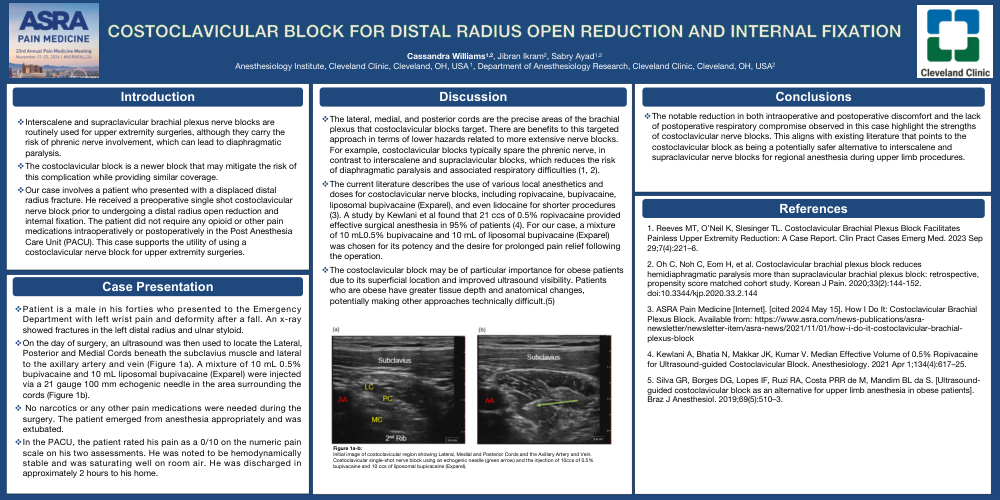
Patient is a male in his forties who presented to the Emergency Department with left wrist pain and deformity after a fall. An x-ray showed fractures in the left distal radius and ulnar styloid. On the day of surgery, an ultrasound was then used to locate the Lateral, Posterior and Medial Cords beneath the subclavius muscle and lateral to the axillary artery and vein (Figure 1a). A mixture of 10 mL 0.5% bupivacaine and 10 mL liposomal bupivacaine (Exparel) were injected via a 21 gauge 100 mm echogenic needle in the area surrounding the cords (Figure 1b). No narcotics or any other pain medications were needed during the surgery. The patient emerged from anesthesia appropriately and was extubated. In the PACU, the patient rated his pain as a 0/10 on the numeric pain scale on his two assessments. He was noted to be hemodynamically stable and was saturating well on room air. He was discharged in approximately 2 hours to his home.
The lateral, medial, and posterior cords are the precise areas of the brachial plexus that costoclavicular blocks target. There are benefits to this targeted approach in terms of lower hazards related to more extensive nerve blocks. For example, costoclavicular blocks typically spare the phrenic nerve, in contrast to interscalene and supraclavicular blocks, which reduces the risk of diaphragmatic paralysis and associated respiratory difficulties (1, 2). The current literature describes the use of various local anesthetics and doses for costoclavicular nerve blocks, including ropivacaine, bupivacaine, liposomal bupivacaine (Exparel), and even lidocaine for shorter procedures (3). A study by Kewlani et al found that 21 ccs of 0.5% ropivacaine provided effective surgical anesthesia in 95% of patients (4). For our case, a mixture of 10 mL0.5% bupivacaine and 10 mL of liposomal bupivacaine (Exparel) was chosen for its potency and the desire for prolonged pain relief following the operation. The costoclavicular block may be of particular importance for obese patients due to its superficial location and improved ultrasound visibility. Patients who are obese have greater tissue depth and anatomical changes, potentially making other approaches technically difficult.(5)
The notable reduction in both intraoperative and postoperative discomfort and the lack of postoperative respiratory compromise observed in this case highlight the strengths of costoclavicular nerve blocks. This aligns with existing literature that points to the costoclavicular block as being a potentially safer alternative to interscalene and supraclavicular nerve blocks for regional anesthesia during upper limb procedures.