501 posters, 2 videos, 1 audios, 8 topics, 37 sessions, 395 authors, 307 institutions
ePostersLive by SciGen Technologies S.A. All rights reserved.
23rd Annual Pain Medicine Meeting 2024
November 21-23, 2024 | Caesars Palace, Las Vegas, Nevada

5682
SEVERE RESISTANT MRSA BACTEREMIA DUE TO RETROPHARYNGEAL AND ANTERIOR EPIDURAL ABSCESS SUPERIMPOSED ON CERVICAL STENOSIS
Poster Presenter
Part of Topic
Medically Challenging Cases
A rare case of severe resistant MRSA bacteremia due to retropharyngeal and anterior epidural abscess superimposed on cervical spinal stenosis
Introduction
Methicillin-resistant Staphylococcus aureus (MRSA) infection and bacteremia is a global health concern. Specifically, S. aureus bacteremia's elevated morbidity and mortality rates can lead to potentially severe complications such as infective endocarditis or sepsis. Key steps in managing S. aureus bacteremia entail promptly identifying the infecting strain and its source and selecting appropriate antibiotic regimens. A pivotal initial step in managing MRSA bacteremia involves pinpointing and eradicating the infection source, most commonly skin and soft tissue infections, catheter-related infections, and pneumonia. We present a distinctive case involving an elderly female who presented with an initial chief complaint of globalized weakness and fall.
Materials and Methods
As the case report is devoid of patient identifiable information, it is exempt from IRB review requirements as per MedStar Health policy. Please see below for further additional details of the case report.
Results/Case Report
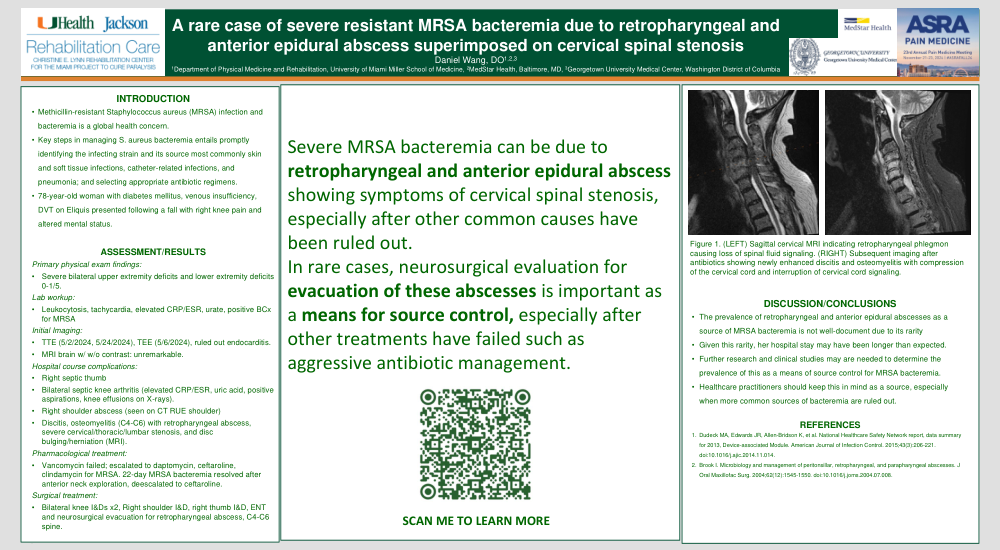
78-year-old woman with diabetes mellitus, venous insufficiency, DVT on Eliquis presented following a fall with right knee pain and altered mental status. Her negative imaging workup included a transthoracic echocardiogram (on 5/2/2024 and 5/24/2024) and transesophageal echocardiogram (on 5/6/2024) which ruled out endocarditis, MRI of the brain with and without contrast which were unremarkable for any source of infection. However, her hospital course was complicated by septic arthritis in the bilateral knees (elevated CRP and ESR, uric acid elevated, positive aspiration cultures, effusion seen on knee x-rays), discitis and osteomyelitis of C4-C6 with retropharyngeal abscess, and severe cervical, thoracic, and lumbar spinal stenosis and disc bulging/herniation (seen on MRI with and without contrast with severe bilateral upper extremity deficits ranging from strength of 0-2/5). She ultimately received bilateral I&D's of the knees x 2 (day 3 and day 15), status post I&D of the right shoulder (day 25) and ENT and neurosurgical intervention for retropharyngeal abscess and C4-C6 spine (day 22). During hospitalization, she failed vancomycin treatment and was escalated to daptomycin, ceftaroline and clindamycin for MRSA clearance. Her 22 day course of MRSA bacteremia cleared based on 2 blood cultures 3 and 5 days subsequently after her anterior neck exploration. Her antibiotics was de-escalated to ceftaroline with long-term antibiotic course through a newly placed tunneled catheter for IV antibiotics at the facility for a 8-week course. She was evaluated by physical and occupational therapy for subacute rehabilitation placement. She will have close follow-up with orthopedic surgery, neurosurgery and infectious disease as outpatient.
Discussion
The prevalence of retropharyngeal and anterior epidural abscesses as a source of MRSA bacteremia is not well-documented due to its rarity. Given this rarity, her hospital stay may have been longer than expected. Further research and clinical studies may are needed to determine the prevalence of this as a means of source control for MRSA bacteremia. Healthcare practitioners should keep this in mind as a source, especially when more common sources of bacteremia are ruled out.