501 posters, 2 videos, 1 audios, 8 topics, 37 sessions, 395 authors, 307 institutions
ePostersLive by SciGen Technologies S.A. All rights reserved.
23rd Annual Pain Medicine Meeting 2024
November 21-23, 2024 | Caesars Palace, Las Vegas, Nevada

5705
LOCAL ANESTHETIC SYSTEMIC TOXICITY MIMICKER DURING A CELIAC PLEXUS NEULOYSIS
Poster Presenter
Authors
Affiliations
Part of Topic
Medically Challenging Cases
Introduction
•Celiac plexus neurolysis (CPN) is less commonly employed for persistent noncancerous visceral organ pain
•Possible intraoperative complications of CPN include pneumothorax, hypotension, and intravascular injection
•Local Anesthetic Systemic Toxicity (LAST) is an acute and life-threatening complication of local-anesthetic administration
•There is a known correlation between anesthesia exposure and spells of functional neurologic deficits (FND) [2,3]
Case Report
•A 23-year-old female undergoing CPN for chronic flank pain secondary to recurring pyelonephritis
•History of migraine headaches, sexual abuse, and anorexia nervosa
•Previous celiac plexus block provided 90% pain reduction for 3 months
•Moderate sedation achieved with midazolam and fentanyl
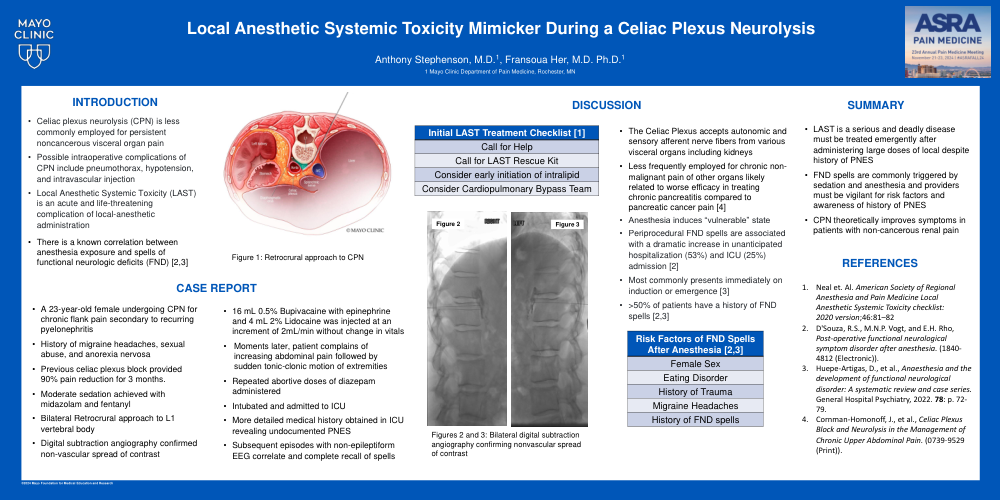
•Bilateral retrocrural approach to L1 vertebral body
•Digital subtraction angiography confirmed non-vascular spread of contrast.
•16 mL 0.5% Bupivacaine with epinephrine and 4 mL 2% Lidocaine was injected at an increment of 2mL/min without change in vitals
•Moments later, patient complains of increasing abdominal pain followed by sudden tonic-clonic motion of extremities
•Repeated abortive doses of diazepam administered
•Intubated and admitted to ICU
•More detailed medical history obtained in ICU revealing undocumented PNES
•Subsequent episodes with non-epileptiform EEG correlate and complete recall of spells
Discussion
•The Celiac Plexus accepts autonomic and sensory afferent nerve fibers from various visceral organs including kidneys
•Less frequently employed for chronic non-malignant pain of other organs likely related to worse efficacy in treating chronic pancreatitis compared to pancreatic cancer pain [4]
•Anesthesia induces “vulnerable” state
•Associated with dramatic increase in unanticipated hospitalization (53%) and ICU (25%) admission with [2]
•Most commonly presents immediately on induction or emergence [3]
>50% of patients have a history of FND spells [2,3]
Summary
•LAST is a serious and deadly disease must be treated emergently after administering large doses of local despite history of PNES
•FND spells are commonly triggered by sedation and anesthesia and providers must be vigilant for risk factors and awareness of history of PNES
•CPN theoretically improves symptoms in patients with non-cancerous renal pain