501 posters, 2 videos, 1 audios, 8 topics, 37 sessions, 395 authors, 307 institutions
ePostersLive by SciGen Technologies S.A. All rights reserved.
23rd Annual Pain Medicine Meeting 2024
November 21-23, 2024 | Caesars Palace, Las Vegas, Nevada

6239
TRANSVERSUS ABDOMINIS PLANE (TAP) BLOCKS CURE CHRONIC ABDOMINAL PAIN AND CONCURRENT DEBILITATING SYMPTOMS - A ONE YEAR FOLLOW-UP
Poster Presenter
Authors
Affiliations
Part of Topic
Medically Challenging Cases
Does Transversus Abdominis Plane (TAP) Blocks Cure Chronic Abdominal Pain and Improve Debilitating Symptoms Long Term – A One Year Follow-up
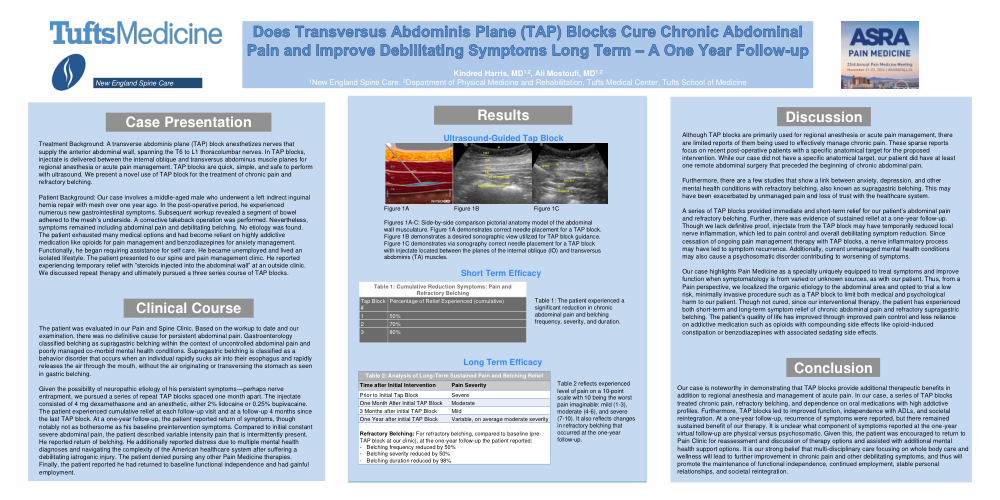
Treatment Background: A transverse abdominis plane (TAP) block anesthetizes nerves that supply the anterior abdominal wall, spanning the T6 to L1 thoracolumbar nerves. In TAP blocks, injectate is delivered between the internal oblique and transversus abdominus muscle planes for regional anesthesia or acute pain management. TAP blocks are quick, simple, and safe to perform with ultrasound. We present a novel use of TAP block for the treatment of chronic pain and refractory belching.
Patient Background: Our case involves a middle-aged male who underwent a left indirect inguinal hernia repair with mesh over one year ago. In the post-operative period, he experienced numerous new gastrointestinal symptoms. Subsequent workup revealed a segment of bowel adhered to the mesh’s underside. A corrective takeback operation was performed. Nevertheless, symptoms remained including abdominal pain and debilitating belching. No etiology was found. The patient exhausted many medical options and had become reliant on highly addictive medication like opioids for pain management and benzodiazepines for anxiety management. Functionally, he began requiring assistance for self care. He became unemployed and lived an isolated lifestyle. The patient presented to our spine and pain management clinic. He reported experiencing temporary relief with ”steroids injected into the abdominal wall” at an outside clinic. We discussed repeat therapy and ultimately pursued a three series course of TAP blocks.
Discussion:
Although TAP blocks are primarily used for regional anesthesia or acute pain management, there are limited reports of them being used to effectively manage chronic pain. These sparse reports focus on recent post-operative patients with a specific anatomical target for the proposed intervention. While our case did not have a specific anatomical target, our patient did have at least one remote abdominal surgery that preceded the beginning of chronic abdominal pain.
Furthermore, there are a few studies that show a link between anxiety, depression, and other mental health conditions with refractory belching, also known as supragastric belching. This may have been exacerbated by unmanaged pain and loss of trust with the healthcare system.
A series of TAP blocks provided immediate and short-term relief for our patient’s abdominal pain and refractory belching. Further, there was evidence of sustained relief at a one-year follow-up. Though we lack definitive proof, injectate from the TAP block may have temporarily reduced local nerve inflammation, which led to pain control and overall debilitating symptom reduction. Since cessation of ongoing pain management therapy with TAP blocks, a nerve inflammatory process may have led to symptom recurrence. Additionally, current unmanaged mental health conditions may also cause a psychosomatic disorder contributing to worsening of symptoms.
Our case highlights Pain Medicine as a specialty uniquely equipped to treat symptoms and improve function when symptomatology is from varied or unknown sources, as with our patient. Thus, from a Pain perspective, we localized the organic etiology to the abdominal area and opted to trial a low risk, minimally invasive procedure such as a TAP block to limit both medical and psychological harm to our patient. Though not cured, since our interventional therapy, the patient has experienced both short-term and long-term symptom relief of chronic abdominal pain and refractory supragastric belching. The patient’s quality of life has improved through improved pain control and less reliance on addictive medication such as opioids with compounding side effects like opioid-induced constipation or benzodiazepines with associated sedating side effects.
Conclusion:
Our case is noteworthy in demonstrating that TAP blocks provide additional therapeutic benefits in addition to regional anesthesia and management of acute pain. In our case, a series of TAP blocks treated chronic pain, refractory belching, and dependence on oral medications with high addictive profiles. Furthermore, TAP blocks led to improved function, independence with ADLs, and societal reintegration. At a one-year follow-up, recurrence of symptoms were reported, but there remained sustained benefit of our therapy. It is unclear what component of symptoms reported at the one-year virtual follow-up are physical versus psychosomatic. Given this, the patient was encouraged to return to Pain Clinic for reassessment and discussion of therapy options and assisted with additional mental health support options. It is our strong belief that multi-disciplinary care focusing on whole body care and wellness will lead to further improvement in chronic pain and other debilitating symptoms, and thus will promote the maintenance of functional independence, continued employment, stable personal relationships, and societal reintegration.