501 posters, 2 videos, 1 audios, 8 topics, 37 sessions, 395 authors, 307 institutions
ePostersLive by SciGen Technologies S.A. All rights reserved.
23rd Annual Pain Medicine Meeting 2024
November 21-23, 2024 | Caesars Palace, Las Vegas, Nevada

6327
COMPLEX REGIONAL PAIN SYNDROME IN THE SETTING OF PARASAGITTAL HEMANGIOPERICYTOMA RESECTION
Poster Presenter
Authors
Affiliations
Part of Topic
Medically Challenging Cases
Complex Regional Pain Syndrome in the Setting of Parasagittal Hemangiopericytoma Resection
Andrew Garcia, MD, PharmD,, Peter Huynh, MD
Harbor-UCLA Medical Center, Department of Anesthesiology, Torrance, California, U.S.A.
Introduction:
Complex regional pain syndrome (CRPS) is characterized by continuous regional
pain with autonomic and inflammatory features, disproportionate to the time or
degree of usual course to any known trauma.1 In order to be diagnosed, at least
one symptom in three out of four of the following categories must be present:
Sensory (hyperalgesia/allodynia), vasomotor (temperature asymmetry),
sudomotor/edema (swelling), and motor/trophic (motor dysfunction/weakness). Two
types of CRPS exist, type 1 and type 2. Type 1 CRPS (CRPS-1), also referred to as
reflex sympathetic dystrophy, is characterized by a chronic severe, continuous pain
in a limb, and can often be caused by trauma or surgery, although the nerve in the
affected limb has not been directly damaged, in contrast to Type 2 CRPS (CRPS-2),
in which specific nerve damage has occurred. CRPS-1 as a phenomenon in cancer
has been previously characterized, with authors noting around 5% of patients with
brain cancer may develop CRPS-1.1 This abstract highlights a patient with a
diagnosis of parasagittal hemangiopericytoma who initially presented with
symptoms of lumbar radiculopathy unsuccessfully treated with lumbar and thoracic
laminectomy with improvement after brain tumor resection. This patient’s clinical
course was further complicated with symptoms of CRPS-1 in the months following
resection of his brain tumor.
Case Summary:
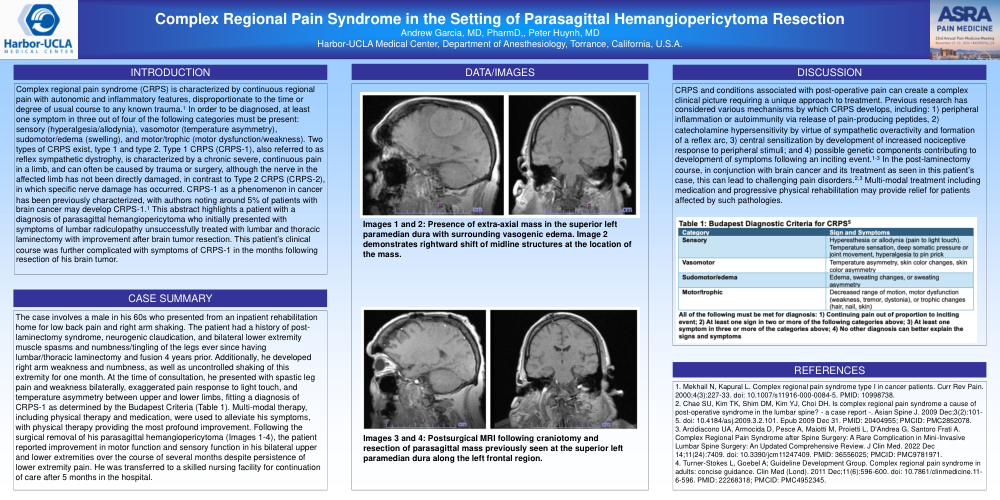
The case involves a male in his 60s who presented from an inpatient rehabilitation home for low back pain and right arm shaking. The patient had a history of post-laminectomy syndrome, neurogenic claudication, and bilateral lower extremity muscle spasms and numbness/tingling of the legs ever since having lumbar/thoracic laminectomy and fusion 4 years prior. Additionally, he developed right arm weakness and numbness, as well as uncontrolled shaking of this extremity for one month. At the time of consultation, he presented with spastic leg pain and weakness bilaterally, exaggerated pain response to light touch, and temperature asymmetry between upper and lower limbs, fitting a diagnosis of CRPS-1 as determined by the Budapest Criteria (Table 1). Multi-modal therapy, including physical therapy and medication, were used to alleviate his symptoms, with physical therapy providing the most profound improvement. Following the surgical removal of his parasagittal hemangiopericytoma (Images 1-4), the patient reported improvement in motor function and sensory function in his bilateral upper and lower extremities over the course of several months despite persistence of lower extremity pain. He was transferred to a skilled nursing facility for continuation of care after 5 months in the hospital.
Discussion:
CRPS and conditions associated with post-operative pain can create a complex
clinical picture requiring a unique approach to treatment. Previous research has
considered various mechanisms by which CRPS develops, including: 1) peripheral
inflammation or autoimmunity via release of pain-producing peptides, 2)
catecholamine hypersensitivity by virtue of sympathetic overactivity and formation
of a reflex arc, 3) central sensitization by development of increased nociceptive
response to peripheral stimuli; and 4) possible genetic components contributing to
development of symptoms following an inciting event.1-3 In the post-laminectomy
course, in conjunction with brain cancer and its treatment as seen in this patient’s
case, this can lead to challenging pain disorders.2,3 Multi-modal treatment including
medication and progressive physical rehabilitation may provide relief for patients
affected by such pathologies.
References:
1. Mekhail N, Kapural L. Complex regional pain syndrome type I in cancer patients. Curr Rev Pain. 2000;4(3):227-33. doi: 10.1007/s11916-000-0084-5. PMID: 10998738.
2. Chae SU, Kim TK, Shim DM, Kim YJ, Choi DH. Is complex regional pain syndrome a cause of post-operative syndrome in the lumbar spine? - a case report -. Asian Spine J. 2009 Dec;3(2):101-5. doi: 10.4184/asj.2009.3.2.101. Epub 2009 Dec 31. PMID: 20404955; PMCID: PMC2852078.
3. Arcidiacono UA, Armocida D, Pesce A, Maiotti M, Proietti L, D'Andrea G, Santoro Frati A. Complex Regional Pain Syndrome after Spine Surgery: A Rare Complication in Mini-Invasive Lumbar Spine Surgery: An Updated Comprehensive Review. J Clin Med. 2022 Dec 14;11(24):7409. doi: 10.3390/jcm11247409. PMID: 36556025; PMCID: PMC9781971.
4. Turner-Stokes L, Goebel A; Guideline Development Group. Complex regional pain syndrome in adults: concise guidance. Clin Med (Lond). 2011 Dec;11(6):596-600. doi: 10.7861/clinmedicine.11-6-596. PMID: 22268318; PMCID: PMC4952345.