501 posters, 2 videos, 1 audios, 8 topics, 37 sessions, 395 authors, 307 institutions
ePostersLive by SciGen Technologies S.A. All rights reserved.
23rd Annual Pain Medicine Meeting 2024
November 21-23, 2024 | Caesars Palace, Las Vegas, Nevada

6226
BALANCING RISK AND BENEFIT OF NEURAXIAL ANESTHESIA IN POST LUNG TRANSPLANT BURN PATIENT
Poster Presenter
Authors
Affiliations
Part of Topic
Medically Challenging Cases
Balancing Risk and Benefit of Neuraxial Anesthesia in a Post Lung Transplant Burn Patient
Introduction
• Burn patients can be hemodynamically unstable, have compromised
ventilation, and are at high risk for infections.
• Regional anesthesia (RA) has proven useful in post-op analgesia (1),
burn donor graft site management, and decreasing ICU duration (2).
• RA techniques are limited by coagulopathy, local anesthetic systemic
toxicity or infection, though risk of meningeal infection after neuraxial
is rare, even in the bacteremic patient (3).
• RA as a primary surgical anesthetic could be considered in critical,
nonintubated patients for preservation of ventilation, slow titration,
and an improved post-surgical period
Case Presentation
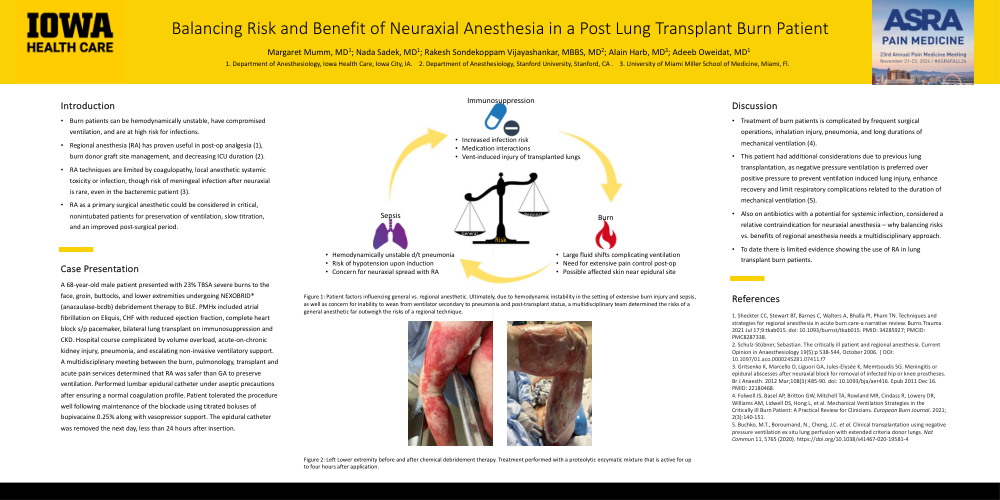
A 68-year-old male patient presented with 23% TBSA severe burns to the
face, groin, buttocks, and lower extremities undergoing NEXOBRID®
(anacaulase-bcdb) debridement therapy to BLE. PMHx included atrial
fibrillation on Eliquis, CHF with reduced ejection fraction, complete heart
block s/p pacemaker, bilateral lung transplant on immunosuppression and
CKD. Hospital course complicated by volume overload, acute-on-chronic
kidney injury, pneumonia, and escalating non-invasive ventilatory support.
A multidisciplinary meeting between the burn, pulmonology, transplant and
acute pain services determined that RA was safer than GA to preserve
ventilation. Performed lumbar epidural catheter under aseptic precautions
after ensuring a normal coagulation profile. Patient tolerated the procedure
well following maintenance of the blockade using titrated boluses of
bupivacaine 0.25% along with vasopressor support. The epidural catheter
was removed the next day, less than 24 hours after insertion.
Discussion
• Treatment of burn patients is complicated by frequent surgical
operations, inhalation injury, pneumonia, and long durations of
mechanical ventilation (4).
• This patient had additional considerations due to previous lung
transplantation, as negative pressure ventilation is preferred over
positive pressure to prevent ventilation induced lung injury, enhance
recovery and limit respiratory complications related to the duration of
mechanical ventilation (5).
• Also on antibiotics with a potential for systemic infection, considered a
relative contraindication for neuraxial anesthesia – why balancing risks
vs. benefits of regional anesthesia needs a multidisciplinary approach.
• To date there is limited evidence showing the use of RA in lung
transplant burn patients.