501 posters, 2 videos, 1 audios, 8 topics, 37 sessions, 395 authors, 307 institutions
ePostersLive by SciGen Technologies S.A. All rights reserved.
23rd Annual Pain Medicine Meeting 2024
November 21-23, 2024 | Caesars Palace, Las Vegas, Nevada

6193
IS EPIDURAL HEMATOMA A CONTRAINDICATION FOR SPINAL CORD STIMULATION THERAPY?
Poster Presenter
Part of Topic
Medically Challenging Cases
Introduction
Spinal cord stimulation (SCS) is used for neuropathic pain syndromes and has two phases including a trial, followed by implantation.2 SCS may offer improved pain control in treating select cases of cancer related neuropathic pain, such as from chemotherapy induced peripheral neuropathy.1,3 Epidural hematoma is a dreaded complication of SCS therapy.2 Below we present a unique case of SCS therapy in a patient presenting with neuropathic abdominal pain, with thoracic vertebral fracture, complicated by an epidural hematoma.
Case
A 77-year-old male with a history of small cell lung cancer was treated with Carboplatin and Etoposide x6 cycles followed by radiation to right hilum 3750 cGy in 15 fractions. The patient reported development of severe upper abdominal pain after radiation, with sympathetic features consistent with radiation-induced neuropathic pain (RINP). The pain was made worse with food intake, and persisted for five years. He had a reduction in food intake, leading to weight loss. Multiple gastrointestinal workups were unrevealing. There were considerations for a percutaneous endoscopic gastrostomy (PEG) tube.
The patient underwent extensive workup with the pain management team, including trials of neuropathic medications, physical therapy, pain psychology, opioid therapy, celiac plexus nerve block, and a peripheral nerve block. Given the neuropathic features of his presentation, a SCS trial was considered. However, the patient had sustained a fall complicated with a T7 compression fracture. His MRI revealed a large dorsal epidural hematoma extending from T3 to T9. The pain team decided to revisit SCS therapy after possible resolution of the epidural hematoma. After a three month wait, repeat scans revealed complete reabsorption of the hematoma.
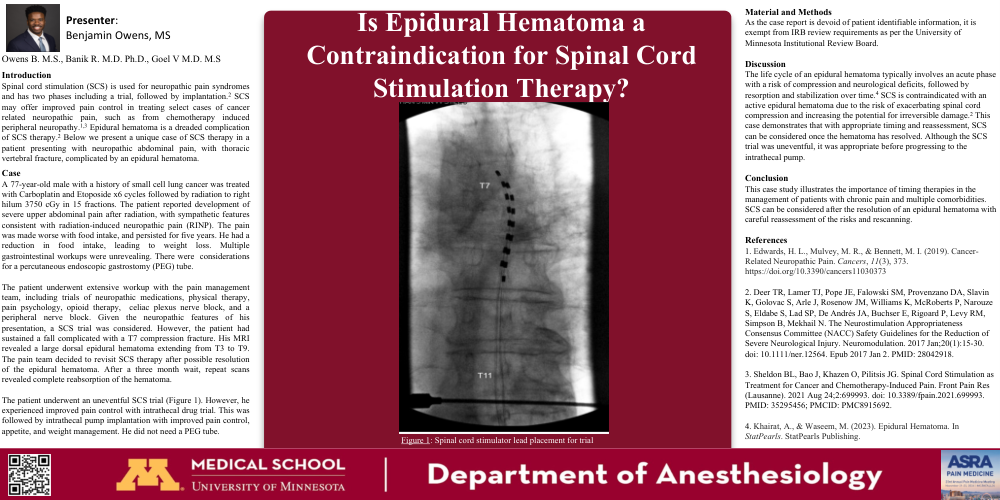
The patient underwent an uneventful SCS trial (Figure 1). However, he experienced improved pain control with intrathecal drug trial. This was followed by intrathecal pump implantation with improved pain control, appetite, and weight management. He did not need a PEG tube.
Material and Methods
As the case report is devoid of patient identifiable information, it is exempt from IRB review requirements as per the University of Minnesota Institutional Review Board.
Discussion
The life cycle of an epidural hematoma typically involves an acute phase with a risk of compression and neurological deficits, followed by resorption and stabilization over time.4 SCS is contraindicated with an active epidural hematoma due to the risk of exacerbating spinal cord compression and increasing the potential for irreversible damage.2 This case demonstrates that with appropriate timing and reassessment, SCS can be considered once the hematoma has resolved. Although the SCS trial was uneventful, it was appropriate before progressing to the intrathecal pump.
Conclusion
This case study illustrates the importance of timing therapies in the management of patients with chronic pain and multiple comorbidities. SCS can be considered after the resolution of an epidural hematoma with careful reassessment of the risks and rescanning.